Clinical Knowledge › Obstetrics and gynaecology › Complications of later pregnancy
Large for gestational age and macrosomia
Large for gestational age (LGA) describes a fetus or baby whose estimated or actual weight is above the 90th centile for gestation; macrosomia describes birthweight of 4000 g or more (some use 4500 g, with 5000 g regarded as severe). The main modifiable drivers are maternal diabetes (pre-existing or gestational) and maternal obesity with excess gestational weight gain; others include previous macrosomia, multiparity, post-term pregnancy, male sex, parental size and rare overgrowth syndromes such as Beckwith–Wiedemann. Fetal hyperinsulinaemia accelerates growth of fat, liver and shoulders, so diabetic macrosomia carries a higher risk of shoulder dystocia at any weight. Ultrasound estimates are imprecise (error 10–15%). Risks include shoulder dystocia, brachial plexus injury, caesarean birth, obstetric anal sphincter injury, postpartum haemorrhage and neonatal hypoglycaemia. Management is shared decision-making: check for diabetes, then discuss expectant management, induction around 38–39 weeks (supported by recent trials such as Big Baby) or planned caesarean at very high estimated weights.
Patient case, mechanism, investigations, management, flashcards and exam-style questions.Open the lesson →
Key facts
- LGA = EFW or birthweight above the 90th centile; macrosomia = birthweight 4000 g or more (4500 g and 5000 g used as higher-risk thresholds)
- Main risk factors: diabetes (pre-existing or gestational), maternal obesity, excessive gestational weight gain, previous macrosomic baby, post-term pregnancy, multiparity, male fetus
- Fetal hyperinsulinaemia (Pedersen) causes disproportionate growth of trunk and shoulders: shoulder dystocia risk is higher in diabetic macrosomia at the same weight
- Ultrasound EFW has an error of about 10–15% and is least accurate at the extremes; SFH above the 90th centile or polyhydramnios should prompt a scan and diabetes testing
- Shoulder dystocia risk rises steeply above 4.5 kg; brachial plexus injury (Erb palsy) and clavicle or humerus fracture may follow
- Big Baby trial (2025): induction at 38+0–38+4 weeks for EFW above 90th centile did not significantly reduce shoulder dystocia by intention-to-treat but did in per-protocol analysis
- ACOG: consider planned caesarean for EFW of at least 5000 g without diabetes or 4500 g with diabetes; the 2012 RCOG GTG 42 advised considering caesarean above 4.5 kg in diabetes (the guideline was revised in 2026; check the current edition)
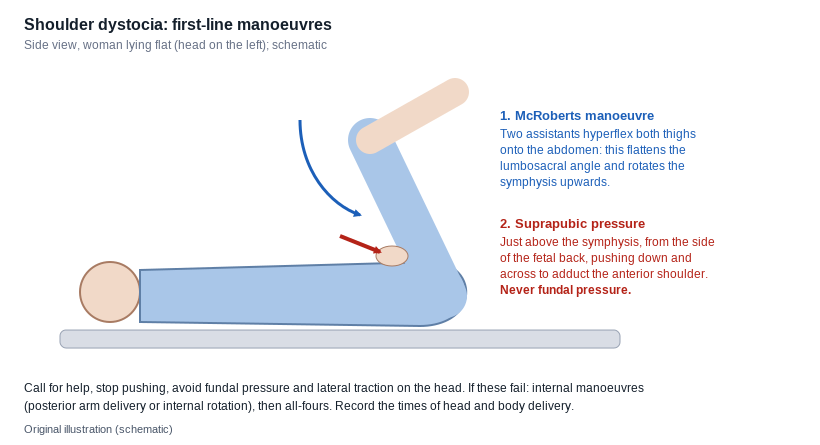
- Intrapartum: senior obstetrician aware, prepare for shoulder dystocia, avoid fundal pressure, active management of third stage for PPH risk
Differential diagnosis
| Condition | Clues | Key test |
|---|---|---|
| Incorrect gestational dating | Large for 'dates' but consistent interval growth | Review first-trimester CRL dating |
| Polyhydramnios | Tense abdomen, difficult palpation, large SFH with normal-sized fetus | Ultrasound deepest pool or AFI |
| Multiple pregnancy | Large uterus, more than two poles palpable | Ultrasound |
| Uterine fibroids | Irregular firm uterus, fundal height misleading | Ultrasound |
| Overgrowth syndrome (Beckwith–Wiedemann) | Macroglossia, omphalocele, organomegaly, polyhydramnios | Detailed anatomy scan; genetic testing |
| Fetal hydrops | Large AC from ascites and skin oedema rather than tissue | Ultrasound: effusions, skin oedema; MCA PSV for anaemia |
Exam pearls
Guideline
NICE NG207 Inducing labour (2021) and NG235 Intrapartum care (2023); ACOG Practice Bulletin No. 216 Macrosomia (2020); RCOG Green-top Guideline No. 42 Shoulder dystocia (2012; revised edition 2026); evidence from the Big Baby trial (2025) and DAME trial (2015)
References
- American College of Obstetricians and Gynecologists. Macrosomia: ACOG Practice Bulletin No. 216. Obstet Gynecol 2020.
- National Institute for Health and Care Excellence. Inducing labour (NG207). NICE guideline NG207 2021.
- National Institute for Health and Care Excellence. Intrapartum care (NG235). NICE guideline NG235 2023.
- Royal College of Obstetricians and Gynaecologists. Shoulder dystocia. Green-top Guideline No. 42 (2nd edition). RCOG 2012.
- Boulvain M, Senat MV, Perrotin F, et al.. Induction of labour versus expectant management for large-for-date fetuses: a randomised controlled trial. Lancet 2015.
- Gardosi J, Ewington LJ, Booth K, et al.. Induction of labour versus standard care to prevent shoulder dystocia in fetuses suspected to be large for gestational age in the UK (the Big Baby trial): a multicentre, open-label, randomised controlled trial. Lancet 2025.
Related topics
By Dr Khalid Seidi (B.Sc., M.D.) · MedEd World Clinical Knowledge library. Original teaching content checked against current guidelines (November 2026); confirm the latest local guidance before clinical use. Not a substitute for clinical judgement.