Clinical Knowledge › Internal medicine › Haematology and oncology › Principles of oncology
Cancer immunotherapy and immune-related adverse events
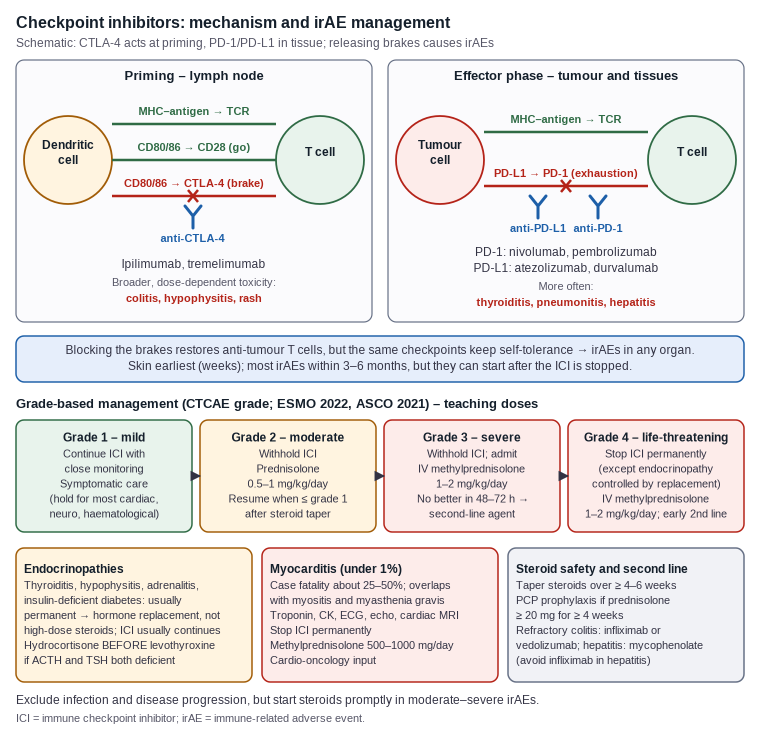
Cancer immunotherapy treats cancer by enabling the patient's own immune system to recognise and kill tumour cells. Immune checkpoint inhibitors (ICIs) are monoclonal antibodies that block CTLA-4, PD-1, PD-L1 or LAG-3, releasing brakes on T cells; they are standard in melanoma, lung, kidney, bladder, head and neck and mismatch-repair-deficient cancers. Because the same brakes maintain self-tolerance, ICIs cause immune-related adverse events (irAEs) that can affect any organ: skin, colon, liver, lung, thyroid, pituitary, adrenal, pancreas, joints, muscle, heart, nerves and kidney. Most appear within 3–6 months but can arise after treatment stops. Combined anti-CTLA-4 plus anti-PD-1 therapy causes severe irAEs in over half of patients. Management depends on grade: continue with monitoring for grade 1, withhold and give corticosteroids for grade 2–3, and stop permanently for most grade 4 events; endocrinopathies are treated with hormone replacement. Steroid-refractory cases need infliximab, vedolizumab, mycophenolate or other agents. Myocarditis is rare but has a high case fatality (reported in roughly a quarter to a half of cases).
Patient case, mechanism, investigations, management, flashcards and exam-style questions.Open the lesson →
Key facts
- ICIs block inhibitory receptors: CTLA-4 (ipilimumab, tremelimumab) acts at T-cell priming in lymph nodes; PD-1 (nivolumab, pembrolizumab) and PD-L1 (atezolizumab, durvalumab) act in peripheral tissues and tumours
- Grade 3–4 irAEs occur in about 10–20% with anti-PD-1 monotherapy and in more than half with ipilimumab plus nivolumab
- Skin toxicity appears earliest (weeks); colitis, hepatitis, pneumonitis and endocrinopathies typically follow within 3 months, but irAEs can start after ICIs are stopped
- Grade 1: continue ICI and monitor; grade 2: withhold and consider prednisolone 0.5–1 mg/kg; grade 3: withhold and give 1–2 mg/kg; grade 4: stop permanently (except endocrinopathies controlled by replacement)
- Taper corticosteroids over at least 4–6 weeks; give PCP prophylaxis if prednisolone 20 mg or more is needed for 4 weeks or longer
- Endocrinopathies (thyroiditis, hypophysitis, adrenalitis, insulin-deficient diabetes) are usually permanent and need hormone replacement, not high-dose steroids
- Give hydrocortisone before levothyroxine when both ACTH and TSH are deficient, to avoid precipitating adrenal crisis
- ICI myocarditis is uncommon (under 1%) but carries a high case fatality (reported 25–50%); it often overlaps with myositis and myasthenia gravis: check troponin and CK
Differential diagnosis
| Condition | Clues | Key test |
|---|---|---|
| Infective diarrhoea (Clostridioides difficile, CMV) | Recent antibiotics or steroids, fever; may coexist with colitis | Stool C. difficile toxin and culture; CMV on colonic biopsy |
| Disease progression (e.g. liver metastases, lymphangitis) | New or enlarging lesions, rising tumour markers | Cross-sectional imaging compared with baseline |
| Pseudoprogression | Lesions enlarge early then shrink, patient clinically well | Repeat imaging after 4–8 weeks (iRECIST) |
| Pneumonia or Pneumocystis infection | Fever, purulent sputum, neutrophilia; steroid exposure for PCP | Sputum culture, bronchoalveolar lavage, beta-D-glucan |
| Drug-induced liver injury from other drugs (paracetamol, antibiotics) | Temporal relation to new drug | Drug history; hepatitis serology; ultrasound |
| Acute coronary syndrome | Chest pain, risk factors, regional wall abnormality | ECG, troponin pattern, coronary angiography |
| Cytokine release syndrome (bispecifics, CAR T cells) | Fever and hypotension within hours to days of T-cell-engaging therapy | Timing; CRP, ferritin; ASTCT grading |
Exam pearls
Guideline
ESMO 2022 Clinical Practice Guideline on management of toxicities from immunotherapy, ASCO 2021 guideline update on immune-related adverse events (with NCCN annual updates) and ESC 2022 cardio-oncology guideline
References
- Haanen J, Obeid M, Spain L, et al.. Management of toxicities from immunotherapy: ESMO Clinical Practice Guideline for diagnosis, treatment and follow-up. Ann Oncol 2022.
- Schneider BJ, Naidoo J, Santomasso BD, et al.. Management of immune-related adverse events in patients treated with immune checkpoint inhibitor therapy: ASCO guideline update. J Clin Oncol 2021.
- Lyon AR, López-Fernández T, Couch LS, et al.. 2022 ESC Guidelines on cardio-oncology developed in collaboration with the European Hematology Association (EHA), the European Society for Therapeutic Radiology and Oncology (ESTRO) and the International Cardio-Oncology Society (IC-OS). Eur Heart J Cardiovasc Imaging 2022.
- Postow MA, Sidlow R, Hellmann MD. Immune-related adverse events associated with immune checkpoint blockade. N Engl J Med 2018.
- DeVita VT Jr, Rosenberg SA, Lawrence TS, eds.. DeVita, Hellman, and Rosenberg's Cancer: Principles and Practice of Oncology. 2023.
- Penman ID, Ralston SH, Strachan MWJ, Hobson RP, eds.. Davidson's Principles and Practice of Medicine. 2022.
Related topics
By Dr Khalid Seidi (B.Sc., M.D.) · MedEd World Clinical Knowledge library. Original teaching content checked against current guidelines (November 2026); confirm the latest local guidance before clinical use. Not a substitute for clinical judgement.