Clinical Knowledge › Internal medicine › Haematology and oncology › Principles of oncology
Targeted therapy and precision oncology
Precision oncology selects treatment according to the molecular features of an individual tumour rather than its site of origin alone. Targeted therapies act on specific molecular drivers on which the cancer depends ('oncogene addiction'), such as BCR-ABL1 in CML, HER2 amplification in breast and gastric cancer, EGFR mutations and ALK fusions in lung adenocarcinoma, BRAF V600E in melanoma, and BRCA-related homologous recombination deficiency, which is exploited by PARP inhibitors through synthetic lethality. Drugs include small-molecule kinase inhibitors, monoclonal antibodies and antibody–drug conjugates. Treatment depends on a validated predictive biomarker measured by immunohistochemistry, in situ hybridisation, PCR or next-generation sequencing (NGS) of tissue or circulating tumour DNA, interpreted with actionability scales such as ESCAT and in molecular tumour boards. Several approvals are tumour-agnostic (NTRK fusions, MSI-high/dMMR, BRAF V600E, RET fusions, HER2 overexpression). Responses can be dramatic, but resistance usually develops through secondary mutations, bypass pathways or histological transformation, and each drug class has characteristic toxicities and interactions.
Patient case, mechanism, investigations, management, flashcards and exam-style questions.Open the lesson →
Key facts
- A predictive biomarker identifies patients likely to benefit from a specific drug; a prognostic biomarker predicts outcome regardless of treatment
- Oncogene addiction: tumours driven by a single activated oncogene (BCR-ABL1, EGFR, ALK) respond dramatically to its inhibition
- Synthetic lethality: PARP inhibitors kill cells lacking homologous recombination repair (BRCA1/2), sparing normal cells
- ESMO recommends multigene NGS for advanced non-squamous NSCLC, prostate, colorectal, ovarian and biliary cancers; the 2024 update added advanced breast cancer, GIST, sarcoma, thyroid cancer and cancer of unknown primary
- ESCAT tier I alterations are ready for routine use, backed by trials showing clinical benefit
- Tumour-agnostic indications include NTRK fusions, MSI-high/dMMR, BRAF V600E, RET fusions and HER2 IHC 3+
- Anti-EGFR antibodies (cetuximab, panitumumab) are used only in RAS wild-type colorectal cancer, mainly left-sided
- Resistance is expected: on-target mutations (EGFR T790M, C797S), bypass signalling and histological transformation; re-biopsy or liquid biopsy guides next treatment
Differential diagnosis
| Condition | Clues | Key test |
|---|---|---|
| EGFR-mutant NSCLC | Never-smoker, often Asian woman, adenocarcinoma, brain metastases | Tissue or plasma NGS (exon 19 deletion, L858R) |
| ALK-rearranged NSCLC | Young never-smoker with adenocarcinoma, frequent brain metastases | ALK IHC or NGS (RNA-based fusion detection) |
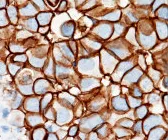
| HER2-positive breast cancer | Aggressive tumour, may be ER-negative | HER2 IHC 3+ or ISH-amplified |
| BRAF V600E melanoma or colorectal cancer | Melanoma on intermittently sun-exposed skin; right-sided, poor-prognosis colorectal cancer | BRAF PCR or NGS |
| BRCA-associated ovarian, breast, prostate or pancreatic cancer | Family history, high-grade serous ovarian cancer, Ashkenazi Jewish ancestry | Germline and tumour BRCA1/2 testing; HRD assay |
| MSI-high/dMMR tumour | Right-sided colorectal or endometrial cancer, Lynch family history | MMR immunohistochemistry or MSI PCR/NGS |
| CML (BCR-ABL1) | Neutrophilia with left shift, basophilia, splenomegaly | BCR-ABL1 quantitative PCR; karyotype for Philadelphia chromosome |
Exam pearls
Guideline
ESMO Precision Medicine Working Group recommendations for NGS in advanced cancer (2024), ESMO Scale for Clinical Actionability of molecular Targets (ESCAT, 2018) and ESMO oncogene-addicted metastatic NSCLC guideline (living guideline, regularly updated)
References
- Mosele MF, Westphalen CB, Stenzinger A, et al.. Recommendations for the use of next-generation sequencing (NGS) for patients with advanced cancer in 2024: a report from the ESMO Precision Medicine Working Group. Ann Oncol 2024.
- Mateo J, Chakravarty D, Dienstmann R, et al.. A framework to rank genomic alterations as targets for cancer precision medicine: the ESMO Scale for Clinical Actionability of molecular Targets (ESCAT). Ann Oncol 2018.
- Druker BJ, Talpaz M, Resta DJ, et al.. Efficacy and safety of a specific inhibitor of the BCR-ABL tyrosine kinase in chronic myeloid leukemia. N Engl J Med 2001.
- Slamon DJ, Leyland-Jones B, Shak S, et al.. Use of chemotherapy plus a monoclonal antibody against HER2 for metastatic breast cancer that overexpresses HER2. N Engl J Med 2001.
- Le DT, Durham JN, Smith KN, et al.. Mismatch repair deficiency predicts response of solid tumors to PD-1 blockade. Science 2017.
- Hanahan D. Hallmarks of cancer: new dimensions. Cancer Discov 2022.
Related topics
By Dr Khalid Seidi (B.Sc., M.D.) · MedEd World Clinical Knowledge library. Original teaching content checked against current guidelines (November 2026); confirm the latest local guidance before clinical use. Not a substitute for clinical judgement.