Clinical Knowledge › Internal medicine › Haematology and oncology › Principles of oncology
Hereditary cancer syndromes (BRCA, Lynch, Li–Fraumeni)
About 5–10% of cancers arise in people who inherit a pathogenic variant in a cancer-predisposition gene. The three syndromes most often tested are hereditary breast and ovarian cancer (BRCA1, BRCA2, plus PALB2 and others), Lynch syndrome (mismatch repair genes MLH1, MSH2, MSH6, PMS2 and EPCAM deletions) and Li–Fraumeni syndrome (TP53). Most are autosomal dominant with incomplete penetrance, so clues are cancer at a young age, several affected relatives on the same side, bilateral or multiple primary tumours, rare tumour types and founder ancestry. BRCA carriers face high lifetime risks of breast and tubo-ovarian cancer; Lynch carriers face colorectal and endometrial cancer; Li–Fraumeni carriers develop sarcomas, premenopausal breast cancer, brain and adrenocortical tumours from childhood. Testing increasingly starts from the tumour (universal mismatch repair testing) or at diagnosis to guide PARP inhibitor therapy. Management combines counselling, cascade testing of relatives, intensive surveillance, risk-reducing surgery and chemoprevention such as aspirin in Lynch syndrome.
Patient case, mechanism, investigations, management, flashcards and exam-style questions.Open the lesson →
Key facts
- Hereditary cancer syndromes cause about 5–10% of all cancers; most are autosomal dominant with incomplete penetrance and a 50% chance of passing the variant to each child
- BRCA1/2 are homologous recombination DNA repair genes; lifetime breast cancer risk about 60–70% and ovarian cancer about 40–45% (BRCA1) or 15–20% (BRCA2)
- BRCA2 also raises male breast, prostate and pancreatic cancer risk; BRCA1 breast cancers are often triple-negative
- Lynch syndrome is caused by germline mismatch repair defects (MLH1, MSH2, MSH6, PMS2, EPCAM) giving microsatellite-unstable (MSI-high, dMMR) tumours
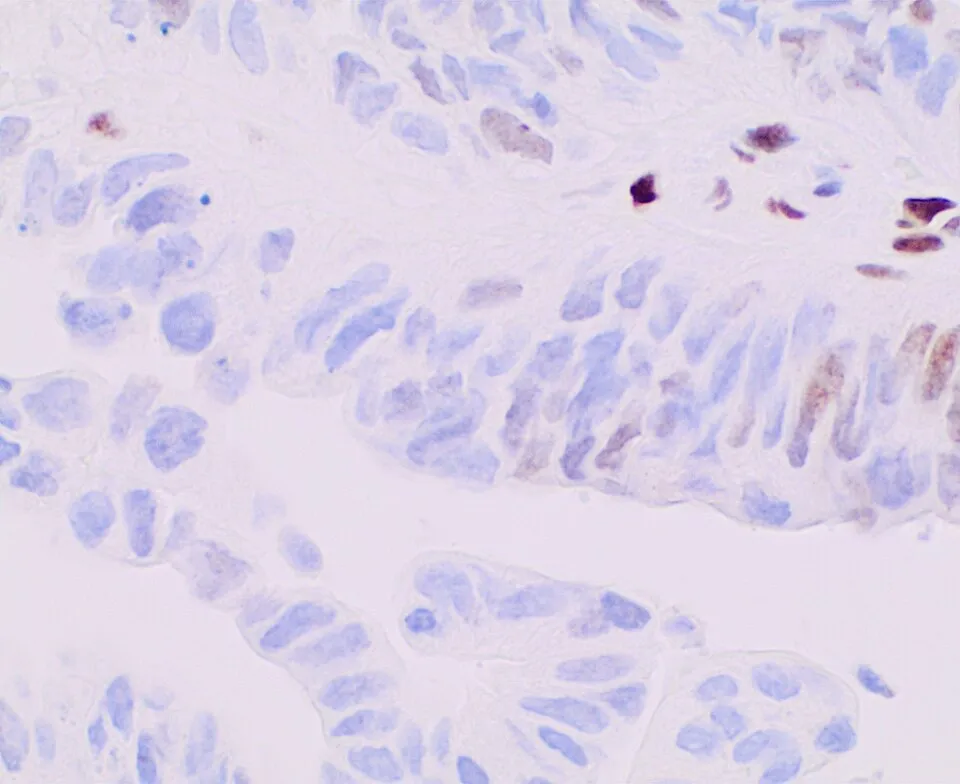
- Universal tumour testing (immunohistochemistry for MMR proteins or MSI) is recommended for all colorectal and endometrial cancers; MLH1 loss needs BRAF V600E or MLH1 promoter methylation testing to exclude sporadic cases
- Lynch surveillance: colonoscopy every 2 years, starting at 25 for MLH1/MSH2 and 35 for MSH6/PMS2 (UK BSG/ACPGBI approach); daily aspirin reduces colorectal cancer risk (CAPP2)
- Li–Fraumeni (TP53) causes childhood and adult cancers: sarcoma, premenopausal breast, brain tumours, adrenocortical carcinoma and leukaemia; avoid radiotherapy where possible and use annual whole-body MRI
- Germline BRCA status guides treatment: PARP inhibitors (olaparib) are used in BRCA-mutated ovarian, breast (including adjuvant, OlympiA), pancreatic and prostate cancers
Differential diagnosis
| Condition | Clues | Key test |
|---|---|---|
| Hereditary breast and ovarian cancer (BRCA1/2) | Breast cancer before 40, triple-negative tumour, ovarian or male breast cancer in family | Germline panel including BRCA1, BRCA2, PALB2 |
| Lynch syndrome | Colorectal or endometrial cancer before 50, right-sided MSI-high tumour, Amsterdam II family | Tumour MMR immunohistochemistry or MSI, then germline MMR genes |
| Li–Fraumeni syndrome | Sarcoma, adrenocortical carcinoma or choroid plexus carcinoma in a child; very early breast cancer | Germline TP53 testing (revised Chompret criteria) |
| Familial adenomatous polyposis | Hundreds to thousands of colorectal adenomas from adolescence | Colonoscopy, germline APC |
| MUTYH-associated polyposis | Tens to hundreds of adenomas, recessive, siblings affected but not parents | Biallelic MUTYH testing |
| Cowden (PTEN hamartoma) syndrome | Macrocephaly, trichilemmomas, breast, thyroid and endometrial cancer | Germline PTEN |
| Sporadic cancer with familial clustering | Common cancers at usual ages, shared environment (smoking), no clear pattern | Risk model; no testing if below threshold |
| Sporadic MLH1-deficient colorectal cancer | Older patient, MLH1/PMS2 loss with BRAF V600E or MLH1 promoter hypermethylation | BRAF and methylation testing on tumour |
Exam pearls
Guideline
NICE CG164 Familial breast cancer (2013, updated 2023; replacement in development), NICE DG27 (2017) and DG42 (2020) Lynch testing, ASCO–SSO germline testing in breast cancer (2024), European (Mallorca) Lynch guidelines 3rd edition (2021) and ERN GENTURIS Li–Fraumeni guidelines (2020)
References
- National Institute for Health and Care Excellence (NICE). Familial breast cancer: classification, care and managing breast cancer and related risks in people with a family history of breast cancer (CG164). NICE 2013.
- National Institute for Health and Care Excellence (NICE). Molecular testing strategies for Lynch syndrome in people with colorectal cancer (DG27). NICE 2017.
- Bedrosian I, Somerfield MR, Achatz MI, et al.. Germline testing in patients with breast cancer: ASCO–Society of Surgical Oncology guideline. J Clin Oncol 2024.
- Seppälä TT, Latchford A, Negoi I, et al.. European guidelines from the EHTG and ESCP for Lynch syndrome: an updated third edition of the Mallorca guidelines based on gene and gender. Br J Surg 2021.
- Frebourg T, Bajalica Lagercrantz S, Oliveira C, et al.. Guidelines for the Li–Fraumeni and heritable TP53-related cancer syndromes. Eur J Hum Genet 2020.
- National Institute for Health and Care Excellence (NICE). Testing strategies for Lynch syndrome in people with endometrial cancer (DG42). NICE 2020.
Related topics
By Dr Khalid Seidi (B.Sc., M.D.) · MedEd World Clinical Knowledge library. Original teaching content checked against current guidelines (November 2026); confirm the latest local guidance before clinical use. Not a substitute for clinical judgement.