Clinical Knowledge › Internal medicine › Haematology and oncology › Principles of oncology
Principles of radiotherapy
Radiotherapy uses ionising radiation to kill cancer cells and is part of the treatment of about half of all people with cancer, either with curative intent (alone, after surgery, or combined with chemotherapy) or for palliation of pain, bleeding and compression. Radiation damages DNA, mainly through free radicals formed from water, and lethal double-strand breaks cause cells to die when they next attempt to divide. Dose is measured in grays (Gy) and is usually divided into fractions so that normal tissues can repair sublethal damage between treatments while the tumour cannot; the four Rs (repair, redistribution, reoxygenation and repopulation) and the alpha/beta ratio explain fractionation. Modern external-beam treatment is planned on CT, shaped with intensity-modulated techniques and verified with on-board imaging; stereotactic radiotherapy delivers ablative doses in a few fractions, and brachytherapy places sources inside or next to the tumour. Acute toxicity affects rapidly dividing tissues (skin, mucosa, bowel) and usually settles within weeks; late effects (fibrosis, organ dysfunction, second cancers) are permanent and dose-limiting.
Patient case, mechanism, investigations, management, flashcards and exam-style questions.Open the lesson →
Key facts
- About half of people with cancer benefit from radiotherapy at some point; it contributes substantially to cure
- 1 gray (Gy) = 1 joule of energy absorbed per kilogram of tissue
- Most photon damage is indirect, via hydroxyl radicals from water; double-strand DNA breaks cause mitotic cell death
- Oxygen 'fixes' radiation damage: hypoxic cells are 2–3 times more resistant (oxygen enhancement ratio)
- Fractionation exploits the four Rs: repair, redistribution, reoxygenation and repopulation (radiosensitivity is the fifth)
- Late-reacting tissues have a low alpha/beta ratio (about 3 Gy) and are spared by small fractions; prostate and breast cancers also have low ratios, favouring hypofractionation
- Acute effects occur within 90 days in rapidly dividing tissue; late effects appear months to years later and are usually irreversible
- Single 8 Gy fractions relieve painful bone metastases as well as longer courses; breast 26 Gy in 5 fractions (FAST-Forward) is now standard in the UK
Differential diagnosis
| Condition | Clues | Key test |
|---|---|---|
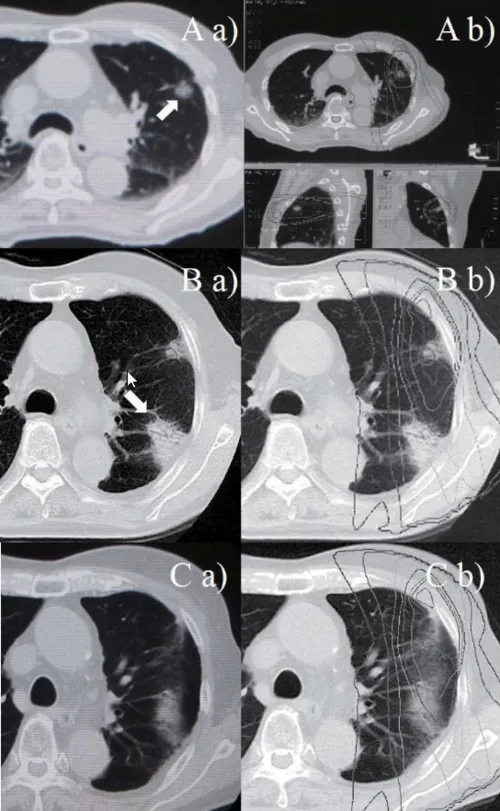
| Radiation pneumonitis | Dry cough, breathlessness and fever 1–6 months after thoracic radiotherapy; changes conform to the treated field | CT: ground-glass or consolidation in the radiation field; exclude infection |
| Pneumonia | Acute fever, purulent sputum, focal signs outside or inside the field | Chest X-ray, CRP, cultures |
| Tumour progression | Enlarging mass or new lesions beyond the field | Restaging CT or PET-CT; biopsy |
| Radiation necrosis (brain) | New enhancing lesion months after stereotactic radiosurgery | Perfusion MRI or PET; biopsy if doubt |
| Late radiation proctitis | Rectal bleeding months to years after pelvic radiotherapy | Flexible sigmoidoscopy showing telangiectasia; exclude colorectal cancer |
| Radiation-induced hypothyroidism | Fatigue, weight gain after neck or mantle radiotherapy | TSH and free T4 |
| Second malignancy in the field | New tumour (sarcoma, breast cancer) 10 or more years later | Imaging and biopsy |
Exam pearls
Guideline
Royal College of Radiologists Radiotherapy Dose Fractionation, 4th edition (2024), with NICE NG101 early and locally advanced breast cancer (2018, updated) and NICE NG234 metastatic spinal cord compression (2023)
References
- The Royal College of Radiologists. Radiotherapy dose fractionation, fourth edition. The Royal College of Radiologists, London 2024.
- Murray Brunt A, Haviland JS, Wheatley DA, et al.. Hypofractionated breast radiotherapy for 1 week versus 3 weeks (FAST-Forward): 5-year efficacy and late normal tissue effects results from a multicentre, non-inferiority, randomised, phase 3 trial. Lancet 2020.
- van As N, Griffin C, Tree A, et al.. Phase 3 trial of stereotactic body radiotherapy in localized prostate cancer. N Engl J Med 2024.
- National Institute for Health and Care Excellence. Spinal metastases and metastatic spinal cord compression (NG234). NICE 2023.
- National Institute for Health and Care Excellence. Early and locally advanced breast cancer: diagnosis and management (NG101). NICE 2018.
- Delaney G, Jacob S, Featherstone C, Barton M. The role of radiotherapy in cancer treatment: estimating optimal utilization from a review of evidence-based clinical guidelines. Cancer 2005.
Related topics
By Dr Khalid Seidi (B.Sc., M.D.) · MedEd World Clinical Knowledge library. Original teaching content checked against current guidelines (November 2026); confirm the latest local guidance before clinical use. Not a substitute for clinical judgement.