Clinical Knowledge › Paediatrics › Clinical problems
Crying or irritable infant: approach to the patient
All healthy infants cry, and crying normally rises from birth to a peak at about 6 weeks before settling by 3–4 months. Infant colic describes long bouts of unexplained, hard-to-soothe crying in an otherwise well, thriving baby under 5 months; it affects roughly one in five infants in the first weeks and resolves on its own. The clinician's job is twofold. First, find the small minority (about 5% of afebrile cases) who have an organic cause: urinary tract infection, otitis media, incarcerated hernia, testicular torsion, intussusception, hair tourniquet, corneal abrasion, fracture, raised intracranial pressure, supraventricular tachycardia or cow's milk protein allergy. A full undressed examination and a urine sample usually suffice. Second, protect the infant and support the family: inconsolable crying is the main trigger for abusive head trauma, so screen for bruising and parental exhaustion or depression, teach coping strategies (it is fine to put the baby down safely and walk away; never shake), and safety-net clearly.
Patient case, mechanism, investigations, management, flashcards and exam-style questions.Open the lesson →
Key facts
- Normal crying peaks at about 6 weeks (often 2–3 hours a day) and falls by 3–4 months; it clusters in the late afternoon and evening
- Rome IV infant colic: onset and resolution before 5 months; recurrent, prolonged crying, fussing or irritability without obvious cause; no faltering growth, fever or illness
- Prevalence of colic is about 17–25% in the first 6 weeks, falling to about 0.6% by 3 months (meta-analysis)
- Only about 5% of afebrile infants presenting with excessive crying have a serious organic cause; urinary tract infection is the commonest
- A full examination with the infant completely undressed (including eyes, digits, genitals, groin, fontanelle and skin) is the most useful 'test'
- Red flags: fever (any fever in under 3 months), bilious vomiting, abnormal cry, lethargy, poor feeding, faltering growth, bruising, bulging fontanelle
- Any bruise in a non-mobile infant is a safeguarding concern; inconsolable crying is the commonest trigger for abusive head trauma (peak 2–4 months)
- Simethicone, lactase and anti-reflux medication do not reduce crying; acid suppression is not recommended for isolated crying or distress
Differential diagnosis
| Condition | Clues | Key test |
|---|---|---|
| Infant colic | Well, thriving baby under 5 months; evening crying bouts; normal examination | Clinical diagnosis after normal examination; crying diary |
| Urinary tract infection | Irritability, poor feeding, vomiting, fever may be absent in young infants | Clean-catch urine dipstick, microscopy and culture |
| Cow's milk protein allergy | Crying with eczema, vomiting, diarrhoea or blood in stool; family atopy | 2–4-week elimination trial then reintroduction |
| Hair or thread tourniquet | Sudden inconsolable crying; swollen red toe, finger or penis | Careful inspection of digits and genitals |
| Incarcerated inguinal hernia or testicular torsion | Groin or scrotal swelling, vomiting | Examine groin and scrotum; urgent surgical review, Doppler ultrasound |
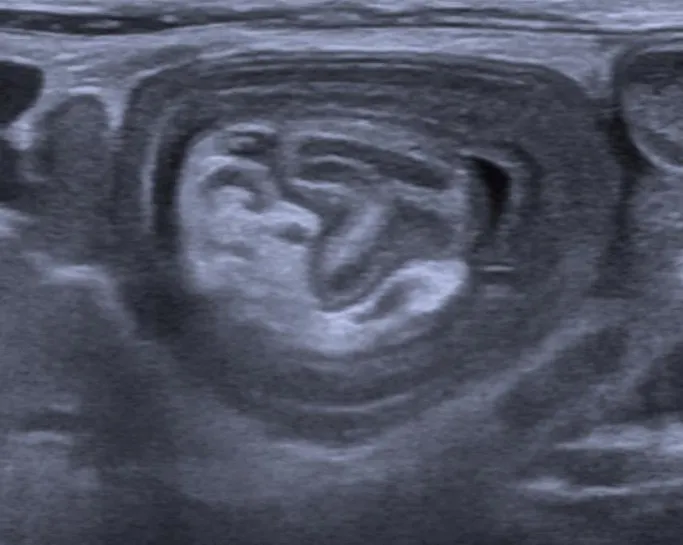
| Intussusception | Paroxysmal crying with pallor and drawing up legs, vomiting, later redcurrant-jelly stool; usually 3 months–3 years | Abdominal ultrasound (target sign) |
| Abusive head trauma or fracture | Inconsistent history, bruising, irritability, vomiting, seizures, bulging fontanelle | CT head, skeletal survey, retinal examination; safeguarding referral |
| Supraventricular tachycardia or heart failure | Pallor, sweating with feeds, poor feeding, heart rate often above 220/min | ECG; echocardiogram |
Exam pearls
Guideline
Rome IV infant colic criteria (2016; Rome V paediatric update 2026), NICE NG1 GORD in children (2015, updated 2019), NASPGHAN/ESPGHAN paediatric GER guideline (2018), ESPGHAN cow's milk allergy position paper (2024), NICE CG89 child maltreatment (2009, updated 2017) and NICE NG143 fever in under 5s (2019, updated 2021)
References
- Benninga MA, Faure C, Hyman PE, et al.. Childhood functional gastrointestinal disorders: neonate/toddler. Gastroenterology 2016.
- Wolke D, Bilgin A, Samara M.. Systematic review and meta-analysis: fussing and crying durations and prevalence of colic in infants. J Pediatr 2017.
- Freedman SB, Al-Harthy N, Thull-Freedman J.. The crying infant: diagnostic testing and frequency of serious underlying disease. Pediatrics 2009.
- Barr RG, Rivara FP, Barr M, et al.. Effectiveness of educational materials designed to change knowledge and behaviors regarding crying and shaken-baby syndrome in mothers of newborns: a randomized, controlled trial. Pediatrics 2009.
- Vandenplas Y, Broekaert I, Domellöf M, et al.. An ESPGHAN position paper on the diagnosis, management, and prevention of cow's milk allergy. J Pediatr Gastroenterol Nutr 2024.
- Rosen R, Vandenplas Y, Singendonk M, et al.. Pediatric gastroesophageal reflux clinical practice guidelines: joint recommendations of NASPGHAN and ESPGHAN. J Pediatr Gastroenterol Nutr 2018.
Related topics
By Dr Khalid Seidi (B.Sc., M.D.) · MedEd World Clinical Knowledge library. Original teaching content checked against current guidelines (November 2026); confirm the latest local guidance before clinical use. Not a substitute for clinical judgement.