Clinical Knowledge › Paediatrics › Clinical problems
Limp in a child: approach to the patient
A limp is an abnormal gait caused by pain, weakness or a structural problem anywhere from spine to foot. Most limps are due to minor trauma or transient synovitis, but the approach is built around never missing infection (septic arthritis, osteomyelitis, discitis), non-accidental injury, malignancy (leukaemia, bone tumours) and slipped capital femoral epiphysis. Age is the best guide: toddlers have toddler's fractures, infection and hip dysplasia; children aged 3–10 have transient synovitis and Perthes disease; adolescents have slipped epiphysis, overuse injuries and bone tumours. Hip disease often presents as knee pain. Fever, refusal to bear weight, night pain, systemic upset or age under 3 years needs same-day assessment. Tests follow the history: blood count, CRP, ESR and blood culture for infection (Kocher criteria), X-rays including a frog-leg lateral, ultrasound for effusion and MRI for occult infection. Safeguarding is considered in every unexplained injury.
Patient case, mechanism, investigations, management, flashcards and exam-style questions.Open the lesson →
Key facts
- Commonest causes overall: minor trauma and transient synovitis; most serious: septic arthritis, osteomyelitis, malignancy, non-accidental injury, slipped capital femoral epiphysis (SCFE)
- Age clues: 1–3 years toddler's fracture, infection, DDH; 3–10 years transient synovitis, Perthes; 10–16 years SCFE, Osgood–Schlatter, bone tumours
- Kocher criteria for septic arthritis of the hip: history of fever (temperature above 38.5 °C in later validations), non-weight-bearing, ESR above 40 mm/h, WBC above 12 × 10⁹/L (CRP above 20 mg/L often added)
- Probability of septic arthritis rises from under 1% with no Kocher criteria to about 40% with two, 93% with three and over 99% with four (original cohort)
- Hip pain is often referred to the knee via the obturator nerve: always examine the hip in a child with knee pain
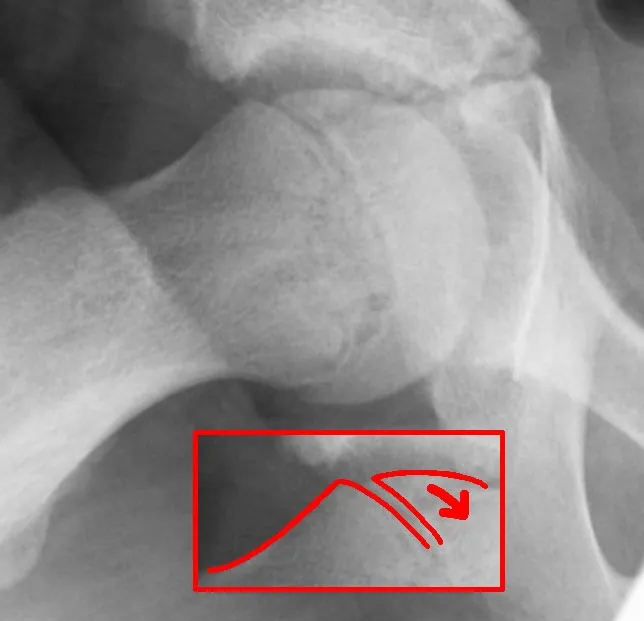
- SCFE: obese adolescent, painful limp, loss of internal rotation with obligatory external rotation on hip flexion; frog-leg lateral X-ray; Klein's line fails to intersect the epiphysis
- Night pain, weight loss, pallor, bruising or hepatosplenomegaly suggest leukaemia or a bone tumour
- A non-ambulant infant with a fracture, or an injury not matching the history, needs child protection assessment
Differential diagnosis
| Condition | Clues | Key test |
|---|---|---|
| Transient synovitis | Age 3–8, well, afebrile or low fever, recent viral illness, can usually bear some weight | Normal or mildly raised CRP; ultrasound effusion; diagnosis of exclusion |
| Septic arthritis | Febrile, unwell, refuses to bear weight, hip held flexed and externally rotated, severe pain on movement | Kocher criteria, blood culture, urgent ultrasound-guided aspiration |
| Osteomyelitis | Fever, focal bony tenderness (often distal femur or proximal tibia), refuses to bear weight | CRP, blood culture; MRI (X-ray normal for 10–14 days) |
| Perthes disease | Boy aged 4–8, insidious limp, mild pain, reduced abduction and internal rotation | AP and frog-leg X-ray: flattened, sclerotic, fragmented femoral head |
| Slipped capital femoral epiphysis | Obese adolescent (10–16), hip or knee pain, externally rotated leg | AP and frog-leg lateral X-ray (Klein's line) |
| Toddler's fracture | Child aged 9 months–3 years, minor twisting fall, refuses to weight-bear, tender tibia | Tibial X-ray (spiral fracture may only show at 10–14 days) |
| Developmental dysplasia of the hip (late) | Painless limp or waddling gait, leg-length discrepancy, limited abduction | Pelvic X-ray (ultrasound under about 4–6 months) |
| Leukaemia or bone tumour | Night pain, systemic symptoms, pallor, bruising, mass | FBC and blood film; X-ray; MRI; urgent oncology referral |
Exam pearls
Guideline
PIDS/IDSA acute haematogenous osteomyelitis in children (2021), NICE NG143 fever in under 5s (2019, updated 2021), with Kocher criteria (1999; CRP added by Caird 2006) as the validated decision rule
References
- Herman MJ, Martinek M. The limping child. Pediatr Rev 2015.
- Kocher MS, Zurakowski D, Kasser JR. Differentiating between septic arthritis and transient synovitis of the hip in children: an evidence-based clinical prediction algorithm. J Bone Joint Surg Am 1999.
- Woods CR, Bradley JS, Chatterjee A, et al.. Clinical practice guideline by the PIDS and IDSA: 2021 guideline on diagnosis and management of acute hematogenous osteomyelitis in pediatrics. J Pediatric Infect Dis Soc 2021.
- National Institute for Health and Care Excellence. Fever in under 5s: assessment and initial management (NG143). NICE guideline 2019.
- Caird MS, Flynn JM, Leung YL, Millman JE, D'Italia JG, Dormans JP. Factors distinguishing septic arthritis from transient synovitis of the hip in children: a prospective study. J Bone Joint Surg Am 2006.
- Royal College of Paediatrics and Child Health. Child Protection Evidence: fractures (systematic review). RCPCH 2020.
Related topics
By Dr Khalid Seidi (B.Sc., M.D.) · MedEd World Clinical Knowledge library. Original teaching content checked against current guidelines (November 2026); confirm the latest local guidance before clinical use. Not a substitute for clinical judgement.