Clinical Knowledge › Paediatrics › Clinical problems
Rash in a child: approach to the patient
Rashes are among the commonest reasons children see a doctor. Most are viral exanthems, eczema or nappy dermatitis, but some are life-threatening and must be recognised within minutes: meningococcal septicaemia, toxic shock, staphylococcal scalded skin syndrome, Stevens–Johnson syndrome/TEN, eczema herpeticum and Kawasaki disease. The approach starts with how ill the child is (traffic-light assessment, vital signs for age), then describes the rash: morphology, distribution, evolution and whether it blanches. A non-blanching rash in a febrile child is meningococcal disease until proved otherwise and needs immediate parenteral antibiotics. Associated features narrow the list: Koplik spots in measles, slapped cheeks in parvovirus, crops of vesicles in chickenpox, strawberry tongue in scarlet fever, and five days of fever with conjunctivitis in Kawasaki disease. Erythema is harder to see on darker skin, so examine palms, soles, conjunctivae and mouth. Immunisation, contacts and safeguarding complete the assessment.
Patient case, mechanism, investigations, management, flashcards and exam-style questions.Open the lesson →
Key facts
- First decide how sick the child is: NICE traffic-light system (colour, activity, respiration, circulation and hydration, other signs) and age-specific vital signs
- Non-blanching (petechial or purpuric) rash with fever = meningococcal disease until proved otherwise; give parenteral antibiotics without delay
- Glass (tumbler) test: a rash that does not fade under pressure is non-blanching; petechiae above the nipple line after coughing or vomiting can be benign if the child is well
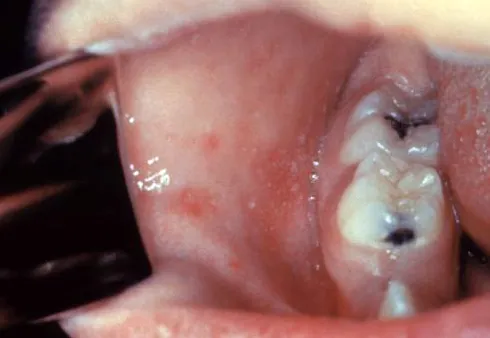
- Measles: 3 Cs prodrome (cough, coryza, conjunctivitis), Koplik spots, then maculopapular rash starting behind the ears and spreading down
- Roseola (HHV-6): 3–5 days of high fever in an infant, then rash as fever settles; febrile seizures common
- Kawasaki disease: fever for 5 days or more plus 4 of 5 – bilateral non-purulent conjunctivitis, oral changes, extremity changes, polymorphous rash, cervical node 1.5 cm or more; IVIG 2 g/kg and aspirin
- Scarlet fever (group A streptococcus): sandpaper rash, strawberry tongue, circumoral pallor, Pastia lines; treat with phenoxymethylpenicillin for 10 days
- Erythema and purpura are harder to see on brown and black skin: check palms, soles, conjunctivae, mucosa and capillary refill
Differential diagnosis
| Condition | Clues | Key test |
|---|---|---|
| Meningococcal septicaemia | Febrile, unwell, rapidly spreading non-blanching petechiae or purpura | Blood culture, meningococcal PCR; treat immediately |
| Immune thrombocytopenia | Well child, petechiae and bruises after a viral illness, no hepatosplenomegaly | FBC (isolated low platelets) and blood film |
| IgA vasculitis (Henoch–Schönlein purpura) | Palpable purpura on buttocks and legs, arthralgia, abdominal pain, normal platelets | Urinalysis, blood pressure, FBC |
| Measles | Prodrome of cough, coryza, conjunctivitis; Koplik spots; unvaccinated | Measles PCR or IgM (saliva or serum); notify |
| Kawasaki disease | Fever 5 days or more, red eyes and lips, swollen hands, irritable | CRP, ESR, FBC, albumin, ALT, urinalysis, echocardiogram |
| Scarlet fever | Sore throat, sandpaper rash, strawberry tongue | Throat swab culture or rapid antigen test |
| Stevens–Johnson syndrome / TEN | Mucositis, target-like lesions, skin detachment after a drug (anticonvulsant, sulfonamide) or Mycoplasma | Clinical; skin biopsy; Nikolsky sign |
| Non-accidental injury | Bruising in non-mobile infants, patterned marks, sites such as ears, neck, torso | Safeguarding assessment, FBC and clotting, skeletal survey |
Exam pearls
Guideline
NICE NG143 Fever in under 5s (2019, updated 2021), NICE NG240 Meningitis (bacterial) and meningococcal disease (2024), AHA Kawasaki disease scientific statement (2017) with its 2024 update, Phoenix paediatric sepsis criteria (2024) and UKHSA Green Book
References
- National Institute for Health and Care Excellence. Fever in under 5s: assessment and initial management (NG143). NICE guideline 2019.
- National Institute for Health and Care Excellence. Meningitis (bacterial) and meningococcal disease: recognition, diagnosis and management (NG240). NICE guideline 2024.
- McCrindle BW, Rowley AH, Newburger JW, et al.. Diagnosis, treatment, and long-term management of Kawasaki disease: a scientific statement for health professionals from the American Heart Association. Circulation 2017.
- Sanchez-Pinto LN, Bennett TD, DeWitt PE, et al.. Development and validation of the Phoenix criteria for pediatric sepsis and septic shock. JAMA 2024.
- UK Health Security Agency. Immunisation against infectious disease (the Green Book): measles, varicella and other chapters. UKHSA 2006.
- Mathes EF, Mancini AJ, Paller AS. Hurwitz Clinical Pediatric Dermatology. 2022.
Related topics
By Dr Khalid Seidi (B.Sc., M.D.) · MedEd World Clinical Knowledge library. Original teaching content checked against current guidelines (November 2026); confirm the latest local guidance before clinical use. Not a substitute for clinical judgement.