Clinical Knowledge › Paediatrics › Clinical problems
Faltering growth: approach to the patient
Faltering growth (formerly 'failure to thrive') means a child's weight gain is slower than expected for age and sex, shown by weight falling across centile lines or lying well below the 2nd centile. NICE NG75 defines thresholds: a fall of 1 or more centile spaces if birth weight was below the 9th centile, 2 or more if between the 9th and 91st, 3 or more if above the 91st, or current weight below the 2nd centile. In the newborn, loss of 10% or more of birth weight or failure to regain it by 3 weeks needs assessment. Usually the cause is inadequate intake (feeding or breastfeeding difficulties, food refusal, family circumstances); organic disease is uncommon and usually suggested by history or examination: malabsorption (coeliac disease, cystic fibrosis, cow's milk allergy), increased needs (heart, lung or renal disease) or losses. Assessment means accurate charting, a feeding history and observed feed, examination, targeted tests (urine, coeliac serology) and attention to safeguarding. Management is multidisciplinary feeding support, with refeeding precautions when severe.
Patient case, mechanism, investigations, management, flashcards and exam-style questions.Open the lesson →
Key facts
- NICE NG75 thresholds: fall of 1 or more centile spaces (birth weight below 9th), 2 or more (9th–91st), 3 or more (above 91st), or weight below the 2nd centile
- Newborn: weight loss of 10% or more of birth weight, or not regaining birth weight by 3 weeks, needs assessment of feeding and health
- A centile space is the gap between two adjacent centile lines on UK-WHO charts (about 0.67 SD)
- Inadequate intake is the commonest cause; organic disease is uncommon and rarely found without suggestive history or examination
- Routine 'blanket' blood tests are not recommended; urine microscopy and culture (UTI) and coeliac serology (if on gluten) are the usual first tests when indicated
- Plot length or height and head circumference as well as weight: weight faltering alone suggests undernutrition; length and head growth affected later or in syndromic or endocrine disease
- WHO definitions (z-scores): wasting weight-for-length/height below −2 SD, stunting length/height-for-age below −2 SD, underweight weight-for-age below −2 SD; severe below −3 SD; MUAC below 115 mm or bilateral pitting oedema = severe acute malnutrition
- Catch-up growth needs extra energy (often about 120–150% of normal requirement for actual weight); monitor phosphate, potassium and magnesium for refeeding syndrome in severe undernutrition
Differential diagnosis
| Condition | Clues | Key test |
|---|---|---|
| Inadequate intake (feeding difficulty) | Breastfeeding problems, incorrect formula preparation, restricted diet, food refusal; normal examination | Feeding history, observed feed, food diary |
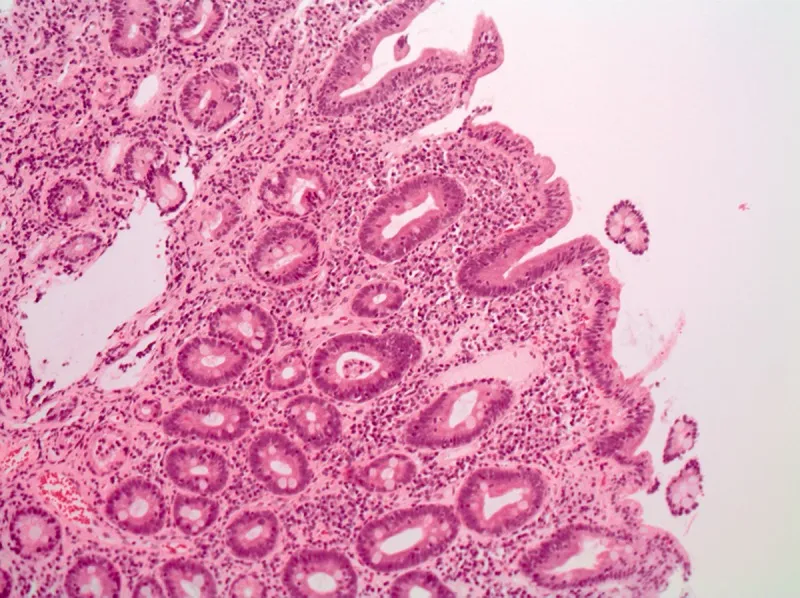
| Coeliac disease | Faltering after gluten introduction, diarrhoea or constipation, distension, irritability | tTG-IgA with total IgA |
| Cow's milk protein allergy | Infant with vomiting, diarrhoea, blood in stool, eczema | Elimination and reintroduction |
| Cystic fibrosis | Steatorrhoea, recurrent chest infections, good appetite | Sweat test (chloride 60 mmol/L or more) |
| Congenital heart disease | Breathlessness and sweating with feeds, murmur, hepatomegaly | Echocardiogram |
| Urinary tract infection or renal tubular acidosis | Vomiting, fever, polyuria; normal anion gap acidosis in RTA | Urine culture; venous gas, electrolytes |
| Neglect or emotional deprivation | Weight gain in hospital with normal feeding, missed appointments, other children affected | Observation of care; safeguarding assessment |
| Constitutional small size or familial short stature | Small but growing parallel to centiles, small parents, normal velocity | Mid-parental height; serial measurements |
Exam pearls
Guideline
NICE NG75 Faltering growth (2017), UK-WHO growth charts (2009) based on WHO Child Growth Standards (2006), WHO guideline on wasting and nutritional oedema (2023), ESPGHAN coeliac disease guideline (2020), ESPGHAN cow's milk allergy position paper (2024) and NICE CG89 child maltreatment (2009, updated 2017)
References
- National Institute for Health and Care Excellence. Faltering growth: recognition and management of faltering growth in children (NG75). NICE guideline 2017.
- Shields B, Wacogne I, Wright CM.. Weight faltering and failure to thrive in infancy and early childhood. BMJ 2012.
- Wright CM, Williams AF, Elliman D, et al.. Using the new UK-WHO growth charts. BMJ 2010.
- World Health Organization. WHO Child Growth Standards: length/height-for-age, weight-for-age, weight-for-length, weight-for-height and body mass index-for-age. WHO 2006.
- World Health Organization. WHO guideline on the prevention and management of wasting and nutritional oedema (acute malnutrition) in infants and children under 5 years. WHO 2023.
- Husby S, Koletzko S, Korponay-Szabó I, et al.. European Society Paediatric Gastroenterology, Hepatology and Nutrition guidelines for diagnosing coeliac disease 2020. J Pediatr Gastroenterol Nutr 2020.
Related topics
By Dr Khalid Seidi (B.Sc., M.D.) · MedEd World Clinical Knowledge library. Original teaching content checked against current guidelines (November 2026); confirm the latest local guidance before clinical use. Not a substitute for clinical judgement.