Clinical Knowledge › Paediatrics › Paediatric neurology
Encephalitis in children
Encephalitis is inflammation of the brain parenchyma causing altered consciousness, behaviour or personality, often with fever, seizures and focal signs. In children it is a neurological emergency with infectious and immune-mediated causes that must be considered in parallel. Herpes simplex virus (HSV) is the commonest treatable sporadic cause in high-income countries; enteroviruses, parechovirus in young infants, influenza, varicella and Mycoplasma are frequent; Japanese encephalitis dominates in Asia; and anti-NMDA receptor encephalitis and ADEM are the leading immune causes. Presentation depends on age: a neonate may only feed poorly or have seizures, a toddler becomes irritable or drowsy, and an adolescent may show psychiatric change. Start intravenous aciclovir (with antibiotics if bacterial meningitis is possible) as soon as encephalitis is suspected, ideally within 6 hours. Lumbar puncture when safe, CSF PCR, MRI and EEG define the cause. Immune encephalitis needs early steroids, immunoglobulin or plasma exchange. Long-term neurodevelopmental follow-up is essential.
Patient case, mechanism, investigations, management, flashcards and exam-style questions.Open the lesson →
Key facts
- Core feature: altered mental status (consciousness, behaviour or personality) for 24 hours or more without another cause
- HSV-1 is the commonest treatable sporadic viral cause beyond the neonatal period; neonatal HSV is often HSV-2 acquired at birth
- Start IV aciclovir empirically without waiting for LP or imaging; give ceftriaxone too until bacterial meningitis is excluded
- Teaching aciclovir doses: under 3 months 20 mg/kg 8-hourly; 3 months–11 years 500 mg/m2 8-hourly; 12 years and over 10 mg/kg 8-hourly
- CSF: lymphocytic pleocytosis, raised protein, normal glucose; HSV PCR may be negative in the first 72 hours – repeat if suspicion persists
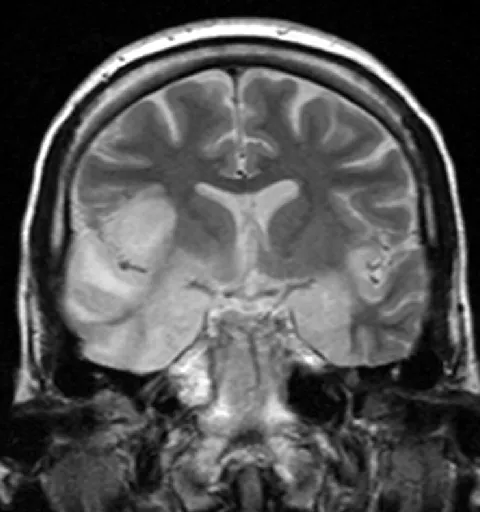
- MRI with diffusion is the imaging of choice: temporal lobe changes in HSV, thalamic necrosis in influenza-associated ANE, multifocal white matter in ADEM
- Anti-NMDAR encephalitis: behaviour change, seizures, dyskinesias, sleep and speech disturbance, autonomic instability; may follow HSV encephalitis
- Prevention: MMR, varicella, influenza and Japanese encephalitis vaccines; rabies post-exposure prophylaxis
Differential diagnosis
| Condition | Clues | Key test |
|---|---|---|
| Bacterial meningitis | Fever, neck stiffness, purpura; CSF neutrophils with low glucose | CSF microscopy, culture, PCR; blood culture |
| Sepsis-associated encephalopathy | Shock and organ dysfunction drive confusion; CSF normal | Blood cultures, lactate; reassess when perfused |
| Toxic or metabolic encephalopathy | Hypoglycaemia, hyperammonaemia, DKA, poisoning; no CSF inflammation | Glucose, ammonia, gas, toxicology |
| Non-convulsive status epilepticus | Fluctuating consciousness, subtle twitching | EEG |
| Non-accidental head injury | Infant with encephalopathy, retinal haemorrhages, bruises, inconsistent history | CT head, skeletal survey, ophthalmology |
| Brain abscess or tumour | Focal signs, raised ICP, slower course | Contrast MRI |
| Primary psychiatric illness | Adolescent with psychosis but no seizures, dyskinesia or CSF change | Consider NMDAR antibodies, EEG before labelling |
Exam pearls
Guideline
UK Joint Societies guideline on suspected infectious and autoimmune encephalitis in children (Ray et al., J Infect 2026, updating Kneen et al. 2012); International Encephalitis Consortium case definition (2013); paediatric autoimmune encephalitis approach (Cellucci et al. 2020)
References
- Ray STJ, Hilton O, Fuller C, McKeever S, et al.. Management of suspected infectious and autoimmune encephalitis in children - National Guidelines from the United Kingdom Joint Societies. J Infect 2026.
- Kneen R, Michael BD, Menson E, et al.. Management of suspected viral encephalitis in children - Association of British Neurologists and British Paediatric Allergy, Immunology and Infection Group national guidelines. J Infect 2012.
- Venkatesan A, Tunkel AR, Bloch KC, et al.. Case definitions, diagnostic algorithms, and priorities in encephalitis: consensus statement of the International Encephalitis Consortium. Clin Infect Dis 2013.
- Graus F, Titulaer MJ, Balu R, et al.. A clinical approach to diagnosis of autoimmune encephalitis. Lancet Neurol 2016.
- Cellucci T, Van Mater H, Graus F, et al.. Clinical approach to the diagnosis of autoimmune encephalitis in the pediatric patient. Neurol Neuroimmunol Neuroinflamm 2020.
- Kimberlin DW, Lin CY, Jacobs RF, et al.. Safety and efficacy of high-dose intravenous acyclovir in the management of neonatal herpes simplex virus infections. Pediatrics 2001.
Related topics
By Dr Khalid Seidi (B.Sc., M.D.) · MedEd World Clinical Knowledge library. Original teaching content checked against current guidelines (November 2026); confirm the latest local guidance before clinical use. Not a substitute for clinical judgement.