Clinical Knowledge › Surgery › Fractures and orthopaedic trauma
Fracture complications (non-union, malunion, avascular necrosis)
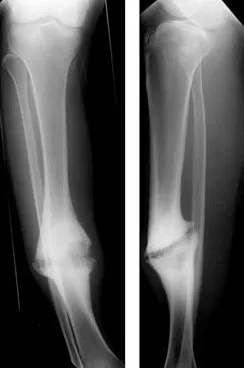
Fracture complications range from immediate neurovascular injury to late failure of healing. The three late bony problems surgeons are asked about most are non-union, malunion and avascular necrosis. Delayed union is slow but progressing healing; non-union means healing has stopped, often defined as no radiographic progress for 3 months. Hypertrophic non-unions have good biology but too much movement and need more stability, whereas atrophic non-unions lack biology and need debridement, bone graft and stable fixation. Infection must be excluded in every non-union with inflammatory markers and deep tissue samples. Malunion is healing with angular, rotational or length deformity or an intra-articular step, and is treated with corrective osteotomy when symptomatic. Avascular necrosis follows injuries that cut a retrograde or fragile blood supply: displaced intracapsular hip fractures, proximal scaphoid, talar neck and four-part humeral fractures. Risk factors include smoking, diabetes, open fractures, poor fixation and soft-tissue stripping.
Patient case, mechanism, investigations, management, flashcards and exam-style questions.Open the lesson →
Key facts
- Non-union: healing has stopped, typically no radiographic progress for 3 months, usually at least 6–9 months after injury
- Hypertrophic non-union = adequate biology, inadequate stability: treat with more stable fixation (e.g. exchange reamed nailing)
- Atrophic non-union = poor biology: debride, autologous bone graft and stable fixation
- Assume infection in every non-union until excluded; deep tissue samples, not superficial swabs, confirm fracture-related infection
- Tibial shaft fractures have the highest non-union rate of long bones; smoking roughly doubles the risk
- Rotational malunion never remodels; check finger cascade and limb rotation clinically
- AVN-prone sites: femoral head (displaced intracapsular fracture), scaphoid proximal pole, talar neck, humeral head
- MRI is the most sensitive test for early avascular necrosis; radiographs show sclerosis, crescent sign and collapse later
Differential diagnosis
| Condition | Clues | Key test |
|---|---|---|
| Delayed union | Slow but progressing callus within expected time frame | Serial radiographs show progress |
| Fracture-related infection | Wound discharge, sinus, rising CRP, loosening around implants | Deep tissue cultures (≥2 matching), histology |
| Pathological fracture through tumour | Pain before injury, low-energy mechanism, lytic lesion | MRI, biopsy, myeloma screen |
| Complex regional pain syndrome | Disproportionate pain, swelling, colour and temperature change, healed fracture | Clinical (Budapest criteria); radiograph shows patchy osteopenia |
| Post-traumatic osteoarthritis | Joint pain and stiffness after intra-articular fracture | Radiograph: joint-space narrowing, step deformity |
| Stress fracture or new fracture | Recent increase in load; localised tenderness | MRI |
| Implant failure without non-union | Loose or prominent metalwork, fracture healed | CT shows bridging bone |
Exam pearls
Guideline
NICE NG38 Fractures (non-complex) (2016), FRI Consensus Group definition (2018) and general treatment principles (2020), and BMJ Rapid Recommendation on low-intensity pulsed ultrasound for bone healing (2017)
References
- National Institute for Health and Care Excellence. Fractures (non-complex): assessment and management (NG38). NICE 2016.
- Metsemakers WJ, Morgenstern M, McNally MA, et al.. Fracture-related infection: a consensus on definition from an international expert group. Injury 2018.
- Metsemakers WJ, Morgenstern M, Senneville E, et al.. General treatment principles for fracture-related infection: recommendations from an international expert group. Arch Orthop Trauma Surg 2020.
- Einhorn TA, Gerstenfeld LC. Fracture healing: mechanisms and interventions. Nat Rev Rheumatol 2015.
- TRUST Investigators writing group; Busse JW, Bhandari M, et al.. Re-evaluation of low intensity pulsed ultrasound in treatment of tibial fractures (TRUST): randomized clinical trial. BMJ 2016.
- Poolman RW, Agoritsas T, Siemieniuk RA, et al.. Low intensity pulsed ultrasound (LIPUS) for bone healing: a clinical practice guideline. BMJ 2017.
Related topics
By Dr Khalid Seidi (B.Sc., M.D.) · MedEd World Clinical Knowledge library. Original teaching content checked against current guidelines (November 2026); confirm the latest local guidance before clinical use. Not a substitute for clinical judgement.