Clinical Knowledge › Internal medicine › Endocrinology › Reproductive endocrinology
Klinefelter syndrome
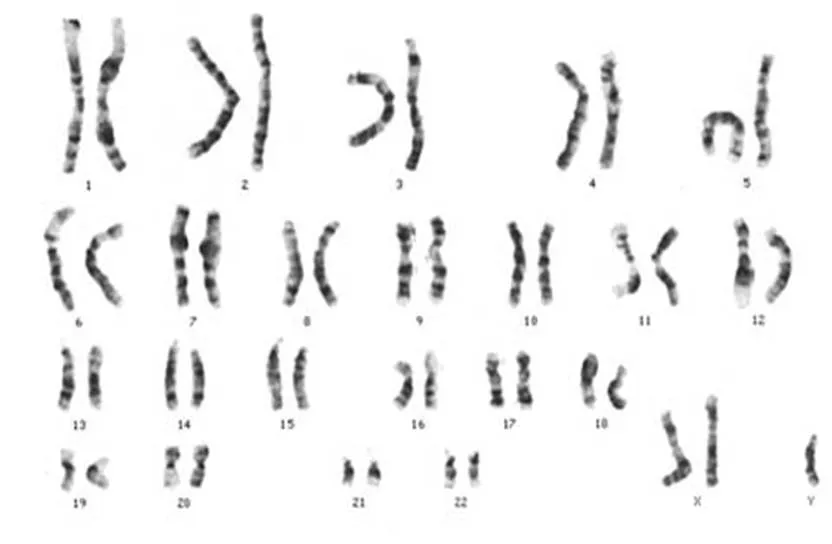
Klinefelter syndrome (KS) is the commonest sex chromosome disorder in males and the commonest genetic cause of primary hypogonadism and non-obstructive azoospermia. About 80–90% have a 47,XXY karyotype; the rest have mosaicism (46,XY/47,XXY) or higher-grade aneuploidy such as 48,XXXY. It affects roughly 1 in 600 newborn boys, yet most are never diagnosed or are found only at a fertility clinic. The extra X chromosome causes progressive hyalinisation of the seminiferous tubules and Leydig cell failure from mid-puberty, giving small firm testes (usually under 4 mL), high FSH and LH, low or low-normal testosterone, gynaecomastia, sparse body hair and tall stature with long legs. Language and learning difficulties, type 2 diabetes, osteoporosis, venous thromboembolism, breast cancer and mediastinal germ cell tumours are more common. A karyotype confirms the diagnosis. Care is lifelong: testosterone when hypogonadism develops, fertility counselling before testosterone (micro-TESE with ICSI finds sperm in about half), educational support and metabolic and bone screening.
Patient case, mechanism, investigations, management, flashcards and exam-style questions.Open the lesson →
Key facts
- 47,XXY in about 80–90%; mosaic 46,XY/47,XXY and 48,XXXY or 49,XXXXY variants make up the rest; prevalence about 1 in 600 males
- Most consistent signs: small firm testes (usually 1–4 mL in adults) and azoospermia (over 90% of non-mosaic men)
- Hypergonadotropic hypogonadism: FSH raised (most consistent), LH raised, testosterone low or low-normal, inhibin B undetectable in adults
- The extra X arises from non-disjunction in maternal or paternal meiosis (roughly half each); advanced maternal age is a modest risk factor
- Diagnosis is confirmed by a peripheral blood karyotype; count more cells or test another tissue if mosaicism is suspected
- Puberty usually starts on time; testes then fail to enlarge and shrink, and testosterone falls from mid-adolescence
- Discuss fertility before starting testosterone: exogenous testosterone suppresses spermatogenesis; micro-TESE with ICSI retrieves sperm in about 40–50%
- Excess risks: type 2 diabetes, osteoporosis, venous thromboembolism, breast cancer, extragonadal germ cell tumours and SLE; overall survival is reduced by a few years
Differential diagnosis
| Condition | Clues | Key test |
|---|---|---|
| Kallmann syndrome / congenital hypogonadotropic hypogonadism | Small testes with low or normal LH and FSH; anosmia in Kallmann | LH, FSH; smell test; pituitary MRI |
| Acquired primary testicular failure | Previous mumps orchitis, torsion, chemotherapy or radiotherapy; normal karyotype | History; karyotype 46,XY |
| 46,XX testicular DSD (de la Chapelle) | Phenotype like KS but short to average height; often SRY-positive | Karyotype 46,XX; SRY FISH |
| Y-chromosome microdeletion (AZFa/b/c) | Azoospermia or severe oligozoospermia with normal virilisation | Karyotype 46,XY; Y microdeletion PCR |
| Constitutional delay of growth and puberty | Delayed puberty with family history; testes enlarge later | Bone age delayed; LH rises with time |
| Marfan syndrome | Tall stature with long limbs but normal testes, lens dislocation, aortic root dilatation | Ghent criteria; echocardiography; FBN1 |
| 47,XYY syndrome | Tall boy with normal testes, normal puberty and usually normal fertility | Karyotype |
Exam pearls
Guideline
European Academy of Andrology (EAA) guidelines on Klinefelter syndrome (2020, published in Andrology 2021), with the Endocrine Society testosterone therapy guideline (2018) and EAU Guidelines on Sexual and Reproductive Health (2025)
References
- Zitzmann M, Aksglaede L, Corona G, et al.. European academy of andrology guidelines on Klinefelter Syndrome. Andrology 2021.
- Bhasin S, Brito JP, Cunningham GR, et al.. Testosterone therapy in men with hypogonadism: an Endocrine Society clinical practice guideline. J Clin Endocrinol Metab 2018.
- European Association of Urology. EAU Guidelines on Sexual and Reproductive Health. EAU Guidelines Office, Arnhem 2025.
- Bojesen A, Juul S, Gravholt CH.. Prenatal and postnatal prevalence of Klinefelter syndrome: a national registry study. J Clin Endocrinol Metab 2003.
- Groth KA, Skakkebæk A, Høst C, Gravholt CH, Bojesen A.. Klinefelter syndrome—a clinical update. J Clin Endocrinol Metab 2013.
- Corona G, Pizzocaro A, Lanfranco F, et al.. Sperm recovery and ICSI outcomes in Klinefelter syndrome: a systematic review and meta-analysis. Hum Reprod Update 2017.
Related topics
By Dr Khalid Seidi (B.Sc., M.D.) · MedEd World Clinical Knowledge library. Original teaching content checked against current guidelines (November 2026); confirm the latest local guidance before clinical use. Not a substitute for clinical judgement.