Clinical Knowledge › Internal medicine › Endocrinology › Reproductive endocrinology
Menopause and hormone replacement therapy
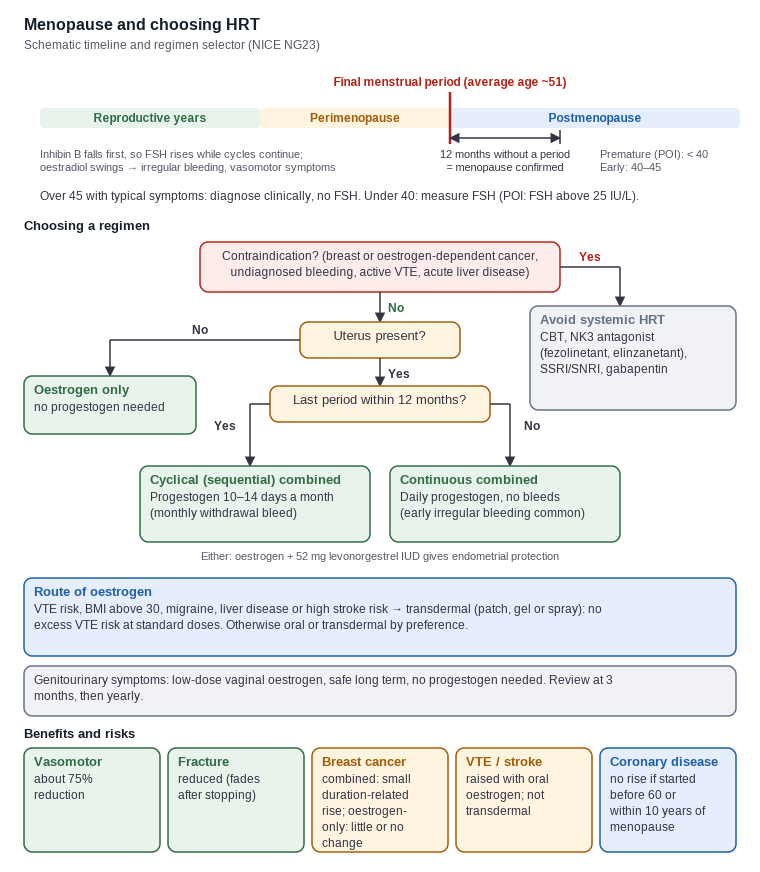
Menopause is the permanent end of menstruation from loss of ovarian follicular activity, diagnosed retrospectively after 12 months of amenorrhoea; the average age is about 51. Low oestradiol causes vasomotor, sleep, mood and genitourinary symptoms and bone loss. In women over 45 with typical symptoms the diagnosis is clinical and FSH is not needed; under 40, menopause is premature ovarian insufficiency and needs FSH confirmation and hormone therapy until about 51. Hormone replacement therapy (HRT) is the most effective treatment for vasomotor symptoms and prevents osteoporotic fracture. Women with a uterus need a progestogen to protect the endometrium. Transdermal oestrogen does not raise the risk of venous thromboembolism, whereas oral oestrogen does. Combined HRT slightly increases breast cancer risk with duration, while oestrogen-only HRT has little or no effect. Started before 60 or within 10 years of menopause, benefits usually outweigh risks. NICE NG23 (2024) added CBT and clearer risk information; NK3 receptor antagonists such as fezolinetant and elinzanetant offer non-hormonal options.
Patient case, mechanism, investigations, management, flashcards and exam-style questions.Open the lesson →
Key facts
- Menopause = 12 months without a period; average age about 51; premature under 40, early 40–45
- Over 45 with typical symptoms: diagnose clinically without FSH; do not use FSH in women on combined hormonal contraception
- Uterus present: oestrogen plus progestogen (cyclical if perimenopausal, continuous combined if over 12 months since last period); no uterus: oestrogen alone
- Transdermal oestradiol carries no excess VTE risk; prefer it with obesity, VTE risk, migraine or liver disease
- Combined HRT: small duration-related rise in breast cancer risk; oestrogen-only: little or no change
- Timing hypothesis: starting before 60 or within 10 years of menopause does not increase coronary disease
- Low-dose vaginal oestrogen for genitourinary symptoms is safe long term and needs no progestogen
- Premature ovarian insufficiency: hormone therapy at least until the average age of menopause to protect bone and heart
Differential diagnosis
| Condition | Clues | Key test |
|---|---|---|
| Hyperthyroidism | Heat intolerance, weight loss, tremor, palpitations | TSH and free T4 |
| Pregnancy | Amenorrhoea in perimenopause | hCG |
| Hyperprolactinaemia | Amenorrhoea with galactorrhoea or drugs | Prolactin |
| Carcinoid syndrome | Flushing with diarrhoea and wheeze | Urinary 5-HIAA |
| Phaeochromocytoma | Episodic sweating, headache and hypertension | Plasma metanephrines |
| Drug-induced flushing | Tamoxifen, aromatase inhibitors, GnRH analogues | Drug history |
| Depression or anxiety disorder | Low mood without vasomotor features | Clinical assessment |
Exam pearls
Guideline
NICE NG23 Menopause: identification and management (updated November 2024) and The Menopause Society 2022 hormone therapy position statement
References
- National Institute for Health and Care Excellence (NICE). Menopause: identification and management (NG23), updated November 2024. NICE guideline NG23 2024.
- The North American Menopause Society (now The Menopause Society). The 2022 hormone therapy position statement of The North American Menopause Society. Menopause 2022.
- Collaborative Group on Hormonal Factors in Breast Cancer. Type and timing of menopausal hormone therapy and breast cancer risk: individual participant meta-analysis of the worldwide epidemiological evidence. Lancet 2019.
- Rossouw JE, Anderson GL, Prentice RL, et al.. Risks and benefits of estrogen plus progestin in healthy postmenopausal women: principal results from the Women's Health Initiative randomized controlled trial. JAMA 2002.
- Manson JE, Aragaki AK, Rossouw JE, et al.. Menopausal hormone therapy and long-term all-cause and cause-specific mortality: the Women's Health Initiative randomized trials. JAMA 2017.
- ESHRE, ASRM, CRE-WHiRL and IMS. Evidence-based guideline: premature ovarian insufficiency (2024 update). Hum Reprod Open 2024.
Related topics
By Dr Khalid Seidi (B.Sc., M.D.) · MedEd World Clinical Knowledge library. Original teaching content checked against current guidelines (November 2026); confirm the latest local guidance before clinical use. Not a substitute for clinical judgement.