Clinical Knowledge › Internal medicine › Endocrinology › Reproductive endocrinology
Turner syndrome
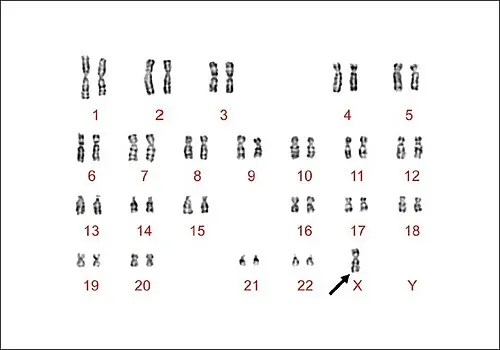
Turner syndrome (TS) is the partial or complete loss of one X chromosome in a phenotypic female, affecting about 1 in 2000–2500 live-born girls. About 40–50% have 45,X; the rest have mosaicism (45,X/46,XX) or a structurally abnormal X such as an isochromosome Xq or ring X. Haploinsufficiency of SHOX causes short stature, and accelerated loss of oocytes leads to streak ovaries and primary ovarian insufficiency. Clues include neonatal lymphoedema, webbed neck, low hairline, broad chest and short fourth metacarpals, but many girls present only with short stature or absent puberty. Bicuspid aortic valve, coarctation and progressive aortic dilatation carry a risk of dissection, especially in pregnancy. Hearing loss, renal anomalies, hypothyroidism, coeliac disease, diabetes and raised liver enzymes are common. A 30-cell karyotype confirms the diagnosis. Management follows the 2024 international guideline: early growth hormone, oestrogen to induce puberty at 11–12 years and replace it in adult life, cardiac imaging, fertility counselling and lifelong multidisciplinary surveillance.
Patient case, mechanism, investigations, management, flashcards and exam-style questions.Open the lesson →
Key facts
- 45,X in about 40–50%; mosaic 45,X/46,XX, isochromosome Xq, ring X and other structural X anomalies make up the rest
- Short stature is the most common feature (over 95%); untreated adults are about 20 cm shorter than their target height
- Primary ovarian insufficiency from streak gonads: high FSH and LH, low oestradiol; about a third start puberty spontaneously, mostly with mosaicism
- Bicuspid aortic valve (about 15–30%) and coarctation (about 10%); aortic diameters must be indexed to body size because women are short
- Aortic dissection occurs at younger ages and at smaller absolute diameters than in the general population; pregnancy increases the risk
- Diagnose with a 30-cell peripheral blood karyotype; look for Y material when a marker chromosome or virilisation is present (gonadoblastoma risk: gonadectomy)
- Treat with growth hormone from early childhood when growth fails, and induce puberty with low-dose transdermal oestradiol from about 11–12 years
- Lifelong screening: blood pressure, echocardiography or cardiac MRI, hearing, TSH, coeliac serology, liver enzymes, HbA1c, lipids and bone density
Differential diagnosis
| Condition | Clues | Key test |
|---|---|---|
| Noonan syndrome | Webbed neck and short stature in either sex; pulmonary valve stenosis; normal ovarian function | Normal karyotype; PTPN11 and RAS-pathway gene panel |
| Constitutional delay of growth and puberty | Short, late-maturing child with family history; normal FSH | Delayed bone age; low (prepubertal) FSH and LH |
| Growth hormone deficiency | Short stature with slow growth velocity, normal ovaries | IGF-1, GH stimulation tests, pituitary MRI |
| SHOX deficiency (Léri–Weill dyschondrosteosis) | Short stature with Madelung deformity and normal puberty | SHOX gene analysis; normal karyotype |
| Coeliac disease or hypothyroidism | Growth failure and delayed puberty; may coexist with TS | tTG-IgA with total IgA; TSH and free T4 |
| 46,XY complete gonadal dysgenesis (Swyer syndrome) | Absent puberty with streak gonads but normal or tall stature | Karyotype 46,XY; gonadectomy for tumour risk |
| Other primary ovarian insufficiency | Secondary amenorrhoea with high FSH and normal stature | Karyotype, FMR1 premutation, adrenal and thyroid antibodies |
Exam pearls
Guideline
Clinical practice guidelines for the care of girls and women with Turner syndrome (International Turner Syndrome Consensus Group, 2024; Eur J Endocrinol), updating the 2016 Cincinnati guideline (2017)
References
- Gravholt CH, Andersen NH, Christin-Maitre S, et al.. Clinical practice guidelines for the care of girls and women with Turner syndrome. Eur J Endocrinol 2024.
- Gravholt CH, Andersen NH, Conway GS, et al.. Clinical practice guidelines for the care of girls and women with Turner syndrome: proceedings from the 2016 Cincinnati International Turner Syndrome Meeting. Eur J Endocrinol 2017.
- Gravholt CH, Viuff MH, Brun S, Stochholm K, Andersen NH.. Turner syndrome: mechanisms and management. Nat Rev Endocrinol 2019.
- Stochholm K, Juul S, Juel K, Naeraa RW, Gravholt CH.. Prevalence, incidence, diagnostic delay, and mortality in Turner syndrome. J Clin Endocrinol Metab 2006.
- Bondy CA.. Care of girls and women with Turner syndrome: a guideline of the Turner Syndrome Study Group. J Clin Endocrinol Metab 2007.
- Panay N, Anderson RA, Bennie A, et al.. Evidence-based guideline: premature ovarian insufficiency. Hum Reprod Open 2024.
Related topics
By Dr Khalid Seidi (B.Sc., M.D.) · MedEd World Clinical Knowledge library. Original teaching content checked against current guidelines (November 2026); confirm the latest local guidance before clinical use. Not a substitute for clinical judgement.