Clinical Knowledge › Surgery › Fractures and orthopaedic trauma
Knee ligament and meniscal injuries
Twisting and contact injuries of the knee damage the cruciate and collateral ligaments, the menisci and the patellar stabilisers. A non-contact pivot with a 'pop' and a haemarthrosis within a few hours is an anterior cruciate ligament (ACL) tear until proven otherwise; the Lachman test is the most sensitive examination and MRI confirms the diagnosis. The Ottawa knee rule identifies who needs an X-ray to exclude fracture. Medial collateral ligament injuries usually heal in a brace; posterolateral corner and multiligament injuries need surgery, and a knee dislocation threatens the popliteal artery and common peroneal nerve. Treatment of an ACL tear is shared decision-making: structured rehabilitation with optional later reconstruction suits many patients, while reconstruction is offered for persistent instability, pivoting sport or associated repairable injuries. Traumatic meniscal tears in young people cause joint line pain, swelling and locking; a locked knee needs urgent arthroscopy, and peripheral tears should be repaired. Degenerative meniscal tears in middle age are managed with exercise therapy rather than arthroscopy.
Patient case, mechanism, investigations, management, flashcards and exam-style questions.Open the lesson →
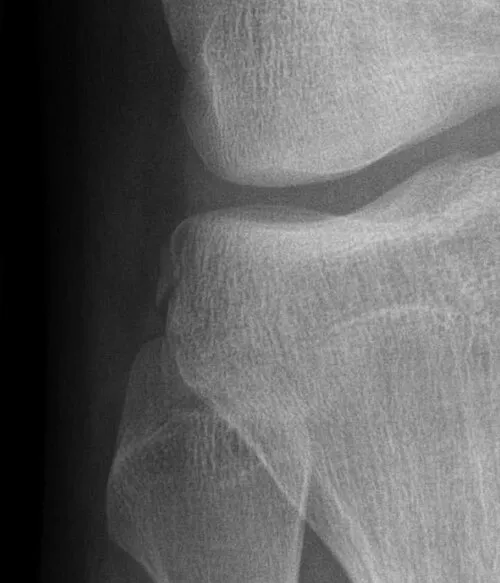
Key facts
- Haemarthrosis within a few hours of a twisting injury: ACL tear in most adults; also osteochondral fracture or patellar dislocation
- Ottawa knee rule: X-ray if age 55 or more, isolated patellar tenderness, fibular head tenderness, cannot flex to 90°, or cannot bear weight for 4 steps
- Lachman test (30° flexion) is the most sensitive clinical test for ACL rupture; the pivot shift is the most specific
- Segond fracture (lateral tibial capsular avulsion) is a strong marker of ACL rupture
- Dashboard injury with posterior tibial sag = PCL tear; most isolated PCL tears are treated non-operatively
- A truly locked knee (cannot fully extend) suggests a displaced bucket-handle meniscal tear: urgent MRI and arthroscopy for repair
- Degenerative meniscal tears (usually over 35–40 years) should not have arthroscopy as first-line treatment
- Knee dislocation: check pulses and ankle–brachial pressure index; popliteal artery injury needs urgent vascular repair
Differential diagnosis
| Condition | Clues | Key test |
|---|---|---|
| ACL tear | Non-contact pivot, pop, rapid haemarthrosis, giving way | Lachman; MRI |
| Meniscal tear | Twisting with delayed swelling, joint line pain, locking or catching | McMurray or Thessaly; MRI |
| Patellar dislocation | Young woman, twisting, patella displaced laterally, apprehension | X-ray for osteochondral fragment; MRI |
| Tibial plateau fracture | Older patient or high energy, valgus load, cannot bear weight | X-ray; CT |
| Extensor mechanism rupture | Cannot straight-leg raise, palpable gap above or below patella | Clinical; ultrasound |
| Septic arthritis or crystal arthritis | Hot swollen knee without major trauma, fever | Joint aspiration |
| Knee dislocation | High energy or obese patient with minor fall, gross instability | ABPI; CT angiography; MRI |
Exam pearls
Guideline
ESSKA meniscus consensus (2016, published 2017), BMJ Rapid Recommendation on knee arthroscopy (2017), NICE NG226 Osteoarthritis (2022) and Ottawa knee rule
References
- Stiell IG, Greenberg GH, Wells GA, et al.. Prospective validation of a decision rule for the use of radiography in acute knee injuries. JAMA 1996.
- Frobell RB, Roos EM, Roos HP, Ranstam J, Lohmander LS. A randomized trial of treatment for acute anterior cruciate ligament tears. N Engl J Med 2010.
- Beard DJ, Davies L, Cook JA, et al.. Comparison of surgical or non-surgical management for non-acute anterior cruciate ligament injury: the ACL SNNAP RCT. Health Technol Assess 2024.
- Sihvonen R, Paavola M, Malmivaara A, et al.. Arthroscopic partial meniscectomy versus sham surgery for a degenerative meniscal tear. N Engl J Med 2013.
- Beaufils P, Becker R, Kopf S, et al.. Surgical management of degenerative meniscus lesions: the 2016 ESSKA meniscus consensus. Knee Surg Sports Traumatol Arthrosc 2017.
- Siemieniuk RAC, Harris IA, Agoritsas T, et al.. Arthroscopic surgery for degenerative knee arthritis and meniscal tears: a clinical practice guideline. BMJ 2017.
Related topics
By Dr Khalid Seidi (B.Sc., M.D.) · MedEd World Clinical Knowledge library. Original teaching content checked against current guidelines (November 2026); confirm the latest local guidance before clinical use. Not a substitute for clinical judgement.