Clinical Knowledge › Internal medicine › Endocrinology › Thyroid disorders
Medullary and anaplastic thyroid cancer
Medullary and anaplastic carcinomas are the two thyroid cancers that do not behave like papillary or follicular disease and do not respond to radioiodine or TSH suppression. Medullary thyroid carcinoma (MTC) arises from calcitonin-secreting parafollicular C cells and makes up a few per cent of thyroid cancers. About a quarter are hereditary, caused by germline RET mutations in MEN2A or MEN2B, so every patient needs RET testing, and phaeochromocytoma must be excluded before surgery. Calcitonin and CEA are diagnostic and follow-up markers, and their doubling time predicts outcome. Treatment is total thyroidectomy with central neck dissection; RET carriers have prophylactic thyroidectomy timed by mutation risk; advanced disease is now treated first with the selective RET inhibitor selpercatinib, which outperformed cabozantinib and vandetanib in LIBRETTO-531. Anaplastic thyroid carcinoma (ATC) is a rare, undifferentiated cancer of older adults that presents as a rapidly growing, hard neck mass with airway compression and is always stage IV. Rapid tissue diagnosis, BRAF V600E testing, airway assessment and early multidisciplinary and palliative input are essential; BRAF-mutant ATC responds to dabrafenib plus trametinib, sometimes enabling surgery.
Patient case, mechanism, investigations, management, flashcards and exam-style questions.Open the lesson →
Key facts
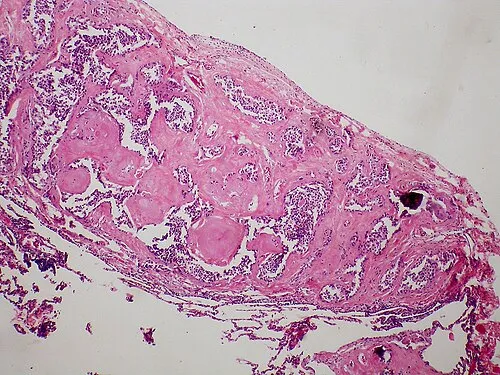
- MTC arises from parafollicular C cells; it secretes calcitonin and CEA and has amyloid stroma (Congo red positive)
- About 25% of MTC is hereditary (germline RET: MEN2A, MEN2B); every patient with MTC needs germline RET testing
- Before MTC surgery: exclude phaeochromocytoma (plasma or urine metanephrines) and check calcium and PTH
- MTC treatment: total thyroidectomy with central (level VI) neck dissection; radioiodine and TSH suppression are ineffective
- Prophylactic thyroidectomy in RET carriers: within the first year for MEN2B (M918T); by about age 5 for codon 634 mutations, guided by calcitonin
- Advanced RET-mutant MTC: selpercatinib improved progression-free survival over cabozantinib or vandetanib (LIBRETTO-531, 2023)
- ATC: older patient, rapidly enlarging hard neck mass, dysphagia, stridor; always stage IV; median survival historically about 5–6 months
- ATC needs urgent biopsy with rapid BRAF V600E testing; BRAF-mutant disease is treated with dabrafenib plus trametinib, with early palliative care
Differential diagnosis
| Condition | Clues | Key test |
|---|---|---|
| Papillary thyroid carcinoma | Slowly growing nodule, nodal spread, normal calcitonin | FNA cytology (nuclear grooves, pseudoinclusions) |
| Thyroid lymphoma | Rapidly enlarging goitre in an older woman with Hashimoto thyroiditis | Core biopsy with flow cytometry and immunohistochemistry |
| Poorly differentiated thyroid carcinoma | Aggressive but less rapid than ATC; partial differentiation | Histology |
| Haemorrhage into a nodule | Sudden painful swelling that settles | Ultrasound showing cystic change |
| Riedel thyroiditis | Woody hard fixed gland, slow progression, IgG4-related features | Open biopsy |
| Metastasis to the thyroid (renal, lung, breast, melanoma) | Known primary cancer | Biopsy with immunohistochemistry |
| Laryngeal or oesophageal squamous carcinoma invading the neck | Smoker, hoarseness or dysphagia first | Endoscopy and biopsy |
Exam pearls
Guideline
Revised ATA Guidelines for the Management of Medullary Thyroid Carcinoma (2015) and ATA Guidelines for Management of Patients with Anaplastic Thyroid Cancer (2021), with NCCN Thyroid Carcinoma guidelines (updated annually, 2026) and the WHO 2022 classification
References
- Wells SA Jr, Asa SL, Dralle H, et al.. Revised American Thyroid Association guidelines for the management of medullary thyroid carcinoma. Thyroid 2015.
- Bible KC, Kebebew E, Brierley J, et al.. 2021 American Thyroid Association Guidelines for Management of Patients with Anaplastic Thyroid Cancer. Thyroid 2021.
- Hadoux J, Elisei R, Brose MS, et al.. Phase 3 trial of selpercatinib in advanced RET-mutant medullary thyroid cancer. N Engl J Med 2023.
- Wells SA Jr, Robinson BG, Gagel RF, et al.. Vandetanib in patients with locally advanced or metastatic medullary thyroid cancer: a randomized, double-blind phase III trial. J Clin Oncol 2012.
- Elisei R, Schlumberger MJ, Müller SP, et al.. Cabozantinib in progressive medullary thyroid cancer. J Clin Oncol 2013.
- Subbiah V, Kreitman RJ, Wainberg ZA, et al.. Dabrafenib and trametinib treatment in patients with locally advanced or metastatic BRAF V600-mutant anaplastic thyroid cancer. J Clin Oncol 2018.
Related topics
By Dr Khalid Seidi (B.Sc., M.D.) · MedEd World Clinical Knowledge library. Original teaching content checked against current guidelines (November 2026); confirm the latest local guidance before clinical use. Not a substitute for clinical judgement.