Clinical Knowledge › Paediatrics › Clinical problems
Neonatal jaundice: approach to the patient
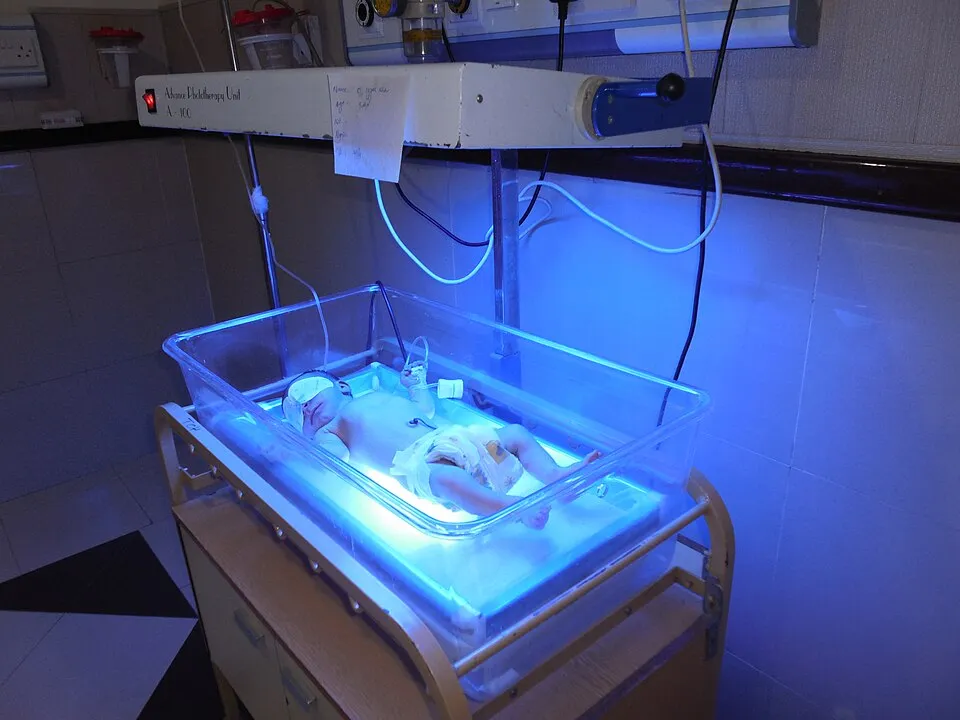
Jaundice is visible in about 60% of term and 80% of preterm babies in the first week. Most is physiological: high red-cell mass, short red-cell lifespan, immature conjugation and enterohepatic recirculation. The approach separates the benign majority from babies at risk of kernicterus or with serious underlying disease. Red flags are jaundice in the first 24 hours (haemolysis or sepsis until proved otherwise), a rapidly rising bilirubin, an unwell baby, and prolonged jaundice (over 14 days at term, 21 days preterm) with a raised conjugated fraction, pale stools or dark urine, which suggests biliary atresia. Visual assessment is unreliable, especially on darker skin, so bilirubin is measured (transcutaneously from 24 hours and 35 weeks, otherwise in serum) and plotted on gestation-specific treatment charts (NICE CG98, AAP 2022). Phototherapy converts bilirubin to excretable isomers; exchange transfusion is reserved for very high or rising levels or signs of bilirubin encephalopathy.
Patient case, mechanism, investigations, management, flashcards and exam-style questions.Open the lesson →
Key facts
- Physiological jaundice: appears after 24 hours, peaks day 3–5 at term, unconjugated, baby well, resolves by about 2 weeks
- Jaundice in the first 24 hours is pathological: measure serum bilirubin within 2 hours and look for haemolysis (Rh, ABO, G6PD deficiency, spherocytosis) or sepsis
- Prolonged jaundice: beyond 14 days in term or 21 days in preterm babies; check conjugated bilirubin, stool colour and urine
- Conjugated bilirubin above 25 µmol/L (or above about 20% of total) is never physiological: urgent referral to exclude biliary atresia; Kasai portoenterostomy is best before about 45–60 days
- NICE CG98: do not rely on visual inspection; use a transcutaneous bilirubinometer in babies of 35 weeks or more and over 24 hours old; serum bilirubin under 24 hours, under 35 weeks, or when TcB is 250 µmol/L or more
- Treatment thresholds depend on gestation and age in hours; for babies under 38 weeks after 72 hours: phototherapy threshold ≈ (gestation × 10) − 100 µmol/L, exchange ≈ gestation × 10
- Phototherapy (blue light, about 460 nm) converts bilirubin to water-soluble photoisomers and lumirubin excreted without conjugation
- Kernicterus: acute encephalopathy (lethargy, hypotonia, poor suck, then hypertonia, retrocollis, opisthotonus, high-pitched cry) → choreoathetoid cerebral palsy, sensorineural deafness, upward gaze palsy
Differential diagnosis
| Condition | Clues | Key test |
|---|---|---|
| Physiological jaundice | After 24 hours, peak day 3–5, well baby, unconjugated | Bilirubin below treatment threshold |
| Haemolytic disease (Rh or ABO isoimmunisation) | Jaundice under 24 hours, rapid rise, anaemia, mother group O or RhD negative | Blood groups, direct antiglobulin test, FBC, reticulocytes |
| G6PD deficiency | Male, Mediterranean, African, Middle Eastern or Asian ancestry, family history, oxidant trigger | G6PD assay (may be falsely normal during haemolysis) |
| Neonatal sepsis or urinary tract infection | Unwell, poor feeding, temperature instability; jaundice may be early or late | Blood culture, CRP, urine culture, LP as indicated |
| Breastfeeding-associated (suboptimal intake) jaundice | Weight loss over 10%, few wet nappies, first week | Weight, feeding assessment, sodium |
| Breast milk jaundice | Thriving breastfed baby, unconjugated jaundice for 2–12 weeks | Diagnosis of exclusion; normal conjugated bilirubin |
| Biliary atresia | Prolonged jaundice, pale stools, dark urine, hepatomegaly, conjugated bilirubin raised | Conjugated bilirubin, LFT, ultrasound, HIDA scan, liver biopsy |
| Congenital hypothyroidism | Prolonged jaundice, hypotonia, constipation, large tongue, umbilical hernia | TSH and free T4 (check newborn bloodspot result) |
Exam pearls
Guideline
NICE CG98 Jaundice in newborn babies under 28 days (2010, updated 2016 and 2023) and AAP Clinical Practice Guideline Revision: management of hyperbilirubinemia in the newborn infant of 35 or more weeks of gestation (2022)
References
- National Institute for Health and Care Excellence. Jaundice in newborn babies under 28 days (CG98). NICE clinical guideline 2010.
- Kemper AR, Newman TB, Slaughter JL, et al.. Clinical practice guideline revision: management of hyperbilirubinemia in the newborn infant 35 or more weeks of gestation. Pediatrics 2022.
- Slaughter JL, Kemper AR, Newman TB. Technical report: diagnosis and management of hyperbilirubinemia in the newborn infant 35 or more weeks of gestation. Pediatrics 2022.
- Bhutani VK, Johnson L, Sivieri EM. Predictive ability of a predischarge hour-specific serum bilirubin for subsequent significant hyperbilirubinemia in healthy term and near-term newborns. Pediatrics 1999.
- Hartley JL, Davenport M, Kelly DA. Biliary atresia. Lancet 2009.
- Gleason CA, Juul SE, eds.. Avery's Diseases of the Newborn. 2018.
Related topics
By Dr Khalid Seidi (B.Sc., M.D.) · MedEd World Clinical Knowledge library. Original teaching content checked against current guidelines (November 2026); confirm the latest local guidance before clinical use. Not a substitute for clinical judgement.