Clinical Knowledge › Internal medicine › Endocrinology › Thyroid disorders
Non-thyroidal illness (sick euthyroid syndrome)
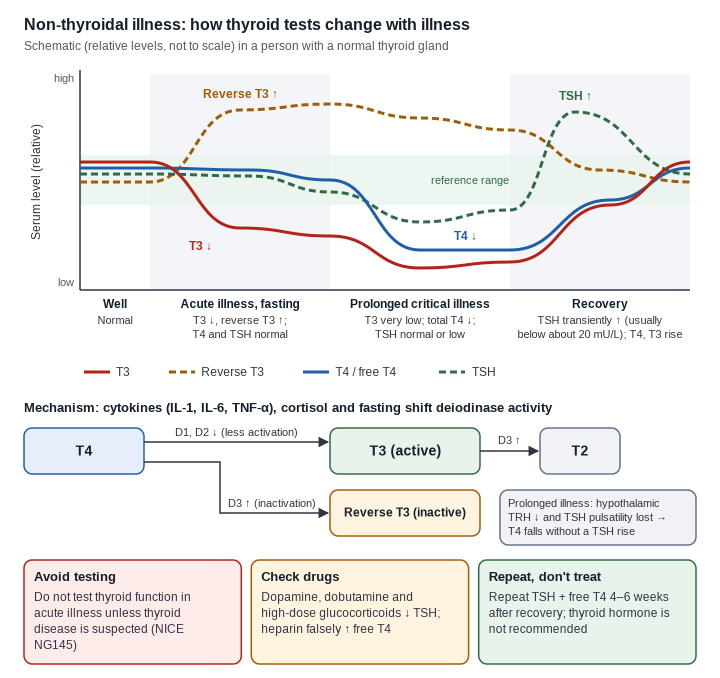
Non-thyroidal illness (NTI), also called sick euthyroid syndrome or low T3 syndrome, describes the abnormal thyroid function tests seen in people with acute or chronic systemic illness, starvation, major surgery or trauma who have no intrinsic thyroid disease. It is very common: a low free or total T3 is found in a large proportion of hospital inpatients and in most patients in intensive care. Cytokines, fasting and stress hormones reduce activating type 1 and type 2 deiodinase activity and increase inactivating type 3 deiodinase, so T3 falls and reverse T3 rises; binding protein changes and central suppression of TRH and TSH follow in prolonged critical illness, when T4 also falls. During recovery TSH may rise transiently, sometimes above the reference range. The pattern is graded, and a very low T4 marks a poor prognosis. The main clinical skill is not to over-interpret: avoid thyroid testing in acute illness unless thyroid disease is genuinely suspected, interpret any result with the illness and drugs (dopamine, glucocorticoids, heparin, amiodarone) in mind, and repeat tests 4–6 weeks after recovery. Thyroid hormone treatment has not improved outcomes and is not recommended.
Patient case, mechanism, investigations, management, flashcards and exam-style questions.Open the lesson →
Key facts
- NTI = abnormal thyroid tests caused by systemic illness, fasting or surgery in a person with a normal thyroid gland
- The earliest and commonest change is low T3 with high reverse T3 and normal TSH (low T3 syndrome)
- Mechanism: less T4→T3 conversion (reduced type 1 and 2 deiodinase) and more T4/T3 inactivation (increased type 3 deiodinase), driven by cytokines and fasting
- Prolonged critical illness adds low T4 and inappropriately normal or low TSH from reduced hypothalamic TRH (a 'central' pattern)
- In recovery TSH can rise transiently (usually below about 20 mU/L) before T4 and T3 normalise, mimicking primary hypothyroidism
- Dopamine, dobutamine and high-dose glucocorticoids suppress TSH; heparin can falsely raise free T4 in vitro
- Do not test thyroid function in acute illness unless thyroid dysfunction is suspected; repeat abnormal results 4–6 weeks after recovery
- Thyroid hormone treatment of NTI is not recommended: trials showed no benefit, and a very low T4 is a marker of poor prognosis rather than a target
Differential diagnosis
| Condition | Clues | Key test |
|---|---|---|
| Primary hypothyroidism | TSH clearly raised (often above 20 mU/L) with low free T4, goitre, positive TPO antibodies or known thyroid disease | Repeat TSH and free T4 after recovery; TPO antibodies |
| Central (secondary) hypothyroidism | Low free T4 with low or normal TSH plus pituitary disease, headache, visual field loss or other hormone deficits | Morning cortisol, prolactin, gonadotrophins, sex steroids; pituitary MRI |
| Thyrotoxicosis in a sick patient | Suppressed TSH with high free T4 and high free T3 (T3 is usually low in NTI), tachycardia, AF | Free T3, TRAb, thyroid uptake scan when stable |
| Drug effect (dopamine, glucocorticoids, octreotide) | Low TSH that recovers when the drug is stopped | Drug history; repeat tests after withdrawal |
| Amiodarone-related change | High free T4, low-normal free T3 and slightly high TSH early in therapy | Drug history; TSH over the following months |
| Assay interference (heparin, biotin, heterophile antibodies) | Results that do not fit the clinical picture or vary between platforms | Sample before heparin, stop biotin, re-test on another platform |
| Myxoedema coma | Hypothermia, bradycardia, hyponatraemia and reduced consciousness with very high TSH and very low free T4 | TSH, free T4, cortisol; urgent endocrinology review |
Exam pearls
Guideline
NICE NG145 Thyroid disease: assessment and management (2019); ATA 2014 hypothyroidism guideline and ATA 2016 hyperthyroidism guideline (no dedicated NTI guideline; practice based on expert reviews, 2015)
References
- Fliers E, Bianco AC, Langouche L, Boelen A.. Thyroid function in critically ill patients. Lancet Diabetes Endocrinol 2015.
- de Vries EM, Fliers E, Boelen A.. The molecular basis of the non-thyroidal illness syndrome. J Endocrinol 2015.
- National Institute for Health and Care Excellence. Thyroid disease: assessment and management (NG145). NICE 2019.
- Jonklaas J, Bianco AC, Bauer AJ, et al.. Guidelines for the treatment of hypothyroidism: prepared by the American Thyroid Association task force on thyroid hormone replacement. Thyroid 2014.
- Ross DS, Burch HB, Cooper DS, et al.. 2016 American Thyroid Association guidelines for diagnosis and management of hyperthyroidism and other causes of thyrotoxicosis. Thyroid 2016.
- Acker CG, Singh AR, Flick RP, et al.. A trial of thyroxine in acute renal failure. Kidney Int 2000.
Related topics
By Dr Khalid Seidi (B.Sc., M.D.) · MedEd World Clinical Knowledge library. Original teaching content checked against current guidelines (November 2026); confirm the latest local guidance before clinical use. Not a substitute for clinical judgement.