Clinical Knowledge › Obstetrics and gynaecology › Labour and delivery
Perineal tears and episiotomy
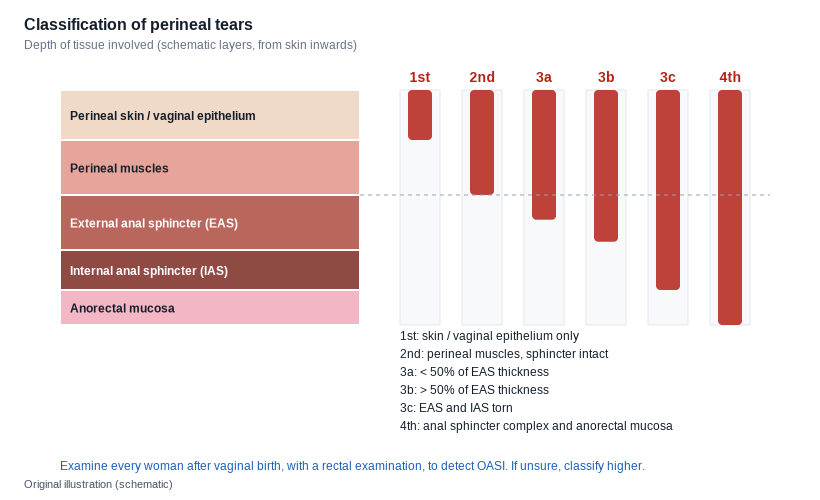
Perineal trauma affects most women after a vaginal birth, either as a spontaneous tear or as an episiotomy (a planned incision of the perineum to enlarge the vaginal outlet). Tears are classified by depth: first degree (skin or vaginal mucosa), second degree (perineal muscles), third degree (anal sphincter complex: 3a less than 50% of the external anal sphincter, 3b more than 50%, 3c external and internal sphincter) and fourth degree (sphincter complex and anorectal mucosa). Obstetric anal sphincter injury (OASI) occurs in about 3% of vaginal births and up to 6% of first births; risk factors include nulliparity, birthweight above 4 kg, occipitoposterior position, a prolonged second stage, shoulder dystocia and instrumental birth, especially forceps without episiotomy. Every woman with perineal trauma needs a rectal examination before repair. Second-degree tears are repaired with continuous rapidly absorbable sutures; OASI is repaired in theatre by a trained clinician, followed by antibiotics, laxatives, physiotherapy and specialist follow-up because anal incontinence and dyspareunia can follow. Episiotomy should be mediolateral, at about 60° from the midline at crowning, and used for a clinical indication, not routinely. The OASI care bundle reduces severe tears.
Patient case, mechanism, investigations, management, flashcards and exam-style questions.Open the lesson →
Key facts
- First degree: perineal skin and/or vaginal mucosa; second degree: perineal muscles, sphincter intact
- Third degree: 3a less than 50% of external anal sphincter (EAS) thickness torn; 3b more than 50% of EAS; 3c both EAS and internal anal sphincter (IAS)
- Fourth degree: anal sphincter complex plus anorectal mucosa; an isolated rectal buttonhole tear with intact sphincters is not fourth degree
- OASI incidence about 3% of vaginal births, up to about 6% in nulliparous women; a rectal examination is needed after every vaginal birth with perineal trauma
- Risk factors for OASI: nulliparity, birthweight above 4 kg, occipitoposterior position, prolonged second stage, shoulder dystocia, forceps (especially without episiotomy), midline episiotomy, South or East Asian ethnicity
- Mediolateral episiotomy is cut from the fourchette at about 60° from the midline when the perineum is distended at crowning; midline episiotomy carries a higher OASI risk
- Second-degree repair: continuous non-locking rapidly absorbable polyglactin suture for vagina, muscle and skin (skin may be left unsutured if well opposed)
- After OASI repair: broad-spectrum antibiotics, laxatives, avoid constipating analgesics, physiotherapy and review at 6–12 weeks; endoanal ultrasound and manometry guide advice for the next birth
Differential diagnosis
| Condition | Clues | Key test |
|---|---|---|
| Vulval or paravaginal haematoma | Severe pain, swelling, tense purple mass after birth, sometimes shock | Examination; ultrasound; evacuation if large or expanding |
| Rectal buttonhole tear | Rectal mucosal tear with intact anal sphincters | Rectal examination with pill-rolling of the sphincter |
| Labial or periurethral tears | Bleeding near the clitoris or urethra, perineum intact | Inspection; catheter if repair near urethra |
| Cervical or high vaginal laceration | Brisk bleeding with a well-contracted uterus | Speculum examination with good light; repair in theatre |
| Perineal wound infection or breakdown | Pain, discharge and gaping days after birth | Swab, review of wound; antibiotics |
| Occult OASI | Sphincter defect not recognised at birth; later anal incontinence | Endoanal ultrasound |
Exam pearls
Guideline
RCOG Green-top Guideline No. 29 The management of third- and fourth-degree perineal tears (2015); NICE NG235 Intrapartum care (2023); NICE NG194 Postnatal care (2021); RCOG/RCM OASI Care Bundle (2017–2021); ACOG Practice Bulletin No. 198 Prevention and management of obstetric lacerations at vaginal delivery (2018, reaffirmed); WHO intrapartum care recommendations (2018)
References
- Royal College of Obstetricians and Gynaecologists. The management of third- and fourth-degree perineal tears (Green-top Guideline No. 29). RCOG, London 2015.
- National Institute for Health and Care Excellence. Intrapartum care (NG235). NICE guideline NG235 2023.
- National Institute for Health and Care Excellence. Postnatal care (NG194). NICE guideline NG194 2021.
- Sultan AH, Kamm MA, Hudson CN, Thomas JM, Bartram CI.. Anal-sphincter disruption during vaginal delivery. N Engl J Med 1993.
- Sultan AH, Thakar R.. Lower genital tract and anal sphincter trauma. Best Pract Res Clin Obstet Gynaecol 2002.
- Gurol-Urganci I, Bidwell P, Sevdalis N, et al.. Impact of a quality improvement project to reduce the rate of obstetric anal sphincter injury: a multicentre study with a stepped-wedge design. BJOG 2021.
Related topics
By Dr Khalid Seidi (B.Sc., M.D.) · MedEd World Clinical Knowledge library. Original teaching content checked against current guidelines (November 2026); confirm the latest local guidance before clinical use. Not a substitute for clinical judgement.