Clinical Knowledge › Obstetrics and gynaecology › Complications of later pregnancy
Unstable lie and malpresentation
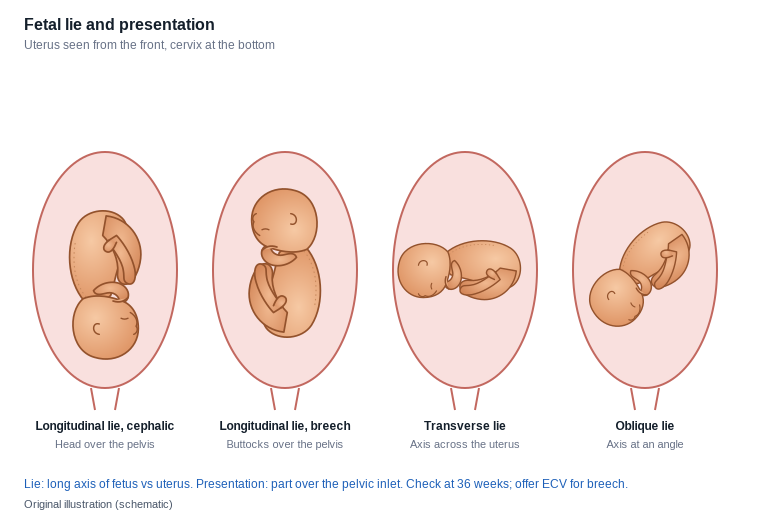
Lie describes how the long axis of the fetus relates to the long axis of the uterus (longitudinal, transverse or oblique); presentation is the part of the fetus over the pelvic inlet. Malpresentation is any presentation other than a well-flexed vertex: breech, face, brow, shoulder (transverse lie) or compound. Unstable lie is a lie that keeps changing after about 36–37 weeks. Causes are things that give the fetus too much room or block the pelvis: multiparity with a lax uterus, polyhydramnios, placenta praevia, fibroids, uterine anomalies, multiple pregnancy, prematurity and fetal anomalies. The main dangers are cord prolapse when the membranes rupture, and obstructed labour with uterine rupture if a transverse lie is neglected in labour. Ultrasound confirms the lie and looks for a cause. Options include waiting (most unstable lies stabilise), external cephalic version, admission near term, a controlled 'stabilising' induction, or caesarean birth. In labour, mentoanterior face can deliver vaginally, but persistent mentoposterior face, persistent brow and shoulder presentation need caesarean birth.
Patient case, mechanism, investigations, management, flashcards and exam-style questions.Open the lesson →
Key facts
- Lie = fetal long axis versus uterine long axis; presentation = fetal part over the pelvic inlet; attitude = flexion; position = denominator relative to the maternal pelvis
- Unstable lie = lie that changes repeatedly after 36–37 weeks; most become longitudinal before labour
- Causes: multiparity, polyhydramnios, placenta praevia, fibroids, uterine anomaly, multiple pregnancy, contracted pelvis, prematurity, fetal anomaly
- Main antenatal risk: cord prolapse at membrane rupture; main intrapartum risk: obstructed labour, arm prolapse and uterine rupture with a neglected transverse lie
- Presenting diameters: vertex (flexed) suboccipitobregmatic 9.5 cm; deflexed occipitofrontal 11.5 cm; brow mentovertical 13–13.5 cm; face submentobregmatic 9.5 cm
- Face: denominator mentum; mentoanterior can deliver vaginally; persistent mentoposterior cannot – caesarean
- Persistent brow and shoulder presentation in established labour: caesarean birth
- Cord prolapse: call for help, elevate the presenting part (manually or by bladder filling), knee-chest or left lateral head-down, tocolysis if delay, category 1 birth
Differential diagnosis
| Condition | Clues | Key test |
|---|---|---|
| Breech presentation | Head in the fundus, longitudinal lie | Ultrasound |
| Placenta praevia | High presenting part with painless bleeding | Ultrasound for placental site (avoid digital examination) |
| Polyhydramnios | Large-for-dates, tense uterus, fetal parts hard to feel | Ultrasound deepest pool above 8 cm or AFI above 24 cm |
| Multiple pregnancy | Large-for-dates, many fetal parts | Ultrasound |
| Occipitoposterior position | Deflexed head, backache, slow labour | Vaginal examination and ultrasound in labour |
| Pelvic mass (fibroid, ovarian cyst) | Presenting part kept out of the pelvis | Ultrasound or MRI |
Exam pearls
Guideline
RCOG Green-top Guideline No. 50 Umbilical cord prolapse (2014); RCOG Green-top Guidelines No. 20a/20b on ECV and breech (2017); NICE NG201 Antenatal care (2021), NG235 Intrapartum care (2023) and NG192 Caesarean birth (2021); WHO Managing complications in pregnancy and childbirth (2nd edition, 2017)
References
- Royal College of Obstetricians and Gynaecologists. Umbilical cord prolapse: Green-top Guideline No. 50. RCOG, London 2014.
- Impey LWM, Murphy DJ, Griffiths M, Penna LK; RCOG. External cephalic version and reducing the incidence of term breech presentation: Green-top Guideline No. 20a. BJOG 2017.
- National Institute for Health and Care Excellence. Antenatal care (NG201). NICE guideline NG201 2021.
- National Institute for Health and Care Excellence. Intrapartum care (NG235). NICE guideline NG235 2023.
- National Institute for Health and Care Excellence. Caesarean birth (NG192). NICE guideline NG192 2021.
- World Health Organization. Managing complications in pregnancy and childbirth: a guide for midwives and doctors. World Health Organization, Geneva 2017.
Related topics
By Dr Khalid Seidi (B.Sc., M.D.) · MedEd World Clinical Knowledge library. Original teaching content checked against current guidelines (November 2026); confirm the latest local guidance before clinical use. Not a substitute for clinical judgement.