Clinical Knowledge › Obstetrics and gynaecology › Labour and delivery
Uterine rupture
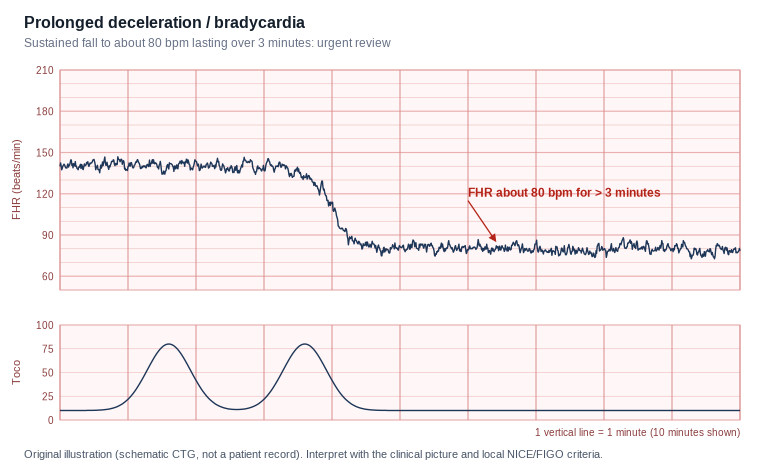
Uterine rupture is a full-thickness tear of the uterine wall, including the serosa, during pregnancy or labour; uterine dehiscence is an incomplete separation, usually of a previous scar, with intact serosa. In high-income countries most ruptures occur in women with a previous caesarean who labour, particularly with induction or oxytocin, two or more previous caesareans or a short birth interval; UK national data estimate 0.2 per 1000 maternities overall and about 2 per 1000 in women planning vaginal birth after caesarean. In low-resource settings rupture of an unscarred uterus from neglected obstructed labour, often in a multiparous woman given oxytocin, remains a major cause of maternal and perinatal death. The most common first sign is an abnormal fetal heart rate pattern (prolonged deceleration or bradycardia); others are constant abdominal pain or scar tenderness, vaginal bleeding, haematuria, cessation of contractions, loss of station, easily palpable fetal parts and maternal shock. Management is resuscitation, the major haemorrhage protocol and a category 1 laparotomy with repair or hysterectomy. Perinatal mortality is high (around 1 in 8 in UK data), and future pregnancies require planned caesarean before labour.
Patient case, mechanism, investigations, management, flashcards and exam-style questions.Open the lesson →
Key facts
- Complete rupture: full-thickness disruption including serosa, often with fetal extrusion and haemoperitoneum; dehiscence: incomplete, serosa intact, usually asymptomatic
- Strongest risk factor: previous caesarean (risk about 0.5% with planned VBAC; higher after classical or T-shaped incisions)
- Other risk factors: induction or oxytocin augmentation with a scar, two or more caesareans, interval under 12 months, previous myomectomy entering the cavity, obstructed labour, grand multiparity, malpresentation, trauma, placenta percreta
- Abnormal CTG (prolonged deceleration or bradycardia) is the most common and often the first sign
- Classic signs: constant pain and scar tenderness, vaginal bleeding, haematuria, loss of contractions, loss of station, palpable fetal parts, shoulder-tip pain, maternal tachycardia and hypotension
- Bandl's pathological retraction ring rising towards the umbilicus is a warning sign of impending rupture in obstructed labour
- Management: ABCDE resuscitation, two large-bore cannulas, crossmatch, major haemorrhage protocol, tranexamic acid 1 g IV (teaching dose; check local protocol) and category 1 laparotomy
- Repair versus hysterectomy depends on the site and extent of the tear, haemodynamic stability, surgical expertise and fertility wishes; future births by planned caesarean before labour
Differential diagnosis
| Condition | Clues | Key test |
|---|---|---|
| Placental abruption | Constant pain, hard 'woody' uterus, bleeding, contractions continue, station unchanged | Clinical; ultrasound unreliable; coagulation |
| Uterine dehiscence | Often silent; found at repeat caesarean | Seen at laparotomy; serosa intact |
| Placenta praevia | Painless bright red bleeding, soft uterus, high presenting part | Placental site on ultrasound (no vaginal examination) |
| Cord prolapse | Sudden bradycardia after membrane rupture without pain or shock | Vaginal examination finds the cord |
| Amniotic fluid embolism | Sudden collapse, hypoxia, coagulopathy, often around birth | Clinical diagnosis of exclusion |
| Intra-abdominal haemorrhage from another source (splenic artery aneurysm, liver rupture in HELLP) | Shock and abdominal pain, sometimes with intact uterus | Ultrasound for free fluid; laparotomy |
Exam pearls
Guideline
RCOG Green-top Guideline No. 45 Birth after previous caesarean birth (2015); RCOG Green-top Guideline No. 52 Prevention and management of postpartum haemorrhage (2016; check for the updated edition); ACOG Practice Bulletin No. 205 Vaginal birth after cesarean delivery (2019); WHO recommendations on intrapartum care (2018)
References
- Royal College of Obstetricians and Gynaecologists. Birth after previous caesarean birth (Green-top Guideline No. 45). RCOG, London 2015.
- Royal College of Obstetricians and Gynaecologists. Prevention and management of postpartum haemorrhage (Green-top Guideline No. 52). BJOG 2016.
- American College of Obstetricians and Gynecologists. Vaginal birth after cesarean delivery (Practice Bulletin No. 205). Obstet Gynecol 2019.
- World Health Organization. WHO recommendations: intrapartum care for a positive childbirth experience. World Health Organization, Geneva 2018.
- Fitzpatrick KE, Kurinczuk JJ, Alfirevic Z, Spark P, Brocklehurst P, Knight M.. Uterine rupture by intended mode of delivery in the UK: a national case-control study. PLoS Med 2012.
- Landon MB, Hauth JC, Leveno KJ, et al.. Maternal and perinatal outcomes associated with a trial of labor after prior cesarean delivery. N Engl J Med 2004.
Related topics
By Dr Khalid Seidi (B.Sc., M.D.) · MedEd World Clinical Knowledge library. Original teaching content checked against current guidelines (November 2026); confirm the latest local guidance before clinical use. Not a substitute for clinical judgement.