Clinical Knowledge › Internal medicine › Haematology and oncology › Bleeding, platelet and thrombotic disorders
Acquired haemophilia
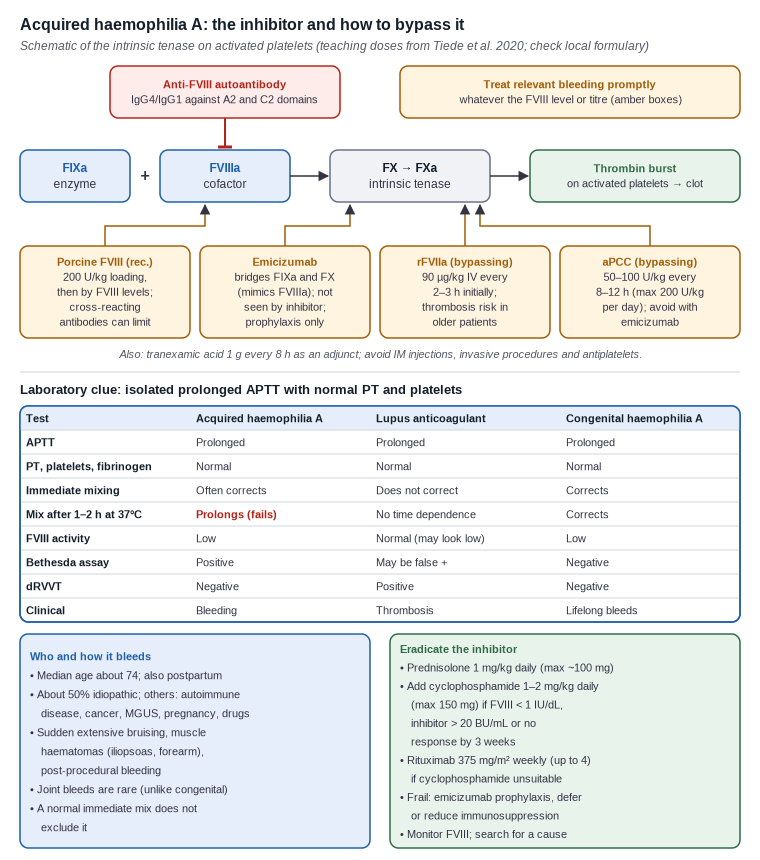
Acquired haemophilia A (AHA) is a rare autoimmune bleeding disorder caused by autoantibodies that neutralise factor VIII in a person with no previous bleeding history. It mainly affects older adults (median age about 74) and women after childbirth; about half of cases are idiopathic and the rest are linked to autoimmune disease, cancer, pregnancy or drugs. Patients present with sudden, often severe bleeding into skin, muscles and soft tissues (extensive bruising, iliopsoas or forearm haematomas, post-procedural bleeding); joint bleeds are uncommon, unlike congenital haemophilia. The key laboratory clue is an isolated prolonged APTT with normal PT and platelets that does not correct in a mixing study after incubation; FVIII is low and an inhibitor is quantified by the Bethesda assay. Management has two arms: stop bleeding with bypassing agents (recombinant FVIIa, aPCC), recombinant porcine FVIII or emicizumab prophylaxis, and eradicate the inhibitor with corticosteroids alone or with cyclophosphamide or rituximab. Mortality reflects bleeding, age and infection.
Patient case, mechanism, investigations, management, flashcards and exam-style questions.Open the lesson →
Key facts
- Autoantibodies (mostly IgG4 and IgG1) against FVIII in a patient with a negative personal and family bleeding history
- Incidence about 1–1.5 per million per year; peaks in older adults and in the postpartum period
- About 50% idiopathic; associations include autoimmune disease, solid and lymphoid cancers, pregnancy, MGUS and some drugs
- Bleeding into skin, muscle and soft tissue predominates; haemarthrosis is rare
- Isolated prolonged APTT, normal PT and platelets; mixing study shows time- and temperature-dependent failure to correct
- Diagnosis confirmed by low FVIII activity and an inhibitor titre on the (Nijmegen-)Bethesda assay
- Haemostasis: rFVIIa, aPCC or recombinant porcine FVIII; emicizumab prophylaxis allows deferral of immunosuppression in frail patients
- Inhibitor eradication: prednisolone ± cyclophosphamide or rituximab; FVIII below 1 IU/dL or inhibitor above 20 BU/mL predicts slower response
Differential diagnosis
| Condition | Clues | Key test |
|---|---|---|
| Congenital haemophilia A | Lifelong bleeding, male, family history, haemarthroses | Mixing study corrects (unless alloantibody inhibitor) |
| Lupus anticoagulant | Prolonged APTT but thrombosis or pregnancy loss, not bleeding | dRVVT positive; FVIII usually normal with dilution |
| Heparin contamination or therapy | Line sample or heparin use; prolonged thrombin time | Thrombin time with heparinase or anti-Xa level |
| Acquired von Willebrand syndrome | Mucosal bleeding with lymphoproliferative disease, aortic stenosis or high platelets | VWF antigen, activity and multimers |
| Disseminated intravascular coagulation | Sepsis or cancer; low platelets and fibrinogen | PT, platelets, fibrinogen, D-dimer |
| Vitamin K deficiency or liver disease | PT prolonged more than APTT | PT/INR correcting with vitamin K |
| Elder abuse or trauma | Patterned bruising, inconsistent history | Normal coagulation tests |
Exam pearls
Guideline
International recommendations on the diagnosis and treatment of acquired haemophilia A (Tiede et al., Haematologica 2020) and GTH-AHA consensus on emicizumab in AHA (Hämostaseologie 2024)
References
- Tiede A, Collins P, Knoebl P, et al.. International recommendations on the diagnosis and treatment of acquired hemophilia A. Haematologica 2020.
- Pfrepper C, Klamroth R, Oldenburg J, et al.. Emicizumab for the treatment of acquired hemophilia A: consensus recommendations from the GTH-AHA Working Group. Hamostaseologie 2024.
- Tiede A, Hart C, Knöbl P, et al.. Emicizumab prophylaxis in patients with acquired haemophilia A (GTH-AHA-EMI): an open-label, single-arm, multicentre, phase 2 study. Lancet Haematol 2023.
- Knoebl P, Marco P, Baudo F, et al.. Demographic and clinical data in acquired hemophilia A: results from the European Acquired Haemophilia Registry (EACH2). J Thromb Haemost 2012.
- Kruse-Jarres R, Kempton CL, Baudo F, et al.. Acquired hemophilia A: updated review of evidence and treatment guidance. Am J Hematol 2017.
- Hoffbrand AV, Higgs DR, Keeling DM, Mehta AB, eds.. Postgraduate Haematology. 2016.
Related topics
By Dr Khalid Seidi (B.Sc., M.D.) · MedEd World Clinical Knowledge library. Original teaching content checked against current guidelines (November 2026); confirm the latest local guidance before clinical use. Not a substitute for clinical judgement.