Clinical Knowledge › Internal medicine › Haematology and oncology › Bleeding, platelet and thrombotic disorders
Vitamin K deficiency and coagulopathy of liver disease
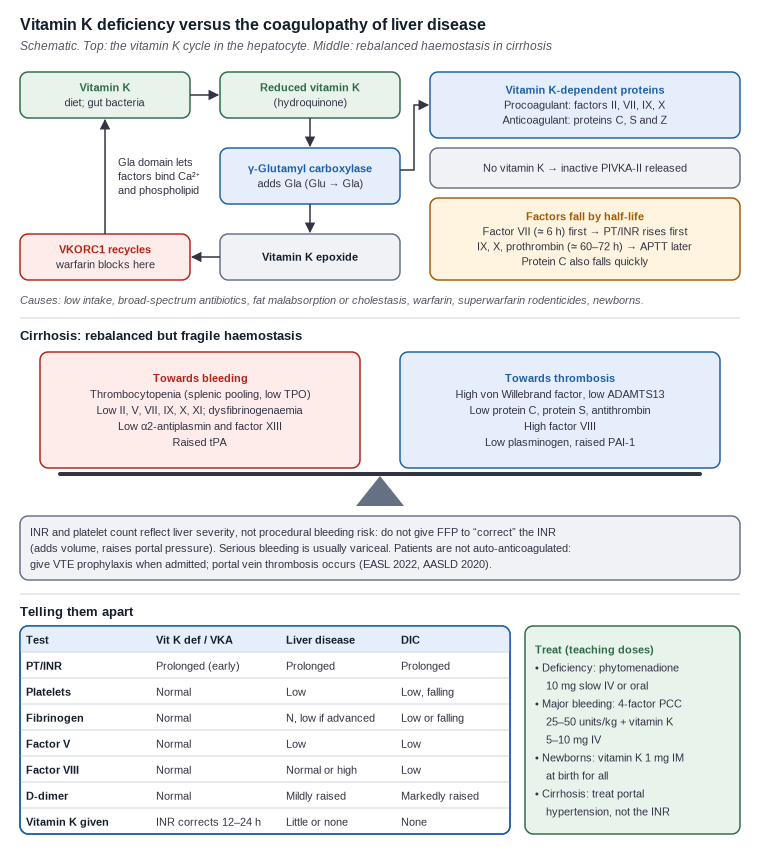
Vitamin K is the cofactor for γ-glutamyl carboxylation of factors II, VII, IX and X and the anticoagulant proteins C, S and Z. Deficiency follows poor intake, broad-spectrum antibiotics, fat malabsorption or cholestasis, vitamin K antagonists and superwarfarin rodenticides, and in newborns causes vitamin K deficiency bleeding. Because factor VII has the shortest half-life, the prothrombin time (PT/INR) rises first, the APTT later; factor V and fibrinogen stay normal, a mixing study corrects, and parenteral vitamin K normalises the INR within about 12–24 hours. Chronic liver disease is different: the liver makes fewer pro- and anticoagulant factors, platelets fall from portal hypertension, while factor VIII and von Willebrand factor rise. The result is a 'rebalanced' but fragile haemostasis: the INR does not predict procedural bleeding and thrombosis still occurs. EASL (2022) and AASLD (2020) guidance advise against correcting the INR with plasma before procedures and treat portal hypertension as the main cause of haemorrhage.
Patient case, mechanism, investigations, management, flashcards and exam-style questions.Open the lesson →
Key facts
- Vitamin K-dependent proteins: factors II, VII, IX, X and proteins C, S and Z – all need γ-carboxylation to bind calcium and phospholipid
- Factor VII has a half-life of about 6 hours, so an isolated prolonged PT/INR is the earliest laboratory sign of vitamin K deficiency or warfarin effect
- Vitamin K deficiency: low II, VII, IX, X with NORMAL factor V and fibrinogen; liver disease: low factor V as well; DIC: low factor VIII and fibrinogen with high D-dimer
- IV phytomenadione corrects the INR in about 6–12 hours, oral in about 24 hours; life-threatening bleeding also needs four-factor prothrombin complex concentrate (PCC)
- Every newborn should receive vitamin K 1 mg IM at birth to prevent early, classical and late vitamin K deficiency bleeding (late VKDB occurs from 2 weeks to 6 months, mostly at 2–12 weeks, often as intracranial haemorrhage)
- Cirrhosis causes 'rebalanced haemostasis': fewer procoagulant factors, but also low protein C, antithrombin and plasminogen with high factor VIII and VWF
- In cirrhosis the INR and platelet count predict procedural bleeding poorly; prophylactic FFP is not recommended and may raise portal pressure
- Patients with cirrhosis are not 'auto-anticoagulated': they still need VTE prophylaxis in hospital and develop portal vein thrombosis
Differential diagnosis
| Condition | Clues | Key test |
|---|---|---|
| Warfarin or other vitamin K antagonist effect | Known prescription, interacting drug (e.g. macrolide, azole, metronidazole) | Medication history; INR; normal factor V |
| Superwarfarin (brodifacoum) poisoning | Unexplained bleeding with very high INR that relapses after short vitamin K | Long-acting anticoagulant rodenticide screen in blood |
| Disseminated intravascular coagulation | Sepsis, trauma, APL or obstetric event; oozing from lines | Low platelets and fibrinogen, very high D-dimer, low factor VIII |
| Acute liver failure | Jaundice, encephalopathy, very high INR without much bleeding | ALT, bilirubin, factor V very low; INR fails to correct with vitamin K |
| Factor VII deficiency (inherited) | Isolated long PT since childhood, family history | Low factor VII only; not corrected by vitamin K |
| Lupus anticoagulant | Prolonged APTT, thrombosis or pregnancy loss, little bleeding | Mixing study fails to correct; dRVVT |
| Direct oral anticoagulant effect | Taking a factor Xa or thrombin inhibitor | Drug-specific anti-Xa level or dilute thrombin time |
Exam pearls
Guideline
EASL Clinical Practice Guidelines on prevention and management of bleeding and thrombosis in cirrhosis (2022), AASLD practice guidance on vascular liver disorders, portal vein thrombosis and procedural bleeding (2020, published 2021), and BSH guidelines on oral anticoagulation with warfarin (4th edition, 2011)
References
- Tripodi A, Mannucci PM.. The coagulopathy of chronic liver disease. N Engl J Med 2011.
- European Association for the Study of the Liver. EASL Clinical Practice Guidelines on prevention and management of bleeding and thrombosis in patients with cirrhosis. J Hepatol 2022.
- Northup PG, Garcia-Pagan JC, Garcia-Tsao G, et al.. Vascular liver disorders, portal vein thrombosis, and procedural bleeding in patients with liver disease: 2020 practice guidance by the American Association for the Study of Liver Diseases. Hepatology 2021.
- Shearer MJ.. Vitamin K deficiency bleeding (VKDB) in early infancy. Blood Rev 2009.
- Keeling D, Baglin T, Tait C, et al.. Guidelines on oral anticoagulation with warfarin – fourth edition. Br J Haematol 2011.
- Hoffbrand AV, Moss PAH.. Hoffbrand's Essential Haematology. Wiley-Blackwell, Oxford (8th edition) 2019.
Related topics
By Dr Khalid Seidi (B.Sc., M.D.) · MedEd World Clinical Knowledge library. Original teaching content checked against current guidelines (November 2026); confirm the latest local guidance before clinical use. Not a substitute for clinical judgement.