Clinical Knowledge › Internal medicine › Haematology and oncology › Bleeding, platelet and thrombotic disorders
Inherited platelet function disorders
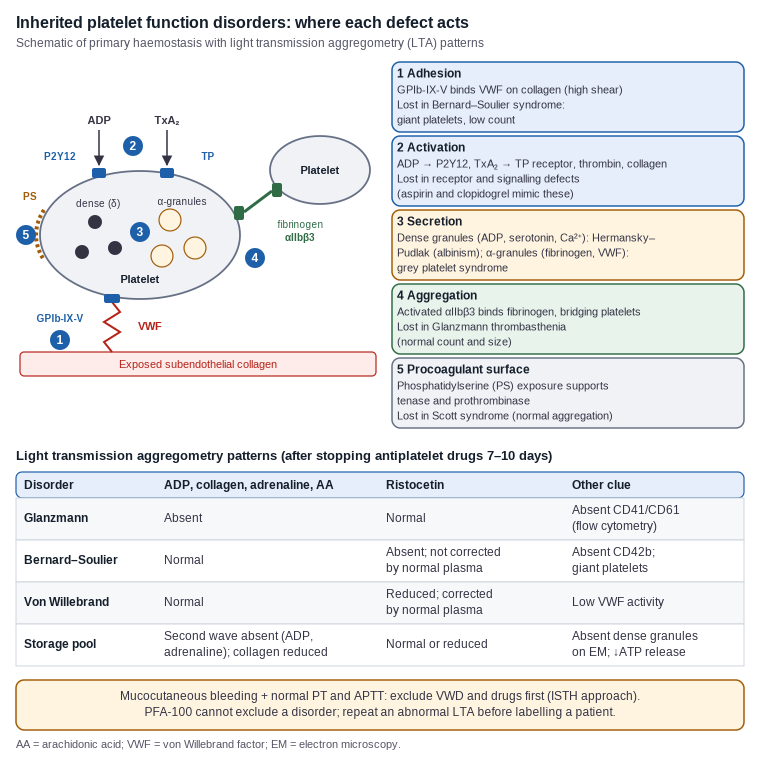
Inherited platelet function disorders are rare genetic defects in platelet adhesion, aggregation, granule secretion, signalling or procoagulant activity. They cause lifelong mucocutaneous bleeding – easy bruising, epistaxis, gum bleeding, heavy menstrual bleeding and bleeding after dental extraction, surgery or childbirth – often with a normal platelet count and normal PT and APTT. The classic examples are Glanzmann thrombasthenia (absent or defective integrin αIIbβ3, autosomal recessive, no aggregation to any agonist except ristocetin), Bernard–Soulier syndrome (absent GPIb-IX-V, giant platelets and thrombocytopenia, no ristocetin response), storage pool disorders such as Hermansky–Pudlak syndrome, and receptor or signalling defects. Diagnosis follows ISTH guidance: a structured bleeding score, exclusion of von Willebrand disease and antiplatelet drugs, light transmission aggregometry, flow cytometry of platelet glycoproteins, granule studies and gene panels. Treatment: avoid antiplatelet drugs; use local measures, tranexamic acid, desmopressin (mild defects), and platelets or rFVIIa (severe).
Patient case, mechanism, investigations, management, flashcards and exam-style questions.Open the lesson →
Key facts
- Mucocutaneous bleeding with normal PT and APTT and a normal (or mildly low) platelet count suggests von Willebrand disease or a platelet function disorder
- Glanzmann thrombasthenia: autosomal recessive ITGA2B or ITGB3 variants, absent αIIbβ3 (CD41/CD61), normal count and size, no aggregation with ADP, collagen, adrenaline or arachidonic acid but normal ristocetin agglutination
- Bernard–Soulier syndrome: usually autosomal recessive GPIb-IX-V defect (GP1BA, GP1BB, GP9), giant platelets, thrombocytopenia and absent ristocetin agglutination that does not correct with normal plasma
- Hermansky–Pudlak syndrome: dense granule (δ-storage pool) deficiency with oculocutaneous albinism, and in some types pulmonary fibrosis and granulomatous colitis
- Grey platelet syndrome (NBEAL2): absent α-granules, large pale platelets, thrombocytopenia, marrow fibrosis and splenomegaly
- Light transmission aggregometry is the key functional test; PFA-100 is a screen with limited sensitivity and the bleeding time is obsolete
- Patients with Glanzmann thrombasthenia can form antibodies to αIIbβ3 or HLA after transfusion; recombinant factor VIIa is licensed for those refractory to platelets
- Germline RUNX1, ETV6 and ANKRD26 variants cause platelet disorders with a predisposition to myeloid malignancy – ask about family leukaemia
Differential diagnosis
| Condition | Clues | Key test |
|---|---|---|
| Von Willebrand disease | Commonest inherited bleeding disorder; menorrhagia, family history; APTT may be long | VWF antigen, VWF activity, factor VIII |
| Drug-induced platelet dysfunction | Aspirin, NSAIDs, clopidogrel, SSRIs, fish oil, ibrutinib | Medication history; repeat tests 7–10 days off drug |
| Immune thrombocytopenia | Acquired thrombocytopenia; platelets normal or mildly enlarged (not giant); no lifelong or family history | FBC, film; response to treatment |
| Mild haemophilia A or B, or carrier | Joint or muscle bleeds, post-surgical bleeding, X-linked family history | Factor VIII or IX assay |
| Uraemic platelet dysfunction | Advanced CKD with mucosal bleeding | Creatinine; improves with dialysis, desmopressin |
| MYH9-related disorder | Macrothrombocytopenia with Döhle-like neutrophil inclusions, deafness, nephropathy, cataract | Film with immunofluorescence for myosin IIA; MYH9 genetics |
| Ehlers–Danlos syndrome | Easy bruising with skin hyperextensibility and joint hypermobility | Normal platelet tests; clinical criteria and genetics |
Exam pearls
Guideline
ISTH SSC guidance on the diagnosis of inherited platelet function disorders (2015), BSH guidelines for laboratory investigation of heritable disorders of platelet function (2011) and French reference centre consensus on emergency management of Glanzmann thrombasthenia (2023)
References
- Gresele P; Subcommittee on Platelet Physiology of the SSC of the ISTH.. Diagnosis of inherited platelet function disorders: guidance from the SSC of the ISTH. J Thromb Haemost 2015.
- Nurden P, Stritt S, Favier R, Nurden AT.. Inherited platelet diseases with normal platelet count: phenotypes, genotypes and diagnostic strategy. Haematologica 2021.
- Nurden AT, Nurden P.. Glanzmann thrombasthenia 10 years later: progress made and future directions. Semin Thromb Hemost 2025.
- French Reference Centre for Inherited Platelet Disorders. Emergency management of patients with Glanzmann thrombasthenia: consensus recommendations from the French reference center for inherited platelet disorders. Orphanet J Rare Dis 2023.
- Harrison P, Mackie I, Mumford A, et al.. Guidelines for the laboratory investigation of heritable disorders of platelet function. Br J Haematol 2011.
- Hoffbrand AV, Moss PAH.. Hoffbrand's Essential Haematology. Wiley-Blackwell, Oxford (8th edition) 2019.
Related topics
By Dr Khalid Seidi (B.Sc., M.D.) · MedEd World Clinical Knowledge library. Original teaching content checked against current guidelines (November 2026); confirm the latest local guidance before clinical use. Not a substitute for clinical judgement.