Clinical Knowledge › Internal medicine › Haematology and oncology › Bleeding, platelet and thrombotic disorders
Thrombotic thrombocytopenic purpura (TTP)
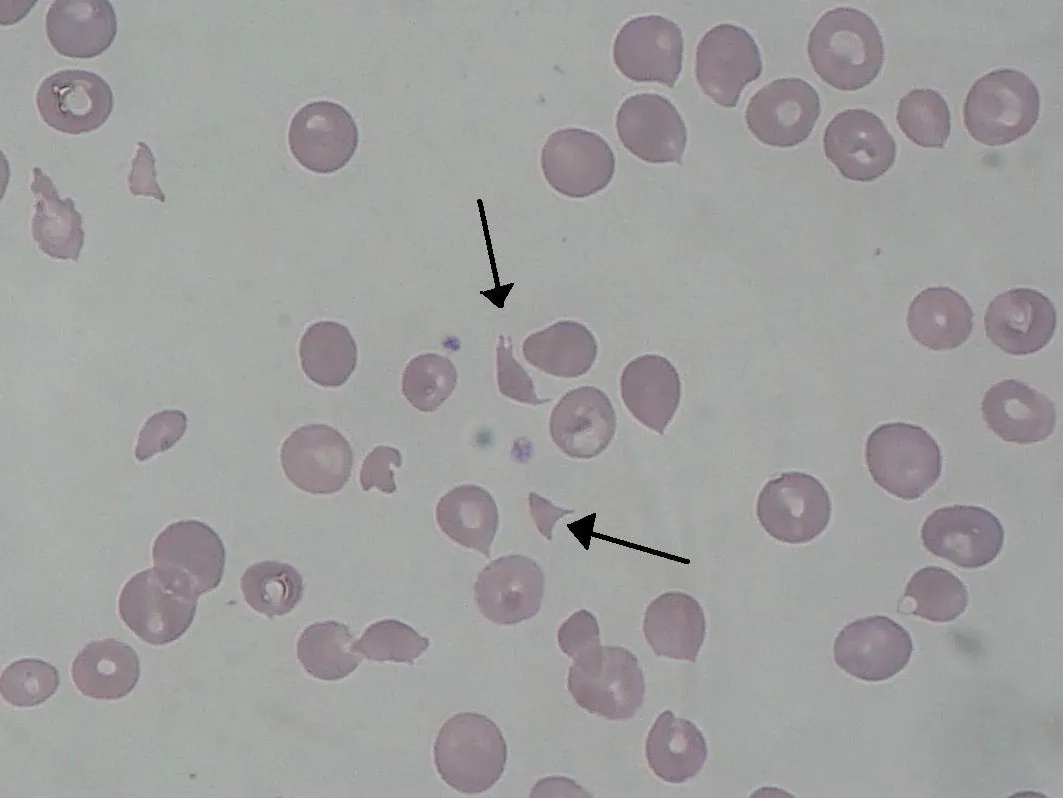
Thrombotic thrombocytopenic purpura (TTP) is a thrombotic microangiopathy caused by severe deficiency of ADAMTS13, the plasma protease that cleaves ultra-large von Willebrand factor (VWF) multimers. Without it, VWF strings capture platelets in the microcirculation, producing microangiopathic haemolytic anaemia (MAHA), severe thrombocytopenia and ischaemia of the brain, heart, gut and kidney. About 95% of adult cases are immune TTP (iTTP), caused by autoantibodies against ADAMTS13; congenital TTP (Upshaw–Schulman syndrome) often appears in childhood or first pregnancy. Typical patients are young adults with purpura, confusion or focal neurology. Schistocytes, high LDH, low haptoglobin, a negative DAT and normal clotting times support the diagnosis; the PLASMIC score estimates probability and ADAMTS13 below 10% confirms it. Immune TTP is an emergency treated with plasma exchange, steroids, rituximab and caplacizumab; platelet transfusion is avoided. Untreated mortality is about 90%; relapse is common, so ADAMTS13 is monitored in remission.
Patient case, mechanism, investigations, management, flashcards and exam-style questions.Open the lesson →
Key facts
- TTP = severe ADAMTS13 deficiency (activity below 10%) causing platelet–VWF microthrombi
- Immune TTP (anti-ADAMTS13 autoantibodies) causes about 95% of adult cases; congenital TTP the rest
- MAHA (schistocytes, high LDH, low haptoglobin, DAT negative) plus severe thrombocytopenia, often below 30 × 10⁹/L, is enough to suspect TTP
- PT, APTT and fibrinogen are usually normal, which separates TTP from DIC
- A PLASMIC score of 6–7 indicates high probability; take an ADAMTS13 sample before plasma
- Start plasma exchange within hours; untreated mortality is about 90%, treated about 10–20%
- Caplacizumab blocks the VWF–platelet interaction and speeds platelet recovery; rituximab prevents relapse
- Platelet transfusion is avoided unless bleeding is life-threatening because it may fuel thrombosis
Differential diagnosis
| Condition | Clues | Key test |
|---|---|---|
| STEC haemolytic uraemic syndrome | Bloody diarrhoea, child, AKI dominant | Stool Shiga toxin PCR; ADAMTS13 above 10% |
| Complement-mediated (atypical) HUS | Severe AKI, family history, no diarrhoea | ADAMTS13 above 10%; complement genetics |
| Disseminated intravascular coagulation | Sepsis, trauma or cancer; bleeding and thrombosis | Prolonged PT/APTT, low fibrinogen, very high D-dimer |
| HELLP syndrome | Third trimester, hypertension, raised transaminases | Liver tests; improves after delivery; ADAMTS13 not severely low |
| Evans syndrome / autoimmune haemolysis with ITP | Spherocytes rather than schistocytes | Positive direct antiglobulin test |
| Malignant hypertension | BP often above 200/120, retinopathy | Improves with BP control; ADAMTS13 above 10% |
| Severe vitamin B12 deficiency (pseudo-TMA) | Macrocytosis, low reticulocytes, neurology | Low B12, high MCV, hypersegmented neutrophils |
| Catastrophic antiphospholipid syndrome | Multiorgan thrombosis, previous APS or SLE | Antiphospholipid antibodies; prolonged APTT from lupus anticoagulant |
Exam pearls
Guideline
ISTH guidelines for the diagnosis (2020) and treatment (2020) of thrombotic thrombocytopenic purpura, and British Society for Haematology TTP and thrombotic microangiopathies guideline (2023)
References
- Zheng XL, Vesely SK, Cataland SR, et al.. ISTH guidelines for the diagnosis of thrombotic thrombocytopenic purpura. J Thromb Haemost 2020.
- Zheng XL, Vesely SK, Cataland SR, et al.. ISTH guidelines for treatment of thrombotic thrombocytopenic purpura. J Thromb Haemost 2020.
- Scully M, Rayment R, Clark A, et al.. A British Society for Haematology guideline: diagnosis and management of thrombotic thrombocytopenic purpura and thrombotic microangiopathies. Br J Haematol 2023.
- Scully M, Cataland SR, Peyvandi F, et al.. Caplacizumab treatment for acquired thrombotic thrombocytopenic purpura. N Engl J Med 2019.
- Bendapudi PK, Hurwitz S, Fry A, et al.. Derivation and external validation of the PLASMIC score for rapid assessment of adults with thrombotic microangiopathies: a cohort study. Lancet Haematol 2017.
- Scully M, Antun A, Cataland SR, et al.. Recombinant ADAMTS13 in congenital thrombotic thrombocytopenic purpura. N Engl J Med 2024.
Related topics
By Dr Khalid Seidi (B.Sc., M.D.) · MedEd World Clinical Knowledge library. Original teaching content checked against current guidelines (November 2026); confirm the latest local guidance before clinical use. Not a substitute for clinical judgement.