Clinical Knowledge › Internal medicine › Haematology and oncology › Bleeding, platelet and thrombotic disorders
Haemophilia A and B
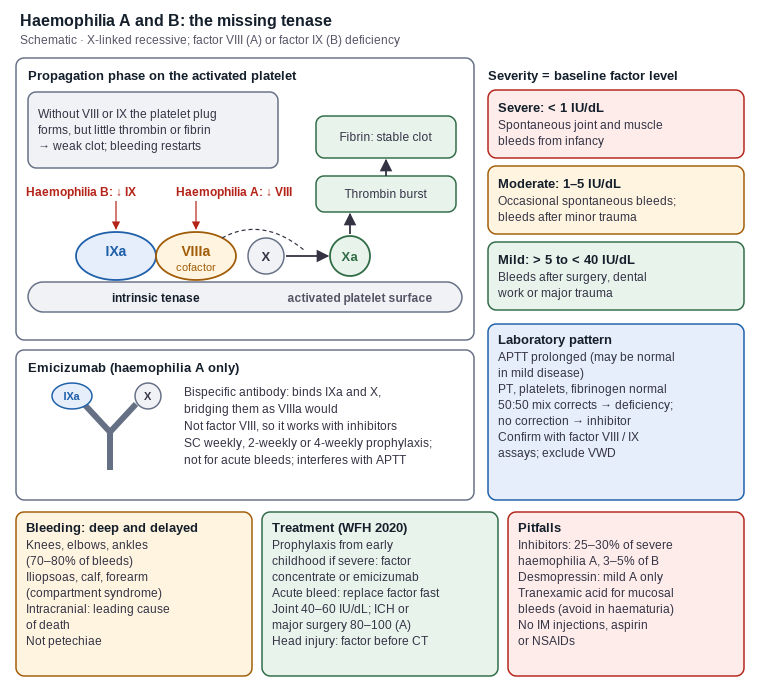
Haemophilia A and B are X-linked recessive bleeding disorders caused by deficiency of coagulation factor VIII (haemophilia A, about 1 in 5000 male births) or factor IX (haemophilia B, about 1 in 25,000). Both impair the intrinsic tenase complex, so a stable fibrin clot fails to form after primary platelet plug formation. Severity depends on the residual factor level: severe below 1%, moderate 1–5% and mild above 5% to below 40%. Severe disease presents in infancy with spontaneous bleeding into joints and muscles; repeated haemarthrosis of knees, elbows and ankles leads to chronic arthropathy, and intracranial haemorrhage is the leading cause of death. Typically the APTT is prolonged and corrects on mixing, while PT and platelet count are normal; factor assays and genetic testing confirm. Treatment is regular prophylaxis with factor concentrates or the non-factor antibody emicizumab for haemophilia A; desmopressin helps mild haemophilia A. About a quarter of patients with severe haemophilia A develop inhibitors. Newer options include rebalancing agents and gene therapy.
Patient case, mechanism, investigations, management, flashcards and exam-style questions.Open the lesson →
Key facts
- X-linked recessive: affected males, carrier females; about a third of cases arise from new variants
- Haemophilia A = factor VIII deficiency (about 80–85%); haemophilia B (Christmas disease) = factor IX deficiency
- Severity by factor level: severe below 1 IU/dL, moderate 1–5, mild above 5 to below 40
- Hallmarks: haemarthrosis, deep muscle haematomas, prolonged bleeding after surgery or circumcision; not petechiae
- Isolated prolonged APTT with normal PT, platelets and bleeding time; mixing study corrects unless an inhibitor is present
- Prophylaxis (factor or emicizumab) from early childhood prevents joint damage in severe disease
- Inhibitors (alloantibodies) develop in about 25–30% of severe haemophilia A and 3–5% of haemophilia B
- Avoid intramuscular injections, aspirin and NSAIDs; desmopressin works only in mild haemophilia A
Differential diagnosis
| Condition | Clues | Key test |
|---|---|---|
| Von Willebrand disease | Mucocutaneous bleeding, menorrhagia, both sexes, autosomal | VWF antigen and activity; APTT may be normal |
| Acquired haemophilia A | Older adult or postpartum, extensive skin and muscle bleeding, no family history | APTT fails to correct on incubated mixing; FVIII inhibitor |
| Factor XI deficiency (haemophilia C) | Ashkenazi Jewish ancestry, bleeding after surgery, both sexes | Low factor XI |
| Vitamin K deficiency bleeding of the newborn | No vitamin K at birth, breastfed infant | PT prolonged more than APTT; corrects with vitamin K |
| Non-accidental injury | Unexplained bruises in a child, inconsistent history | Normal coagulation tests; safeguarding assessment |
| Platelet function disorder | Mucosal bleeding, petechiae | Normal APTT; platelet function tests |
| Septic arthritis | Hot swollen joint with fever | Joint aspirate culture; raised CRP |
Exam pearls
Guideline
WFH Guidelines for the Management of Hemophilia, 3rd edition (2020), and ISTH clinical practice guideline for treatment of congenital hemophilia A and B (2024)
References
- Srivastava A, Santagostino E, Dougall A, et al.. WFH Guidelines for the Management of Hemophilia, 3rd edition. Haemophilia 2020.
- Rezende SM, Neumann I, Angchaisuksiri P, et al.. International Society on Thrombosis and Haemostasis clinical practice guideline for treatment of congenital hemophilia A and B based on the Grading of Recommendations Assessment, Development, and Evaluation methodology. J Thromb Haemost 2024.
- Oldenburg J, Mahlangu JN, Kim B, et al.. Emicizumab prophylaxis in hemophilia A with inhibitors. N Engl J Med 2017.
- Mahlangu J, Oldenburg J, Paz-Priel I, et al.. Emicizumab prophylaxis in patients who have hemophilia A without inhibitors. N Engl J Med 2018.
- Pipe SW, Leebeek FWG, Recht M, et al.. Gene therapy with etranacogene dezaparvovec for hemophilia B. N Engl J Med 2023.
- von Drygalski A, Chowdary P, Kulkarni R, et al.. Efanesoctocog alfa prophylaxis for patients with severe hemophilia A. N Engl J Med 2023.
Related topics
By Dr Khalid Seidi (B.Sc., M.D.) · MedEd World Clinical Knowledge library. Original teaching content checked against current guidelines (November 2026); confirm the latest local guidance before clinical use. Not a substitute for clinical judgement.