Clinical Knowledge › Obstetrics and gynaecology › Fertility and contraception
Contraception: medical eligibility and choice
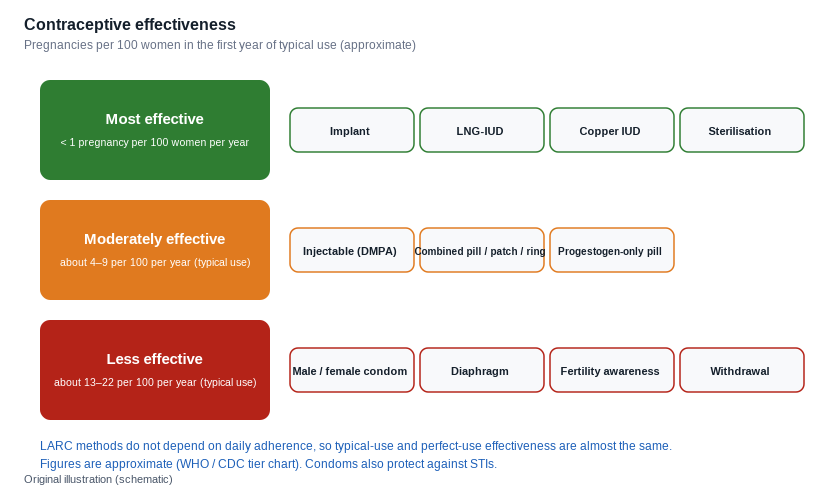
Choosing contraception matches a woman's priorities with what is medically safe for her. Safety is graded by medical eligibility criteria: the UKMEC (College of Sexual and Reproductive Healthcare, UKMEC 2025), the WHO MEC and the US MEC 2024. Each condition is rated 1 (no restriction), 2 (benefits generally outweigh risks), 3 (risks usually outweigh benefits; specialist judgement) or 4 (unacceptable risk). Oestrogen drives most restrictions: combined hormonal contraception (CHC) is UKMEC 4 with migraine with aura, previous VTE, blood pressure of 160/100 mmHg or more, smoking 15 or more cigarettes a day at 35 or older, current breast cancer, known thrombogenic mutations and breastfeeding under 6 weeks. The copper IUD is the most widely eligible method. Effectiveness depends on user-dependence: implant and IUDs fail in under 1% a year, whereas pills fail in about 7–9% with typical use. Enzyme inducers reduce the efficacy of pills, patch, ring and implant; teratogens demand highly effective, user-independent methods. Choice also depends on age, postpartum status and safeguarding.
Patient case, mechanism, investigations, management, flashcards and exam-style questions.Open the lesson →
Key facts
- UKMEC 1 = no restriction; 2 = advantages generally outweigh risks; 3 = risks usually outweigh advantages (specialist judgement); 4 = unacceptable health risk
- CHC is UKMEC 4 with migraine with aura, history of VTE, known thrombogenic mutation, BP 160/100 mmHg or more, current breast cancer, smoking 15 or more a day at 35 or over, and breastfeeding under 6 weeks postpartum
- Copper IUD is UKMEC 1 for almost all medical conditions, including VTE and breast cancer; IUDs are UKMEC 4 to initiate with unexplained vaginal bleeding, pelvic infection or uterine cancer before treatment
- First-year failure with typical use: implant about 0.05%, LNG-IUD about 0.2%, copper IUD about 0.8%, injectable about 6%, pill, patch or ring about 9%, male condom about 18%
- Enzyme inducers (carbamazepine, phenytoin, rifampicin, St John's wort, efavirenz) reduce pill, patch, ring and implant efficacy: use an IUD or DMPA, continuing 28 days after the inducer stops
- Women taking teratogens (valproate, isotretinoin, mycophenolate) need highly effective contraception; user-independent LARC is preferred
- Pregnancy can be reasonably excluded if, for example, she has had no sex since her last normal period, is within 5 days of its start, or is fully breastfeeding, amenorrhoeic and under 6 months postpartum
- UKMEC 2025 (December 2025) replaced UKMEC 2016/2019: several DMPA ratings rose, new conditions were added (multiple sclerosis, chronic kidney disease, Mycoplasma genitalium)
Differential diagnosis
| Condition | Clues | Key test |
|---|---|---|
| Combined hormonal contraception | Cycle control, acne and dysmenorrhoea benefit; oestrogen raises VTE and arterial risk | UKMEC screen: BP, BMI, smoking, migraine, VTE history |
| Progestogen-only pill (desogestrel, drospirenone) | Few restrictions; useful when oestrogen contraindicated | Medical history; check enzyme inducers |
| Etonogestrel implant | Most effective reversible method; irregular bleeding is the main reason for removal | Insertion in non-dominant arm, 3 years |
| Depot medroxyprogesterone acetate | Every 13 weeks; weight gain, delayed return of fertility, reduced bone density | Consider bone health in under-18s and over-45s |
| LNG-IUD | Very effective; reduces heavy menstrual bleeding; endometrial protection with HRT | Exclude infection, pregnancy, distorted cavity |
| Copper IUD | Non-hormonal; most effective emergency method; may increase bleeding and pain | Exclude pregnancy and infection |
| Barrier methods | Only methods protecting against STIs; high typical-use failure | Combine with another method ('double Dutch') |
Exam pearls
Guideline
CoSRH UK Medical Eligibility Criteria for Contraceptive Use (UKMEC 2025, December 2025); CDC US MEC and US Selected Practice Recommendations (2024); WHO Medical eligibility criteria for contraceptive use (6th edition, 2025)
References
- College of Sexual and Reproductive Healthcare. UK Medical Eligibility Criteria for Contraceptive Use (UKMEC 2025). CoSRH 2025.
- Centers for Disease Control and Prevention. U.S. Medical Eligibility Criteria for Contraceptive Use, 2024. MMWR Recomm Rep 2024.
- World Health Organization. Medical eligibility criteria for contraceptive use, 6th edition. WHO 2025.
- Centers for Disease Control and Prevention. U.S. Selected Practice Recommendations for Contraceptive Use, 2024. MMWR Recomm Rep 2024.
- Trussell J. Contraceptive failure in the United States. Contraception 2011.
- Sundaram A, Vaughan B, Kost K, et al.. Contraceptive failure in the United States: estimates from the 2006-2010 National Survey of Family Growth. Perspect Sex Reprod Health 2017.
Related topics
By Dr Khalid Seidi (B.Sc., M.D.) · MedEd World Clinical Knowledge library. Original teaching content checked against current guidelines (November 2026); confirm the latest local guidance before clinical use. Not a substitute for clinical judgement.