Clinical Knowledge › Obstetrics and gynaecology › Fertility and contraception
Female sterilisation
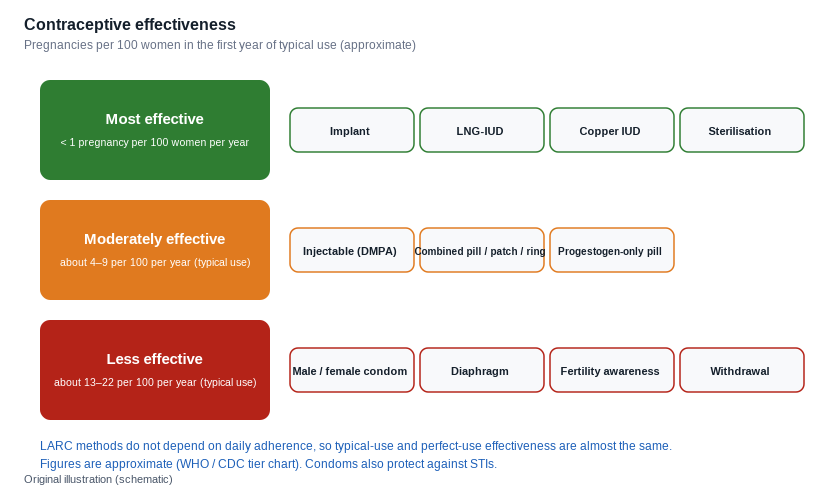
Female sterilisation is a permanent surgical method of contraception that blocks or removes both fallopian tubes so that sperm and oocyte cannot meet. It is the most widely used method worldwide, but long-acting reversible contraception (LARC) now offers equal effectiveness without surgery. Interval sterilisation is laparoscopic, using Filshie clips, bipolar coagulation or bilateral salpingectomy; at caesarean a partial or total salpingectomy is done, and postpartum mini-laparotomy with Pomeroy ligation is common in low-resource settings. Hysteroscopic micro-inserts have been withdrawn. Lifetime failure after tubal occlusion is about 1 in 200, and up to a third of failures are ectopic. Vasectomy is simpler, safer and more effective (about 1 in 2000 after clearance). Counselling must cover permanence, LARC alternatives, failure, ectopic risk, surgical risks and regret, which is highest in women sterilised at 30 years or younger or around childbirth. Partner consent is not required. ACOG (2026) now prefers complete bilateral salpingectomy, which also lowers serous ovarian cancer risk.
Patient case, mechanism, investigations, management, flashcards and exam-style questions.Open the lesson →
Key facts
- Sterilisation is intended to be permanent; reversal is rarely state-funded, less successful than IVF in many women, and raises ectopic risk
- Lifetime failure after laparoscopic tubal occlusion is about 1 in 200; vasectomy failure is about 1 in 2000 once azoospermia (clearance) is confirmed
- Up to one third of pregnancies after tubal sterilisation are ectopic: a positive pregnancy test after sterilisation needs urgent ultrasound
- Regret is highest when sterilisation is done at 30 years or younger, at caesarean or soon after a birth or loss, or during relationship difficulty
- LARC methods (LNG-IUD, copper IUD, implant) are as effective as sterilisation and must be discussed; vasectomy should also be offered
- After clip occlusion, contraception is continued until the next menstrual period; salpingectomy is effective immediately
- A pregnancy test and documented last menstrual period are required on the day of surgery; luteal-phase pregnancy is a known cause of 'failure'
- ACOG 2026: complete bilateral salpingectomy is the preferred tubal procedure for permanent contraception (ovarian cancer risk reduction)
Differential diagnosis
| Condition | Clues | Key test |
|---|---|---|
| Levonorgestrel IUD (52 mg) | Reversible, about 0.2% failure per year, reduces heavy bleeding | Insertion in clinic; no anaesthetic needed |
| Copper IUD | Non-hormonal, reversible, can stay 10 years (to menopause if inserted at 40 or over) | Clinic insertion; check STI risk |
| Etonogestrel implant | Most effective reversible method (about 0.05% failure) | Subdermal insertion; irregular bleeding common |
| Vasectomy (partner) | Local anaesthetic, lower morbidity, about 1 in 2000 failure after clearance | Semen analysis about 12 weeks after procedure |
| Hysterectomy | Only if there is a separate gynaecological indication (for example fibroids with heavy bleeding) | Not performed for contraception alone |
| Depot medroxyprogesterone acetate | Injection every 13 weeks; delay in return of fertility | Clinical choice; bone density concerns with long use |
Exam pearls
Guideline
FSRH (now CoSRH) Male and female sterilisation guideline (2014); ACOG Practice Bulletin No. 208 Benefits and risks of sterilization (2019); ACOG Clinical Practice Update: Salpingectomy for the prevention of epithelial ovarian cancer (August 2026); WHO Medical eligibility criteria for contraceptive use (5th edition 2015; 6th edition 2025)
References
- Faculty of Sexual and Reproductive Healthcare (now College of Sexual and Reproductive Healthcare). Male and female sterilisation. FSRH clinical guidance 2014.
- American College of Obstetricians and Gynecologists. Benefits and risks of sterilization (Practice Bulletin No. 208). Obstet Gynecol 2019.
- American College of Obstetricians and Gynecologists. Salpingectomy for the prevention of epithelial ovarian cancer (ACOG Clinical Practice Update). Obstet Gynecol 2026.
- Peterson HB, Xia Z, Hughes JM, Wilcox LS, Tylor LR, Trussell J. The risk of pregnancy after tubal sterilization: findings from the U.S. Collaborative Review of Sterilization. Am J Obstet Gynecol 1996.
- Peterson HB, Xia Z, Hughes JM, Wilcox LS, Tylor LR, Trussell J. The risk of ectopic pregnancy after tubal sterilization. U.S. Collaborative Review of Sterilization Working Group. N Engl J Med 1997.
- Hanley GE, Pearce CL, Talhouk A, et al.. Outcomes from opportunistic salpingectomy for ovarian cancer prevention. JAMA Netw Open 2022.
Related topics
By Dr Khalid Seidi (B.Sc., M.D.) · MedEd World Clinical Knowledge library. Original teaching content checked against current guidelines (November 2026); confirm the latest local guidance before clinical use. Not a substitute for clinical judgement.