Clinical Knowledge › Paediatrics › Respiratory and ENT
Croup
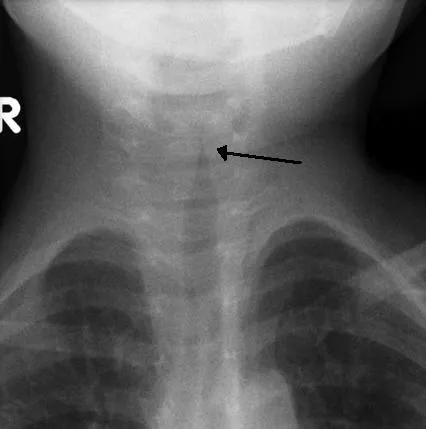
Croup (acute laryngotracheobronchitis) is a viral infection of the larynx and trachea that causes subglottic oedema in children aged 6 months to 6 years, peaking in the second year of life, mostly in autumn. Parainfluenza virus type 1 is the classic cause; others include parainfluenza 3, RSV, human metapneumovirus, influenza, adenovirus and SARS-CoV-2. After 1–2 days of coryza and low-grade fever, the child develops a harsh barking (seal-like) cough, hoarse voice and inspiratory stridor, typically worse at night and with crying. Diagnosis is clinical; severity is graded with the Westley score or a simple mild–moderate–severe scale, remembering that hypoxia, agitation and a quiet chest are late signs. Every child should receive a single oral dose of dexamethasone (0.15 mg/kg in UK practice; 0.6 mg/kg in many guidelines, with similar outcomes), or prednisolone or nebulised budesonide as alternatives. Severe croup is treated with nebulised adrenaline, oxygen and senior anaesthetic help, with observation for at least 2–3 hours afterwards. Most children recover in 2–3 days and fewer than 1% need intubation. Atypical, recurrent or very early croup should prompt a search for structural airway disease.
Patient case, mechanism, investigations, management, flashcards and exam-style questions.Open the lesson →
Key facts
- Age 6 months to 6 years, peak 1–2 years; boys more often affected; autumn epidemics (parainfluenza 1 peaks in odd-numbered years in some countries)
- Parainfluenza virus types 1 and 3 cause most cases; also RSV, metapneumovirus, influenza, adenovirus, SARS-CoV-2 (notably during Omicron waves)
- Barking cough, hoarse voice, inspiratory stridor, worse at night, after 1–2 days of coryza and low-grade fever
- Subglottic oedema narrows the cricoid ring, the narrowest and only complete cartilaginous ring of the paediatric airway
- Westley score: stridor, recession, air entry, cyanosis, conscious level; 0–2 mild, 3–5 moderate, 6–11 severe, 12 or more impending respiratory failure
- All severities: single oral dose of dexamethasone (0.15 mg/kg, or 0.6 mg/kg; maximum commonly 10–16 mg); prednisolone 1 mg/kg or nebulised budesonide 2 mg are alternatives
- Severe: nebulised adrenaline 400 micrograms/kg (0.4 mL/kg of 1 in 1000, maximum 5 mL) plus oxygen; observe at least 2–3 hours after
- Keep the child calm on the parent's lap; do not examine the throat or perform unnecessary procedures in severe croup
Differential diagnosis
| Condition | Clues | Key test |
|---|---|---|
| Epiglottitis | Toxic, high fever, drooling, muffled voice, tripod position, little cough | Clinical; airway secured in theatre before any test |
| Bacterial tracheitis | Croup-like onset then high fever, toxicity, copious purulent secretions, poor response to adrenaline | Airway endoscopy; lateral neck X-ray (ragged trachea) |
| Inhaled foreign body | Sudden choking episode, no prodrome, afebrile | Rigid bronchoscopy |
| Anaphylaxis or angio-oedema | Rapid onset after allergen; urticaria, facial swelling, wheeze, hypotension | Clinical; mast cell tryptase |
| Retropharyngeal or peritonsillar abscess | Fever, neck stiffness or torticollis, drooling, trismus | Lateral neck X-ray or CT neck |
| Spasmodic (recurrent) croup | Sudden nocturnal croup without fever or coryza, recurrent, atopic child | Clinical; consider airway assessment if frequent |
| Subglottic stenosis or haemangioma, laryngomalacia | Onset under 6 months, recurrent or persistent stridor; previous intubation; facial haemangioma | Airway endoscopy by ENT |
| Diphtheria | Unvaccinated child, grey adherent pharyngeal membrane, bull neck | Throat swab culture and toxin testing |
Exam pearls
Guideline
NICE CKS Croup (2022 revision), Cochrane review of glucocorticoids for croup (2023), and national paediatric emergency guidance (for example PREDICT Australasia, Canadian Paediatric Society)
References
- National Institute for Health and Care Excellence. Croup: Clinical Knowledge Summary. NICE CKS 2022.
- Aregbesola A, Tam CM, Kothari A, et al.. Glucocorticoids for croup in children. Cochrane Database Syst Rev 2023.
- Parker CM, Cooper MN.. Prednisolone versus dexamethasone for croup: a randomized controlled trial. Pediatrics 2019.
- Bjornson CL, Johnson DW.. Croup in children. CMAJ 2013.
- Shlomovich M, Hyatt S, Cassel-Choudhury GN.. Croup and epiglottitis. Pediatr Rev 2025.
- Hopkins A, Lahiri T, Salerno R, Heath B.. Changing epidemiology of life-threatening upper airway infections: the reemergence of bacterial tracheitis. Pediatrics 2006.
Related topics
By Dr Khalid Seidi (B.Sc., M.D.) · MedEd World Clinical Knowledge library. Original teaching content checked against current guidelines (November 2026); confirm the latest local guidance before clinical use. Not a substitute for clinical judgement.