Clinical Knowledge › Paediatrics › Respiratory and ENT
Epiglottitis
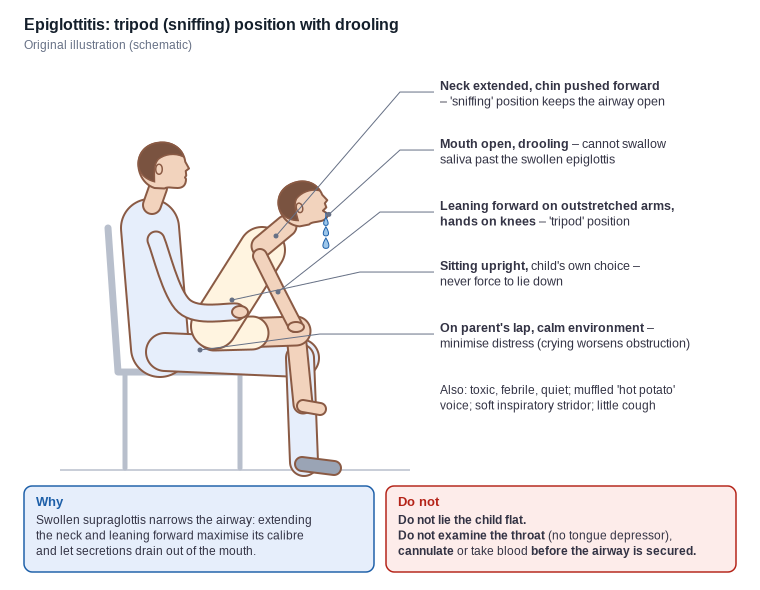
Epiglottitis (supraglottitis) is a rapidly progressive bacterial cellulitis of the epiglottis and surrounding supraglottic structures that can cause sudden, complete airway obstruction. Before conjugate Haemophilus influenzae type b (Hib) vaccines it was a disease of children aged 2–7 years; it is now rare in immunised children and most cases occur in adults, while children who are unimmunised, incompletely immunised or immunocompromised remain at risk. Other causes include streptococci, Staphylococcus aureus and non-type b H. influenzae. The child is toxic with high fever, sore throat, drooling, dysphagia, a muffled 'hot potato' voice and soft inspiratory stridor, sitting forward in a tripod position with little cough. It is an airway emergency: keep the child calm and upright with a parent, give oxygen without upsetting them, do not examine the throat, cannulate or send for X-ray, and call the most senior anaesthetist, ENT surgeon and paediatrician. The airway is secured in theatre by inhalational induction with a surgical airway ready. Intravenous ceftriaxone follows, with rifampicin prophylaxis for vulnerable household contacts of Hib cases.
Patient case, mechanism, investigations, management, flashcards and exam-style questions.Open the lesson →
Key facts
- Hib conjugate vaccination reduced childhood epiglottitis by more than 90%; incidence in vaccinated populations is now well under 1 per 100 000 children per year, with adults the main group
- Classic child: 2–7 years, unimmunised, abrupt onset over hours, high fever, toxic, drooling, dysphagia, muffled voice, soft stridor, tripod position
- The four Ds: drooling, dysphagia, dysphonia (muffled voice) and distress; cough is minimal, unlike croup
- Do not lie the child down, do not inspect the throat, do not cannulate or take blood before the airway is secured
- Airway secured in theatre by a senior anaesthetist with inhalational induction, ENT ready for rigid bronchoscopy or tracheostomy
- Lateral neck X-ray (only if stable and accompanied): 'thumb sign' of swollen epiglottis and loss of vallecular air
- Treatment: IV ceftriaxone (teaching dose 80 mg/kg once daily, maximum 4 g) or cefotaxime for 7–10 days; add anti-staphylococcal cover if suspected
- Rifampicin prophylaxis for household contacts after invasive Hib disease when vulnerable contacts are present; check and complete the index child's Hib vaccination
Differential diagnosis
| Condition | Clues | Key test |
|---|---|---|
| Croup | Gradual onset after coryza, barking cough, low-grade fever, no drooling | Clinical; responds to steroids and adrenaline |
| Bacterial tracheitis | Croup-like then toxic, brassy cough, purulent secretions, can lie flat | Airway endoscopy; lateral X-ray ragged trachea |
| Retropharyngeal abscess | Under 5 years, fever, neck stiffness or torticollis, drooling | Lateral neck X-ray prevertebral widening; CT with contrast |
| Peritonsillar abscess (quinsy) | Adolescent, trismus, uvular deviation, unilateral swelling | Clinical; aspiration |
| Inhaled or ingested foreign body | Sudden choking, afebrile | Bronchoscopy or oesophagoscopy |
| Anaphylaxis or angio-oedema | Rapid onset after allergen, urticaria, lip swelling | Clinical; IM adrenaline |
| Diphtheria | Unvaccinated, grey adherent membrane, bull neck | Throat swab culture and toxin testing |
Exam pearls
Guideline
Consensus paediatric airway emergency practice (APLS/RCUK 2025 airway principles, Difficult Airway Society paediatric guidance) with UKHSA Hib post-exposure guidance and national immunisation schedules (UK Green Book, CDC/ACIP 2026)
References
- Guldfred LA, Lyhne D, Becker BC.. Acute epiglottitis: epidemiology, clinical presentation, management and outcome. J Laryngol Otol 2008.
- Shah RK, Stocks C.. Epiglottitis in the United States: national trends, variances, prognosis, and management. Laryngoscope 2010.
- Shlomovich M, Hyatt S, Cassel-Choudhury GN.. Croup and epiglottitis. Pediatr Rev 2025.
- Akhavan M.. Ear, nose, throat: beyond pharyngitis: retropharyngeal abscess, peritonsillar abscess, epiglottitis, bacterial tracheitis, and postoperative tonsillectomy. Emerg Med Clin North Am 2021.
- Resuscitation Council UK. Paediatric advanced life support guidelines. Resuscitation Council UK 2025.
- Public Health England (now UK Health Security Agency). Revised recommendations for the prevention of secondary Haemophilus influenzae type b (Hib) disease. PHE guidance 2013.
Related topics
By Dr Khalid Seidi (B.Sc., M.D.) · MedEd World Clinical Knowledge library. Original teaching content checked against current guidelines (November 2026); confirm the latest local guidance before clinical use. Not a substitute for clinical judgement.