Clinical Knowledge › Paediatrics › Respiratory and ENT
Inhaled foreign body
Foreign body aspiration is a common, potentially fatal emergency of early childhood, peaking between 1 and 3 years when children explore with their mouths, lack molar teeth and run or laugh while eating. Food is the usual culprit (peanuts and other nuts, seeds, grapes, popcorn), followed by small toy parts. Complete obstruction of the larynx or trachea causes silent choking and, without immediate back blows and chest or abdominal thrusts, cardiac arrest. Most children reach hospital with partial obstruction: a witnessed choking episode followed by cough, wheeze or reduced breath sounds, usually on one side. Signs may settle after the first episode, so the diagnosis is often delayed and mislabelled as asthma or pneumonia. Most objects are radiolucent; the chest X-ray may be normal or show obstructive hyperinflation that persists on expiration, or collapse beyond the object. Low-dose CT is highly sensitive, but rigid bronchoscopy under general anaesthesia is both the definitive test and the treatment. A clear history of choking warrants bronchoscopy even with normal imaging.
Patient case, mechanism, investigations, management, flashcards and exam-style questions.Open the lesson →
Key facts
- Peak age 1–3 years; boys slightly more often; food (nuts, seeds, grapes, popcorn, raw carrot) is the commonest object
- A witnessed choking episode (penetration syndrome) is the most sensitive historical clue; always ask specifically
- Classic triad of cough, unilateral wheeze and reduced breath sounds is present in under half of children
- Objects lodge more often in the right main bronchus, but left-sided foreign bodies are common in young children
- CXR is often normal; obstructive (ball-valve) hyperinflation on an expiratory or decubitus film is the key sign
- Low-dose CT has about 99% sensitivity and 92% specificity in pooled studies and can avoid negative bronchoscopies
- Rigid bronchoscopy under general anaesthesia is the gold standard for diagnosis and removal; flexible bronchoscopy is increasingly used in experienced centres
- Choking management (ERC/RCUK 2025): effective cough, encourage coughing; ineffective cough, up to 5 back blows then up to 5 chest thrusts (infant) or abdominal thrusts (child); unconscious, start CPR
Differential diagnosis
| Condition | Clues | Key test |
|---|---|---|
| Preschool wheeze or asthma | Bilateral, symmetrical wheeze with colds or triggers; good bronchodilator response | Clinical; response to salbutamol |
| Croup | Barking cough, inspiratory stridor, coryzal prodrome, worse at night | Clinical diagnosis |
| Community-acquired pneumonia | Fever, tachypnoea, focal crackles; no choking history | CXR; response to antibiotics |
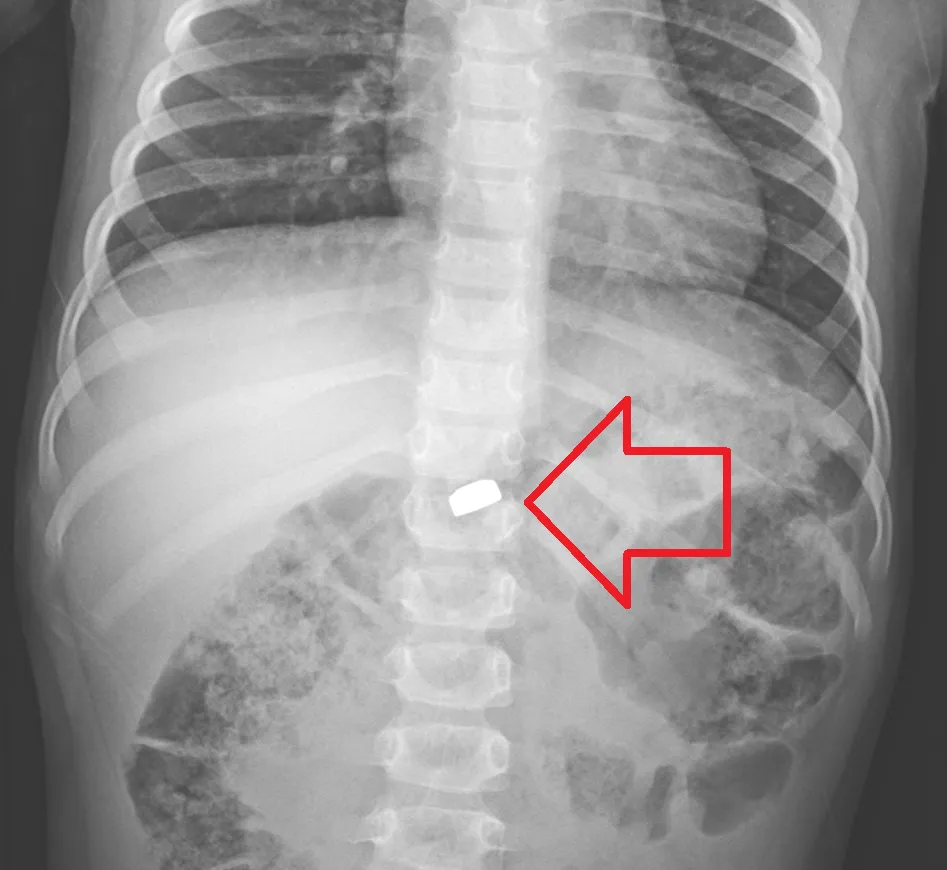
| Oesophageal foreign body | Drooling, dysphagia, food refusal; may compress trachea causing stridor | Neck and chest X-ray (AP and lateral); coin in coronal plane |
| Bronchiolitis | Infant with coryza and bilateral crackles and wheeze | Clinical |
| Epiglottitis or bacterial tracheitis | Toxic, febrile, drooling or stridor | Airway team assessment; avoid distressing the child |
| Anaphylaxis | Sudden stridor or wheeze with urticaria or angioedema after food | Clinical; IM adrenaline response; mast cell tryptase |
Exam pearls
Guideline
ERC Guidelines 2025 and Resuscitation Council UK 2025 paediatric basic life support (foreign body airway obstruction); AHA 2025 paediatric BLS; consensus paediatric airway practice
References
- European Resuscitation Council. European Resuscitation Council Guidelines 2025: Paediatric Life Support. Resuscitation 2025.
- Resuscitation Council UK. Paediatric basic life support guidelines. Resuscitation Council UK 2025.
- American Heart Association. 2025 American Heart Association Guidelines for Cardiopulmonary Resuscitation and Emergency Cardiovascular Care: Pediatric Basic Life Support. Circulation 2025.
- El Khoury P, Makhoul M, El Hadi C, et al.. CT scan in children suspected of foreign body aspiration: a systematic review and meta-analysis. Otolaryngol Head Neck Surg 2024.
- Keil O, Schwerk N.. Foreign body aspiration in children - being safe and flexible. Curr Opin Anaesthesiol 2023.
- Lee JJW, Philteos J, Levin M, et al.. Clinical prediction models for suspected pediatric foreign body aspiration: a systematic review and meta-analysis. JAMA Otolaryngol Head Neck Surg 2021.
Related topics
By Dr Khalid Seidi (B.Sc., M.D.) · MedEd World Clinical Knowledge library. Original teaching content checked against current guidelines (November 2026); confirm the latest local guidance before clinical use. Not a substitute for clinical judgement.