Clinical Knowledge › Internal medicine › Basics of internal medicine › Nutrition
Hypervitaminosis (vitamins A and D)
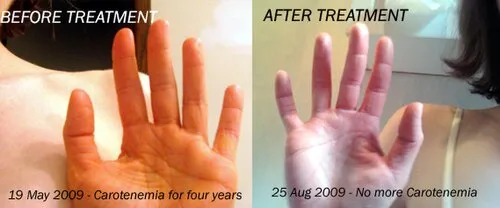
Hypervitaminosis is toxicity from excess intake of a vitamin; it occurs almost only with the fat-soluble vitamins A and D because they are stored in liver and fat. Vitamin A toxicity follows high-dose supplements, liver or fish-liver oils, and retinoid drugs. Acute toxicity causes headache, vomiting, drowsiness and later skin peeling; chronic toxicity causes idiopathic intracranial hypertension, dry skin and cheilitis, alopecia, bone pain, hypercalcaemia, osteoporosis and hepatotoxicity with portal hypertension. Retinoids are potent teratogens. Plant beta-carotene causes only harmless carotenaemia. Vitamin D toxicity is almost always iatrogenic or from supplements: manufacturing or prescribing errors, repeated loading doses, or long-term intake well above the upper limit. A very high 25-hydroxyvitamin D (usually above 375 nmol/L) drives PTH-independent hypercalcaemia with hypercalciuria, causing polyuria, vomiting, confusion, AKI and nephrocalcinosis. Management is to stop the source, rehydrate with saline and use glucocorticoids or bisphosphonates for severe hypercalcaemia.
Patient case, mechanism, investigations, management, flashcards and exam-style questions.Open the lesson →
Key facts
- Toxicity is a feature of fat-soluble vitamins (A and D) because they accumulate in liver and adipose tissue
- Tolerable upper intake of preformed vitamin A in adults is about 3000 µg retinol activity (10 000 IU) daily, including in pregnancy
- Chronic vitamin A excess causes intracranial hypertension, cheilitis, alopecia, bone pain, hypercalcaemia and liver fibrosis
- Beta-carotene causes carotenaemia (yellow palms, sclerae spared) but not hypervitaminosis A
- Vitamin D toxicity: 25-OH D usually above 375 nmol/L (150 ng/mL) with hypercalcaemia, suppressed PTH and hypercalciuria
- The usual adult upper limit for vitamin D is 4000 IU (100 µg) daily; toxicity typically follows much larger chronic or bolus doses
- Calcitriol-mediated hypercalcaemia (sarcoidosis, lymphoma) has high 1,25-(OH)2 D with normal 25-OH D
- Treatment: stop vitamin and calcium sources, IV 0.9% saline, then glucocorticoids and/or a bisphosphonate
Differential diagnosis
| Condition | Clues | Key test |
|---|---|---|
| Primary hyperparathyroidism | Mild chronic hypercalcaemia, kidney stones | PTH raised or inappropriately normal |
| Hypercalcaemia of malignancy (PTHrP) | Known or occult cancer, rapid rise, weight loss | PTH suppressed, PTHrP raised |
| Granulomatous disease or lymphoma | Sarcoidosis, TB, lymphadenopathy | High 1,25-(OH)2 D with normal 25-OH D |
| Milk–alkali syndrome | Large calcium carbonate intake, metabolic alkalosis, AKI | Drug history; alkalosis; normal 25-OH D |
| Idiopathic intracranial hypertension | Young obese woman, headache, papilloedema | Normal vitamin A intake; MRI and lumbar puncture |
| Drug-induced liver injury from other agents | Hepatitis or portal hypertension after new drug | Causality assessment; liver biopsy if needed |
| CYP24A1 deficiency | Recurrent hypercalcaemia or nephrocalcinosis with modest vitamin D intake | High 25-OH D:24,25-(OH)2 D ratio; genetics |
Exam pearls
Guideline
Endocrine Society clinical practice guideline: Vitamin D for the prevention of disease (2024), Institute of Medicine Dietary Reference Intakes for calcium and vitamin D (2011) and vitamin A (2001), and ESPEN micronutrient guideline (2022)
References
- Penniston KL, Tanumihardjo SA. The acute and chronic toxic effects of vitamin A. Am J Clin Nutr 2006.
- Demay MB, Pittas AG, Bikle DD, et al.. Vitamin D for the prevention of disease: an Endocrine Society clinical practice guideline. J Clin Endocrinol Metab 2024.
- Galior K, Grebe S, Singh R. Development of vitamin D toxicity from overcorrection of vitamin D deficiency: a review of case reports. Nutrients 2018.
- Vogiatzi MG, Jacobson-Dickman E, DeBoer MD. Vitamin D supplementation and risk of toxicity in pediatrics: a review of current literature. J Clin Endocrinol Metab 2014.
- Aberger S, Schreiber N, Pilz S, et al.. Targeting calcitriol metabolism in acute vitamin D toxicity – a comprehensive review and clinical insight. Int J Mol Sci 2024.
- Institute of Medicine. Dietary Reference Intakes for Calcium and Vitamin D. National Academies Press, Washington DC 2011.
Related topics
By Dr Khalid Seidi (B.Sc., M.D.) · MedEd World Clinical Knowledge library. Original teaching content checked against current guidelines (November 2026); confirm the latest local guidance before clinical use. Not a substitute for clinical judgement.