Clinical Knowledge › Internal medicine › Basics of internal medicine › Nutrition
Niacin deficiency (pellagra)
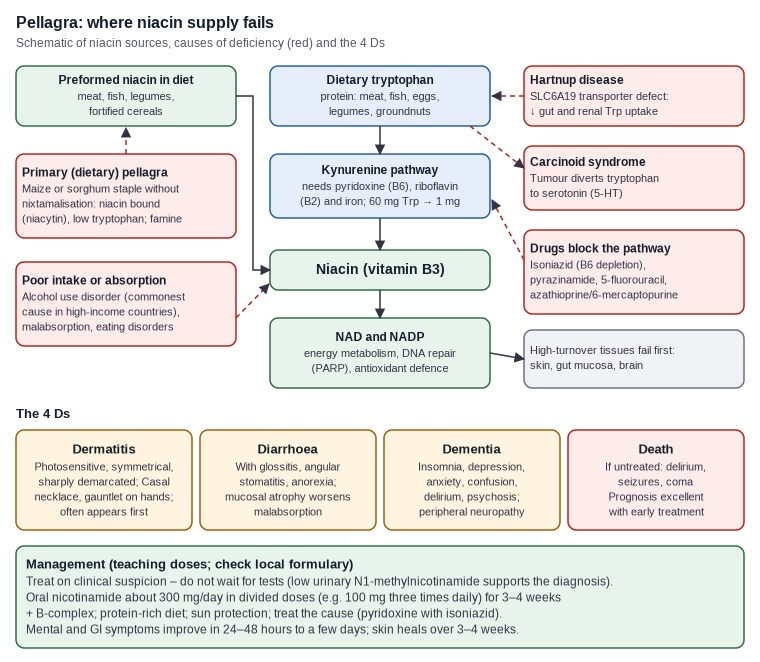
Pellagra is the clinical syndrome of severe niacin (vitamin B3) deficiency. Niacin is obtained from food or synthesised from tryptophan, a pathway that needs pyridoxine, riboflavin and iron, and it forms NAD and NADP, which are vital for energy metabolism and DNA repair. Primary pellagra occurs on maize- or sorghum-based diets without nixtamalisation, in famines and in emergencies; secondary pellagra follows alcohol use disorder, malabsorption, drugs such as isoniazid, 5-fluorouracil and azathioprine, carcinoid syndrome (tryptophan diverted to serotonin) and Hartnup disease. The classic features are the 4 Ds: a symmetrical, sharply demarcated photosensitive dermatitis (Casal necklace, gauntlet on the hands), diarrhoea with glossitis, neuropsychiatric change progressing to dementia, and death if untreated. Diagnosis is clinical, supported by low urinary niacin metabolites and by a rapid response to treatment. Oral nicotinamide with a B-complex supplement, a protein-rich diet, sun protection and treatment of the cause usually bring improvement within days.
Patient case, mechanism, investigations, management, flashcards and exam-style questions.Open the lesson →
Key facts
- Niacin forms NAD and NADP; it can be made from tryptophan (60 mg → 1 mg) using B6, B2 and iron
- Classic 4 Ds: dermatitis, diarrhoea, dementia, death
- Dermatitis is photosensitive, symmetrical and sharply demarcated: Casal necklace, gauntlet on the hands
- Maize diets cause pellagra because niacin is bound and tryptophan is low; nixtamalisation prevents it
- Alcohol use disorder is the commonest cause in high-income countries
- Isoniazid (via B6 depletion), 5-FU, azathioprine and carcinoid syndrome cause secondary pellagra
- Hartnup disease: SLC6A19 neutral amino acid transporter defect with pellagra-like rash and ataxia
- Treat with oral nicotinamide plus B complex; GI and mental symptoms improve within days, skin within weeks
Differential diagnosis
| Condition | Clues | Key test |
|---|---|---|
| Phototoxic or photoallergic drug eruption | Recent new drug, no diarrhoea or glossitis | Drug history; response to withdrawal |
| Sunburn | Acute after exposure, no scaling hyperpigmentation or systemic features | History |
| Cutaneous lupus erythematosus | Photosensitive malar rash, arthralgia | ANA, anti-Ro, skin biopsy |
| Porphyria cutanea tarda | Blisters and fragility on hands, hypertrichosis | Urine and plasma porphyrins |
| Zinc deficiency (acrodermatitis) | Periorificial and acral rash, diarrhoea, alopecia | Serum zinc |
| Kwashiorkor | Flaky paint dermatosis with oedema in children | Anthropometry; oedema |
| Seborrhoeic or contact dermatitis | Not confined to sun-exposed areas | Distribution; patch testing |
Exam pearls
Guideline
ESPEN micronutrient guideline (2022) and WHO guidance on pellagra prevention and control in emergencies (2000); no dedicated contemporary clinical guideline exists
References
- Hegyi J, Schwartz RA, Hegyi V. Pellagra: dermatitis, dementia, and diarrhea. Int J Dermatol 2004.
- Prabhu D, Dawe RS, Mponda K. Pellagra: a review exploring causes and mechanisms, including isoniazid-induced pellagra. Photodermatol Photoimmunol Photomed 2021.
- Hołubiec P, Leończyk M, Staszewski F, et al.. Pathophysiology and clinical management of pellagra – a review. Folia Med Cracov 2021.
- Badawy AA. Pellagra and alcoholism: a biochemical perspective. Alcohol Alcohol 2014.
- Berger MM, Shenkin A, Schweinlin A, et al.. ESPEN micronutrient guideline. Clin Nutr 2022.
- World Health Organization. Pellagra and its prevention and control in major emergencies. WHO, Geneva (WHO/NHD/00.10) 2000.
Related topics
By Dr Khalid Seidi (B.Sc., M.D.) · MedEd World Clinical Knowledge library. Original teaching content checked against current guidelines (November 2026); confirm the latest local guidance before clinical use. Not a substitute for clinical judgement.