Clinical Knowledge › Internal medicine › Basics of internal medicine › Nutrition
Vitamin K deficiency
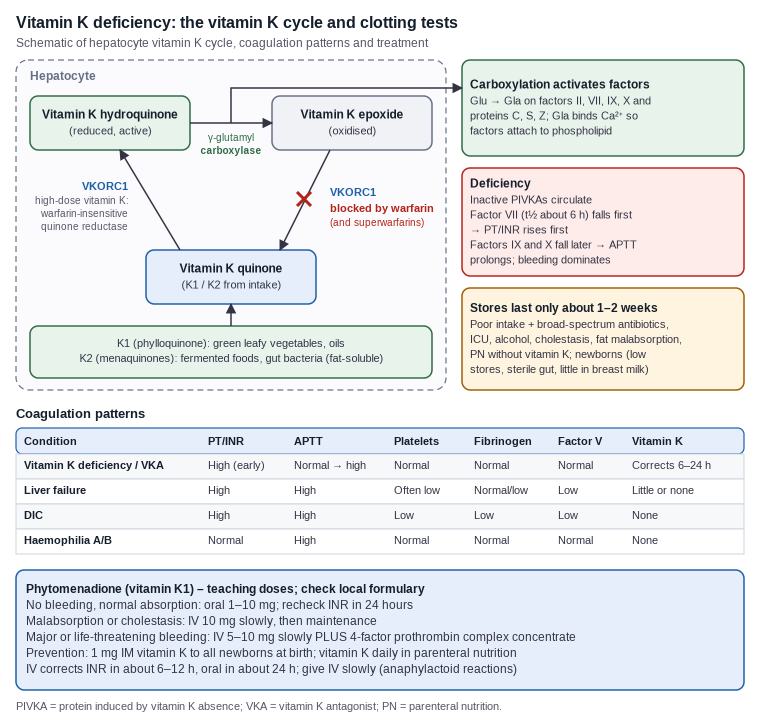
Vitamin K deficiency is a lack of the fat-soluble cofactor that gamma-glutamyl carboxylase needs to activate clotting factors II, VII, IX and X and the anticoagulant proteins C and S. Body stores are small and turn over within days, so deficiency appears quickly in hospital patients who are eating little and receiving broad-spectrum antibiotics, in intensive care, in alcohol misuse, on parenteral nutrition without added vitamin K, and in any fat malabsorption (cholestasis, pancreatic insufficiency, coeliac disease, bariatric surgery, short bowel). Newborns are born with low stores and, without prophylaxis, can develop vitamin K deficiency bleeding, including intracranial haemorrhage. The classic laboratory picture is a prolonged PT/INR with a later rise in APTT, normal platelets, fibrinogen and factor V, and correction within hours of intravenous phytomenadione. Treatment is vitamin K1 by mouth or slow intravenous injection, adding prothrombin complex concentrate for serious bleeding. Prevention means newborn prophylaxis, nutrition review and INR checks in at-risk ward patients.
Patient case, mechanism, investigations, management, flashcards and exam-style questions.Open the lesson →
Key facts
- Vitamin K is needed for gamma-carboxylation of factors II, VII, IX and X and proteins C and S
- Body stores last only about 1–2 weeks without intake; gut bacteria contribute menaquinones (K2)
- PT/INR rises first because factor VII has the shortest half-life (about 6 hours); APTT prolongs later
- Factor V is normal in vitamin K deficiency but low in liver failure and DIC; fibrinogen falls in DIC and advanced liver failure
- Ward risk: poor intake plus broad-spectrum antibiotics, ICU, alcohol, cholestasis, parenteral nutrition without vitamin K
- Intravenous phytomenadione corrects the INR within about 6–12 hours; oral takes about 24 hours
- Serious bleeding: give 4-factor prothrombin complex concentrate as well as intravenous vitamin K
- All newborns should be offered 1 mg intramuscular vitamin K at birth to prevent vitamin K deficiency bleeding
Differential diagnosis
| Condition | Clues | Key test |
|---|---|---|
| Warfarin or other vitamin K antagonist | Known prescription, interacting drug (antibiotic, azole) | Medication history; INR pattern identical |
| Superwarfarin (brodifacoum) poisoning | Unexplained severe coagulopathy recurring after vitamin K, rodenticide access | Toxicology screen for long-acting anticoagulants |
| Liver failure | Jaundice, encephalopathy, ascites | Low factor V and albumin; INR does not correct with vitamin K |
| Disseminated intravascular coagulation | Sepsis, shock, oozing from all sites | Low platelets and fibrinogen, high D-dimer |
| Haemophilia A or B | Isolated prolonged APTT from childhood, male, joint bleeds | Normal PT; low factor VIII or IX |
| Acquired factor inhibitor | New bleeding with isolated APTT prolongation in older adult | Mixing study fails to correct |
| Direct oral anticoagulant effect | Taking apixaban, rivaroxaban or dabigatran | Drug-specific anti-Xa level or dilute thrombin time |
Exam pearls
Guideline
ESPEN micronutrient guideline (2022), ESPGHAN position paper on prevention of vitamin K deficiency bleeding (2016), NICE NG194 Postnatal care (2021), BSH warfarin guideline (4th ed, 2011) and ACC expert consensus on bleeding with oral anticoagulants (2020)
References
- Berger MM, Shenkin A, Schweinlin A, et al.. ESPEN micronutrient guideline. Clin Nutr 2022.
- Mihatsch WA, Braegger C, Bronsky J, et al.. Prevention of vitamin K deficiency bleeding in newborn infants: a position paper by the ESPGHAN Committee on Nutrition. J Pediatr Gastroenterol Nutr 2016.
- Keeling D, Baglin T, Tait C, et al.. Guidelines on oral anticoagulation with warfarin – fourth edition. Br J Haematol 2011.
- Tomaselli GF, Mahaffey KW, Cuker A, et al.. 2020 ACC expert consensus decision pathway on management of bleeding in patients on oral anticoagulants. J Am Coll Cardiol 2020.
- National Institute for Health and Care Excellence. Postnatal care (NG194). NICE 2021.
- Shearer MJ. Vitamin K. Lancet 1995.
Related topics
By Dr Khalid Seidi (B.Sc., M.D.) · MedEd World Clinical Knowledge library. Original teaching content checked against current guidelines (November 2026); confirm the latest local guidance before clinical use. Not a substitute for clinical judgement.