Clinical Knowledge › Internal medicine › Basics of internal medicine › Nutrition
Protein–energy malnutrition
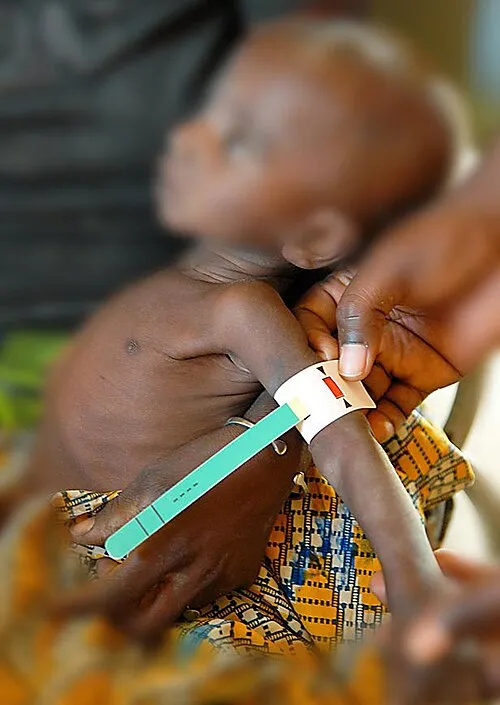
Protein–energy malnutrition is a deficiency of energy and protein that changes body composition, reduces muscle mass and impairs function and recovery from illness. In low-income settings it mainly affects children under 5 as wasting (marasmus), nutritional oedema (kwashiorkor) or stunting; in hospitals it affects 20–50% of adult inpatients, especially older adults and people with cancer, chronic organ failure, dysphagia or alcohol use disorder. Adults are screened with a validated tool such as MUST or NRS-2002 and diagnosed with the GLIM criteria, which need one phenotypic criterion (weight loss, low BMI or low muscle mass) and one aetiological criterion (reduced intake or absorption, or inflammation). Children are classified with weight-for-height, mid-upper arm circumference and oedema. Treatment combines correcting the cause, food fortification, oral supplements, enteral or parenteral feeding when needed, and prevention of refeeding syndrome. Children with severe acute malnutrition follow the WHO approach of stabilisation with F-75 and rehabilitation with F-100 or RUTF.
Patient case, mechanism, investigations, management, flashcards and exam-style questions.Open the lesson →
Key facts
- GLIM diagnosis requires at least 1 phenotypic criterion (weight loss, low BMI, low muscle mass) plus 1 aetiological criterion (reduced intake/absorption or inflammation)
- Severe weight loss in GLIM: more than 10% within 6 months or more than 20% beyond 6 months
- Children 6–59 months: severe wasting = WHZ below −3 or MUAC below 115 mm; any bilateral pitting oedema = severe acute malnutrition
- Kwashiorkor = oedema, flaky paint dermatosis, hair depigmentation, fatty liver and apathy; marasmus = severe wasting without oedema
- Albumin and prealbumin fall with inflammation and do not diagnose malnutrition
- Adult targets: about 25–30 kcal/kg/day energy and at least 1.0 g/kg/day protein, adjusted to disease
- High refeeding risk: start at about 10 kcal/kg/day with thiamine and daily phosphate, potassium and magnesium
- WHO SAM stabilisation: treat hypoglycaemia, hypothermia and infection; F-75 small frequent feeds; no iron until rehabilitation
Differential diagnosis
| Condition | Clues | Key test |
|---|---|---|
| Cancer cachexia | Weight loss despite intake; raised CRP; muscle loss resistant to feeding | CT, tumour markers as indicated; CRP |
| Hyperthyroidism | Weight loss with increased appetite, tremor, tachycardia | TSH and free T4 |
| Uncontrolled diabetes mellitus | Polyuria, polydipsia, weight loss | Glucose, HbA1c, ketones |
| Malabsorption (coeliac disease, pancreatic insufficiency) | Steatorrhoea, diarrhoea, iron or vitamin deficiencies | Coeliac serology, faecal elastase |
| Nephrotic syndrome (vs kwashiorkor) | Oedema with heavy proteinuria and hyperlipidaemia | Urine protein:creatinine ratio |
| Anorexia nervosa | Restriction, fear of weight gain, amenorrhoea, bradycardia | Clinical history; BMI; ECG and electrolytes |
| Chronic infection (tuberculosis, HIV) | Fever, night sweats, cough, lymphadenopathy | HIV test, chest X-ray, sputum testing |
| Adrenal insufficiency | Weight loss, fatigue, hyponatraemia, hyperkalaemia, pigmentation | Morning cortisol, short Synacthen test |
Exam pearls
Guideline
GLIM criteria (2019), ESPEN guideline on nutritional support for polymorbid medical inpatients (2023), NICE CG32 Nutrition support for adults (2006, updated 2017) and WHO guideline on wasting and nutritional oedema in children under 5 (2023)
References
- Cederholm T, Jensen GL, Correia MITD, et al.. GLIM criteria for the diagnosis of malnutrition – a consensus report from the global clinical nutrition community. Clin Nutr 2019.
- Cederholm T, Barazzoni R, Austin P, et al.. ESPEN guidelines on definitions and terminology of clinical nutrition. Clin Nutr 2017.
- Wunderle C, Gomes F, Schuetz P, et al.. ESPEN guideline on nutritional support for polymorbid medical inpatients. Clin Nutr 2023.
- National Institute for Health and Care Excellence. Nutrition support for adults: oral nutrition support, enteral tube feeding and parenteral nutrition (CG32). NICE (last updated 2017) 2006.
- World Health Organization. WHO guideline on the prevention and management of wasting and nutritional oedema (acute malnutrition) in infants and children under 5 years. WHO, Geneva 2023.
- Schuetz P, Fehr R, Baechli V, et al.. Individualised nutritional support in medical inpatients at nutritional risk: a randomised clinical trial (EFFORT). Lancet 2019.
Related topics
By Dr Khalid Seidi (B.Sc., M.D.) · MedEd World Clinical Knowledge library. Original teaching content checked against current guidelines (November 2026); confirm the latest local guidance before clinical use. Not a substitute for clinical judgement.