Clinical Knowledge › Internal medicine › Basics of internal medicine › Nutrition
Vitamin C deficiency (scurvy)
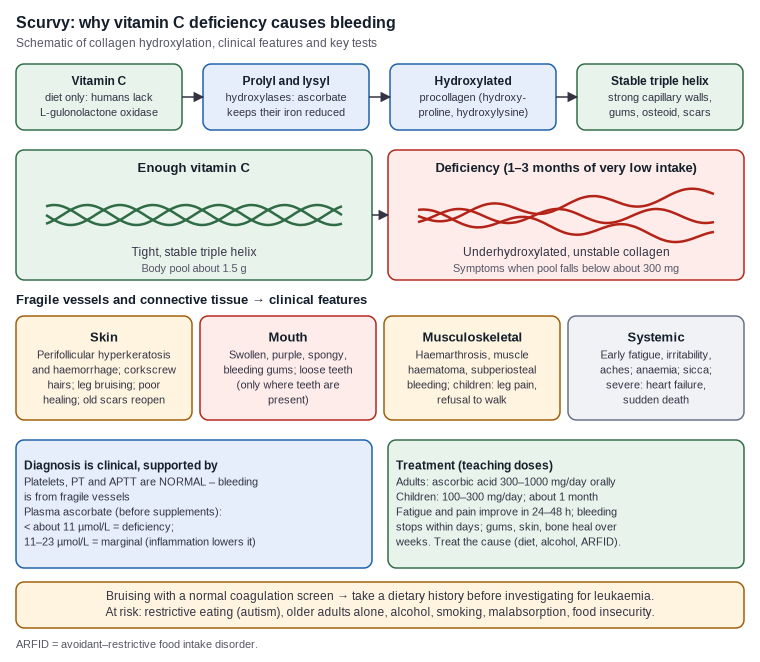
Scurvy is the clinical syndrome of severe vitamin C (ascorbic acid) deficiency. Humans cannot synthesise vitamin C, which is the cofactor for prolyl and lysyl hydroxylases needed for stable collagen; deficiency produces fragile capillaries and poor connective tissue. It develops after about 1–3 months of very low intake and is seen today in children with restrictive eating (often autism), older adults living alone, people with alcohol use disorder, smokers, people with eating disorders or malabsorption, and those facing food insecurity. Early symptoms are fatigue, irritability and aches, followed by perifollicular hyperkeratosis and haemorrhage with corkscrew hairs, bruising on the legs, swollen bleeding gums, poor wound healing, haemarthrosis and anaemia; children often present with leg pain and refusal to walk. Platelets and coagulation tests are normal. Diagnosis is clinical, supported by plasma ascorbate below about 11 µmol/L. Oral vitamin C (300–1000 mg daily in adults) improves symptoms within days, but recurrence is common unless diet and the underlying cause are addressed.
Patient case, mechanism, investigations, management, flashcards and exam-style questions.Open the lesson →
Key facts
- Humans lack L-gulonolactone oxidase and need dietary vitamin C
- Vitamin C is the cofactor for prolyl and lysyl hydroxylases in collagen synthesis
- Scurvy develops after about 1–3 months of very low intake
- Classic signs: perifollicular haemorrhage, corkscrew hairs, swollen bleeding gums, leg bruising, poor wound healing
- Platelets, PT and APTT are normal; bleeding comes from fragile vessels
- Plasma ascorbate below about 11 µmol/L defines deficiency
- Children present with leg pain and refusal to walk, mimicking leukaemia or osteomyelitis
- Treat with oral vitamin C 300–1000 mg/day in adults; symptoms improve within days
Differential diagnosis
| Condition | Clues | Key test |
|---|---|---|
| Immune thrombocytopenia | Petechiae and mucosal bleeding | Low platelet count |
| Vitamin K deficiency or anticoagulant | Bruising with prolonged clotting times | Raised PT/INR |
| Leukaemia | Bone pain, bruising, gum hypertrophy, cytopenias | Blood film, bone marrow |
| IgA vasculitis or other small-vessel vasculitis | Palpable purpura on legs, abdominal pain, haematuria | Urinalysis, skin biopsy |
| Septic arthritis or osteomyelitis (children) | Fever, single painful joint or bone | Joint aspiration, blood cultures, MRI |
| Periodontal disease | Gum bleeding without skin signs | Dental examination |
| Senile purpura | Bruising on forearms of older adults, no perifollicular pattern | Clinical; normal ascorbate |
| Non-accidental injury (children) | Bruises and fractures of different ages | Skeletal survey, safeguarding assessment |
Exam pearls
Guideline
ESPEN micronutrient guideline (2022) and US dietary reference intakes for vitamin C (2000); no dedicated clinical scurvy guideline exists
References
- Hirschmann JV, Raugi GJ. Adult scurvy. J Am Acad Dermatol 1999.
- Fain O. Musculoskeletal manifestations of scurvy. Joint Bone Spine 2005.
- Rowe S, Carr AC. Global vitamin C status and prevalence of deficiency: a cause for concern?. Nutrients 2020.
- Schleicher RL, Carroll MD, Ford ES, Lacher DA. Serum vitamin C and the prevalence of vitamin C deficiency in the United States: 2003–2004 National Health and Nutrition Examination Survey (NHANES). Am J Clin Nutr 2009.
- Berger MM, Shenkin A, Schweinlin A, et al.. ESPEN micronutrient guideline. Clin Nutr 2022.
- Kinlin LM, Weinstein M. Scurvy: old disease, new lessons. Paediatr Int Child Health 2023.
Related topics
By Dr Khalid Seidi (B.Sc., M.D.) · MedEd World Clinical Knowledge library. Original teaching content checked against current guidelines (November 2026); confirm the latest local guidance before clinical use. Not a substitute for clinical judgement.