Clinical Knowledge › Paediatrics › Respiratory and ENT
Obstructive sleep apnoea in children
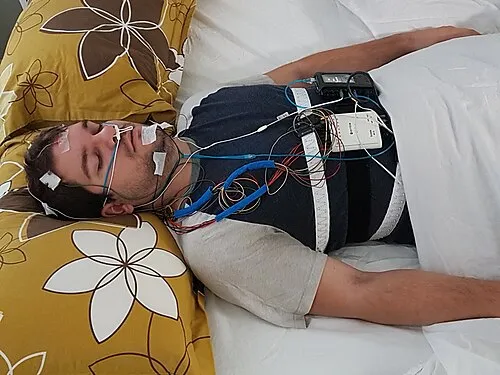
Obstructive sleep apnoea (OSA) in children is repeated partial or complete obstruction of the upper airway during sleep that disturbs ventilation and sleep. It affects about 1–5% of children, peaks at 2–8 years when tonsils and adenoids are largest relative to the airway, and is more common in obesity, Down syndrome, craniofacial anomalies, neuromuscular disease and sickle cell disease. Unlike adults, children rarely present with daytime sleepiness: the picture is habitual loud snoring with witnessed pauses, gasping, mouth breathing, restless sleep and sweating, followed by daytime hyperactivity, poor attention, behaviour and learning problems, morning headache, secondary enuresis or, in young children, faltering growth. Polysomnography is the reference test, and an obstructive apnoea–hypopnoea index of 1 or more per hour is abnormal in children. Overnight oximetry helps triage when it is clearly abnormal. Adenotonsillectomy is first-line for children with adenotonsillar hypertrophy; intranasal corticosteroids and montelukast suit mild disease; CPAP, weight management and specialist airway surgery are used for residual or complex OSA. High-risk children need inpatient monitoring after surgery, and codeine must never be given.
Patient case, mechanism, investigations, management, flashcards and exam-style questions.Open the lesson →
Key facts
- Prevalence about 1–5% (primary snoring about 10%); peak 2–8 years with adenotonsillar hypertrophy; a second peak in adolescents with obesity
- Paediatric scoring: obstructive AHI 1 or more per hour is abnormal; roughly mild 1–5, moderate 5–10, severe 10 or more per hour
- Children present with snoring, pauses, gasping, restless sleep and daytime behavioural or learning problems; excessive sleepiness is less common than in adults
- Polysomnography is the gold standard; a clearly abnormal overnight oximetry (clusters of desaturation) supports OSA, but a normal oximetry does not exclude it
- Adenotonsillectomy is first-line in otherwise healthy children with enlarged tonsils and adenoids; it normalises the sleep study in most but not all
- Mild OSA: intranasal corticosteroid with or without montelukast is a reasonable option (warn about neuropsychiatric effects of montelukast)
- High-risk groups (age under 3, severe OSA, obesity, Down syndrome, craniofacial or neuromuscular disease, cardiac complications) need overnight inpatient monitoring after surgery
- Codeine is contraindicated after adenotonsillectomy for OSA in children (risk of fatal opioid toxicity in ultra-rapid metabolisers)
Differential diagnosis
| Condition | Clues | Key test |
|---|---|---|
| Primary snoring | Snoring without apnoeas, gas-exchange or sleep disruption | Polysomnography: obstructive AHI under 1 per hour |
| Central sleep apnoea / hypoventilation | Pauses without effort; neuromuscular disease, Chiari malformation, opioids | Polysomnography with CO2 monitoring; MRI brain if indicated |
| Attention deficit hyperactivity disorder | Daytime inattention and hyperactivity without nocturnal snoring or pauses | Clinical criteria; screen sleep history before diagnosing ADHD |
| Asthma or nocturnal cough | Night cough and wheeze, atopy, response to inhaled therapy | Clinical; spirometry and bronchodilator response in older children |
| Gastro-oesophageal reflux | Night-time coughing or choking in infants after feeds | Clinical; pH-impedance only if diagnosis unclear |
| Allergic rhinitis alone | Nasal obstruction and mouth breathing with seasonal or perennial triggers; no apnoeas | Clinical; trial of intranasal corticosteroid |
| Nocturnal seizures | Stereotyped events, tongue biting, post-ictal confusion | EEG (video-EEG) or polysomnography with extended EEG |
| Insufficient sleep or behavioural insomnia | Short sleep, late bedtimes, no snoring | Sleep diary |
Exam pearls
Guideline
AAP clinical practice guideline on childhood OSA (2012), AAO-HNS tonsillectomy in children (2019 update), ERS statement on obstructive sleep-disordered breathing in children (2016) and ATS guideline on persistent post-adenotonsillectomy OSA (2024)
References
- Marcus CL, Brooks LJ, Draper KA, et al.. Diagnosis and management of childhood obstructive sleep apnea syndrome. Pediatrics 2012.
- Mitchell RB, Archer SM, Ishman SL, et al.. Clinical practice guideline: tonsillectomy in children (update). Otolaryngol Head Neck Surg 2019.
- Kaditis AG, Alonso Alvarez ML, Boudewyns A, et al.. Obstructive sleep disordered breathing in 2- to 18-year-old children: diagnosis and management. Eur Respir J 2016.
- Ehsan Z, Ishman SL, Soghier I, et al.. Management of persistent, post-adenotonsillectomy obstructive sleep apnea in children: an official American Thoracic Society clinical practice guideline. Am J Respir Crit Care Med 2024.
- Marcus CL, Moore RH, Rosen CL, et al.. A randomized trial of adenotonsillectomy for childhood sleep apnea. N Engl J Med 2013.
- Redline S, Cook K, Chervin RD, et al.. Adenotonsillectomy for snoring and mild sleep apnea in children: a randomized clinical trial. JAMA 2023.
Related topics
By Dr Khalid Seidi (B.Sc., M.D.) · MedEd World Clinical Knowledge library. Original teaching content checked against current guidelines (November 2026); confirm the latest local guidance before clinical use. Not a substitute for clinical judgement.