Clinical Knowledge › Internal medicine › Infectious diseases › Tropical and travel medicine
Cholera
Cholera is an acute secretory diarrhoea caused by toxigenic Vibrio cholerae serogroup O1 (rarely O139), a curved, motile Gram-negative rod spread by faecally contaminated water and food. It is endemic in parts of Africa and Asia and causes explosive outbreaks where water and sanitation fail. Cholera toxin activates adenylate cyclase in enterocytes; the rise in cAMP drives chloride secretion through CFTR and blocks sodium absorption, but glucose-coupled sodium uptake remains intact, which is why oral rehydration solution (ORS) works. Most infected people have mild or no symptoms, but some develop painless, profuse 'rice-water' stools and vomiting, losing up to 1 L per hour, with shock, acidosis and hypokalaemia within hours. Diagnosis is clinical in outbreaks, supported by rapid tests and confirmed by culture or PCR. Treatment is rapid rehydration (ORS, or IV Ringer's lactate for severe dehydration), a single antibiotic dose for severe or high-risk cases, and zinc for children. Prevention relies on safe water, sanitation, hygiene and oral cholera vaccines.
Patient case, mechanism, investigations, management, flashcards and exam-style questions.Open the lesson →
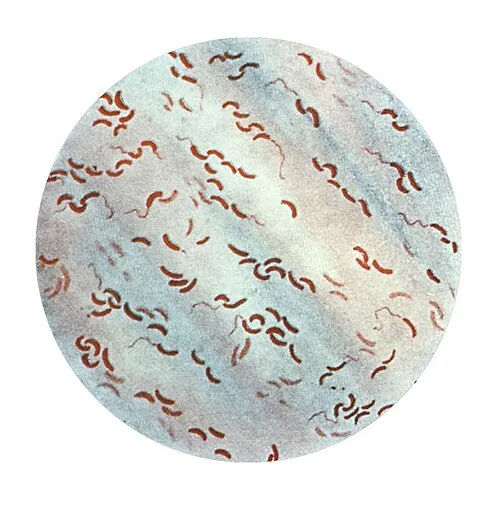
Key facts
- Vibrio cholerae O1 (biotypes classical and El Tor) and O139 produce cholera toxin; the seventh pandemic (El Tor) began in 1961
- An estimated 1.3–4 million cases and 21 000–143 000 deaths occur each year; most infections are asymptomatic or mild
- Cholera toxin (AB5): B subunit binds GM1 ganglioside; A subunit ADP-ribosylates Gs alpha, raising cAMP and causing chloride secretion through CFTR
- Severe cholera: painless rice-water stools with a fishy smell, vomiting, cramps, no fever, and shock within hours
- Severe dehydration: IV Ringer's lactate 100 mL/kg (30 mL/kg fast, then 70 mL/kg), with ORS as soon as the patient can drink
- Low-osmolarity ORS (sodium 75 mmol/L, glucose 75 mmol/L, 245 mOsm/L) exploits intact sodium–glucose co-transport
- Antibiotics (single dose doxycycline 300 mg adults; azithromycin or ciprofloxacin alternatives) for severe dehydration and priority groups, guided by local susceptibility (teaching dose; check local guidelines)
- With good case management, case fatality should be below 1%; untreated severe cholera can kill more than half of patients
Differential diagnosis
| Condition | Clues | Key test |
|---|---|---|
| Enterotoxigenic E. coli (traveller's diarrhoea) | Watery diarrhoea, usually milder, traveller | Stool PCR panel; cholera culture negative |
| Rotavirus or norovirus gastroenteritis | Vomiting prominent, fever, children, outbreaks in institutions | Stool antigen or PCR |
| Shigellosis or invasive bacterial enteritis | Fever, bloody stools, tenesmus | Stool culture; leucocytes |
| Cryptosporidiosis | Prolonged watery diarrhoea, HIV, water outbreaks | Stool PCR or modified acid-fast stain |
| Severe malaria with diarrhoea | Fever, travel to malarial area | Blood film or rapid diagnostic test |
| Diabetic ketoacidosis or other causes of shock with vomiting | Hyperglycaemia, ketosis | Glucose and ketones |
| VIPoma | Chronic high-volume watery diarrhoea with hypokalaemia | Fasting VIP level; diarrhoea persists while fasting |
Exam pearls
Guideline
WHO/GTFCC interim technical note on the use of antibiotics for the treatment and control of cholera (revised October 2022), WHO diarrhoea treatment manual (2005), GTFCC roadmap to 2030 and WHO cholera vaccine position paper (2017)
References
- World Health Organization / Global Task Force on Cholera Control. Interim technical note: use of antibiotics for the treatment and control of cholera (revised October 2022). GTFCC / WHO 2022.
- Global Task Force on Cholera Control. Ending cholera: a global roadmap to 2030. GTFCC / WHO, Geneva 2017.
- World Health Organization. Cholera vaccines: WHO position paper – August 2017. Wkly Epidemiol Rec 2017.
- World Health Organization. The treatment of diarrhoea: a manual for physicians and other senior health workers, 4th revision. WHO 2005.
- Clemens JD, Nair GB, Ahmed T, Qadri F, Holmgren J. Cholera. Lancet 2017.
- Harris JB, LaRocque RC, Qadri F, Ryan ET, Calderwood SB. Cholera. Lancet 2012.
Related topics
By Dr Khalid Seidi (B.Sc., M.D.) · MedEd World Clinical Knowledge library. Original teaching content checked against current guidelines (November 2026); confirm the latest local guidance before clinical use. Not a substitute for clinical judgement.