Clinical Knowledge › Internal medicine › Infectious diseases › Tropical and travel medicine
Malaria
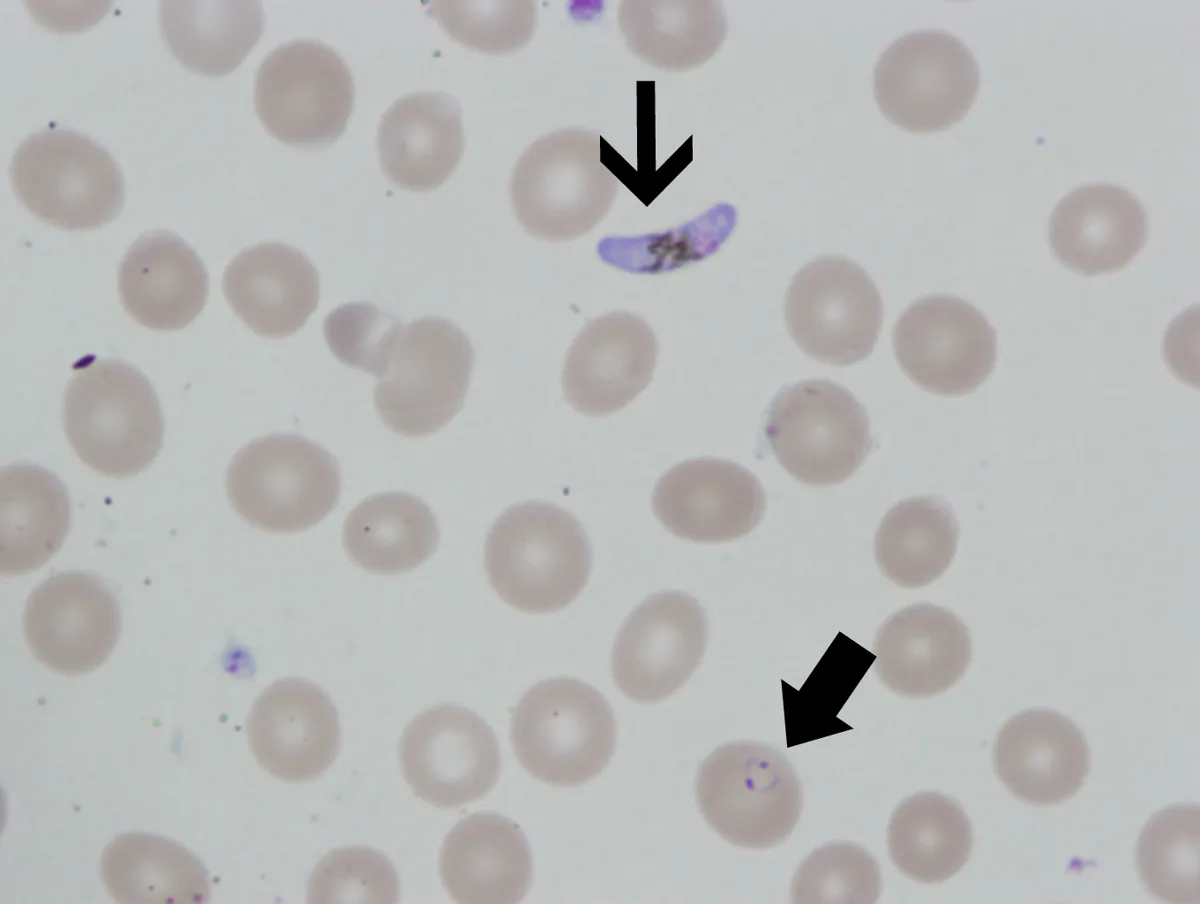
Malaria is a mosquito-borne infection of red cells by Plasmodium parasites transmitted by female Anopheles mosquitoes. P. falciparum causes almost all deaths, mainly in young children in sub-Saharan Africa and in non-immune travellers; P. vivax and P. ovale form dormant liver hypnozoites that cause relapses, P. malariae can cause late recrudescence and nephrotic syndrome, and P. knowlesi (South-East Asia) multiplies daily and can become severe quickly. Fever within a year (especially within 3 months) of travel to an endemic area is malaria until proven otherwise. Diagnosis is by thick and thin blood films, which identify species and parasitaemia, supported by rapid antigen tests; one negative test does not exclude it. Severe falciparum malaria (impaired consciousness, acidosis, hypoglycaemia, severe anaemia, kidney injury, pulmonary oedema, shock, bleeding or high parasitaemia) needs IV artesunate. Uncomplicated falciparum malaria is treated with an artemisinin-based combination, and vivax or ovale malaria needs primaquine or tafenoquine after G6PD testing to prevent relapse. Prevention combines bite avoidance, chemoprophylaxis, vector control and, for African children, the RTS,S and R21 vaccines.
Patient case, mechanism, investigations, management, flashcards and exam-style questions.Open the lesson →
Key facts
- Five species infect humans: P. falciparum, P. vivax, P. ovale, P. malariae and P. knowlesi; falciparum causes over 90% of deaths
- Most imported falciparum malaria presents within 3 months of return, but vivax and ovale may appear a year or more later
- Three negative films 12–24 hours apart (with an RDT) are needed to exclude malaria in a febrile traveller
- Severe malaria or parasitaemia 2% or more (UK threshold for IV therapy) needs IV artesunate 2.4 mg/kg at 0, 12 and 24 hours then daily
- Uncomplicated falciparum malaria is treated with a 3-day artemisinin-based combination such as artemether–lumefantrine
- Hypoglycaemia is common in severe malaria, children, pregnancy and with quinine: check glucose often
- Vivax and ovale need radical cure with primaquine or tafenoquine to kill hypnozoites, only after G6PD testing
- Artemisinin partial resistance (kelch13 mutations) is established in the Greater Mekong subregion and now confirmed in parts of East Africa
Differential diagnosis
| Condition | Clues | Key test |
|---|---|---|
| Dengue | Fever, myalgia, rash, retro-orbital pain; incubation under 14 days | NS1 antigen or PCR; negative malaria films |
| Enteric fever | Stepwise fever, headache, abdominal pain, relative bradycardia; South Asia | Blood cultures |
| Bacterial sepsis or meningococcaemia | Focal source, neutrophilia, purpuric rash | Blood cultures, lactate, source imaging |
| Leptospirosis | Freshwater exposure, conjunctival suffusion, calf pain, jaundice with AKI | Leptospira PCR or serology |
| Rickettsial infection | Eschar, rash, safari or bush travel in southern Africa | Clinical; serology; empirical doxycycline |
| Acute HIV or viral hepatitis | Pharyngitis, rash, lymphadenopathy; or jaundice with very high ALT | HIV antigen/antibody; hepatitis serology |
| Viral haemorrhagic fever | Contact with case, bleeding, outbreak area within 21 days | Urgent risk assessment and specialist lab testing |
Exam pearls
Guideline
WHO guidelines for malaria (living guideline, latest version 2026), UK malaria treatment guidelines 2016 (Lalloo et al.) and UKHSA ACMP guidelines for malaria prevention in travellers from the UK (2026)
References
- World Health Organization. WHO guidelines for malaria. World Health Organization, Geneva (living guideline) 2026.
- Lalloo DG, Shingadia D, Bell DJ, Beeching NJ, Whitty CJM, Chiodini PL. UK malaria treatment guidelines 2016. J Infect 2016.
- UK Health Security Agency, Advisory Committee on Malaria Prevention. Guidelines for malaria prevention in travellers from the UK. UKHSA 2026.
- World Health Organization. World malaria report 2024. World Health Organization, Geneva 2024.
- Dondorp A, Nosten F, Stepniewska K, Day N, White N. Artesunate versus quinine for treatment of severe falciparum malaria: a randomised trial. Lancet 2005.
- Dondorp AM, Fanello CI, Hendriksen IC, et al.. Artesunate versus quinine in the treatment of severe falciparum malaria in African children (AQUAMAT): an open-label, randomised trial. Lancet 2010.
Related topics
By Dr Khalid Seidi (B.Sc., M.D.) · MedEd World Clinical Knowledge library. Original teaching content checked against current guidelines (November 2026); confirm the latest local guidance before clinical use. Not a substitute for clinical judgement.