Clinical Knowledge › Internal medicine › Infectious diseases › Tropical and travel medicine
Pre-travel advice and travel vaccines
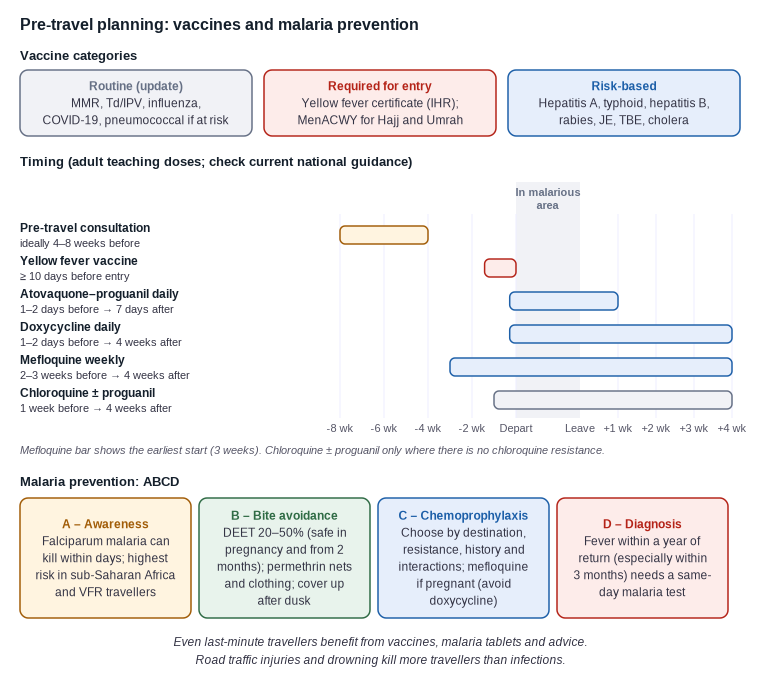
Pre-travel consultation reduces illness and death in international travellers by matching advice to the destination, itinerary, activities and the traveller's health. It should ideally happen 4–8 weeks before departure. The core elements are a risk assessment; updating routine vaccines (MMR, diphtheria–tetanus–polio, influenza, COVID-19); giving travel vaccines according to risk (hepatitis A, typhoid, hepatitis B, rabies, Japanese encephalitis, tick-borne encephalitis, cholera, dengue and chikungunya in selected cases) and vaccines required for entry (yellow fever under the International Health Regulations, meningococcal ACWY for Hajj and Umrah); malaria prevention using the ABCD approach (awareness, bite avoidance, chemoprophylaxis, prompt diagnosis); and advice on food and water, traveller's diarrhoea, road safety, sexual health, sun, altitude and thrombosis. Travellers visiting friends and relatives, pregnant women, children, older adults and immunocompromised people need extra care, especially with live vaccines and antimalarials.
Patient case, mechanism, investigations, management, flashcards and exam-style questions.Open the lesson →
Key facts
- Ideally see travellers 4–8 weeks before departure, but even last-minute travellers benefit from vaccines, malaria tablets and advice
- Yellow fever vaccine is live, gives lifelong protection after one dose for most people (IHR since 2016) and the certificate is valid from 10 days after vaccination
- Hepatitis A is the commonest vaccine-preventable travel infection; one dose protects within about 2 weeks and a booster gives long-term protection
- Rabies pre-exposure vaccination simplifies post-exposure care (no immunoglobulin needed) but every bite or scratch still needs urgent wound washing and booster doses
- Malaria prevention = ABCD: Awareness of risk, Bite avoidance (DEET 20–50%, nets), Chemoprophylaxis, Diagnosis promptly for fever up to a year after return
- Atovaquone–proguanil starts 1–2 days before and stops 7 days after leaving; doxycycline 1–2 days before and 4 weeks after; mefloquine 2–3 weeks before and 4 weeks after
- Travellers visiting friends and relatives in their country of origin have the highest rates of malaria and enteric fever
- Road traffic injuries and drowning cause more deaths in travellers than infections
Differential diagnosis
| Condition | Clues | Key test |
|---|---|---|
| Falciparum malaria after travel | Fever within 3 months of return from sub-Saharan Africa | Thick and thin blood films or rapid antigen test, repeated × 3 |
| Enteric fever | Fever, headache, constipation or diarrhoea after South Asia travel | Blood cultures |
| Dengue | Fever, myalgia, rash, leucopenia and thrombocytopenia within 2 weeks of return | NS1 antigen and dengue serology |
| Hepatitis A | Jaundice 2–6 weeks after travel, unvaccinated | Hepatitis A IgM |
| Traveller's diarrhoea | Watery diarrhoea in first week of travel | Clinical; stool culture/PCR if severe or persistent |
| Vaccine adverse reaction | Fever, headache, myalgia days after yellow fever vaccine | Clinical; consider viscerotropic disease if severe |
Exam pearls
Guideline
UKHSA Immunisation against infectious disease (the Green Book, chapters updated continuously); UKHSA Guidelines for malaria prevention in travellers from the UK (2026); CDC Yellow Book 2026 (Health Information for International Travel); WHO vaccine position papers (rabies 2018, typhoid 2018, dengue 2024)
References
- UK Health Security Agency. Immunisation against infectious disease (the Green Book). UKHSA 2013.
- UK Health Security Agency, Advisory Committee on Malaria Prevention. Guidelines for malaria prevention in travellers from the UK. UKHSA 2026.
- Centers for Disease Control and Prevention. CDC Yellow Book 2026: Health Information for International Travel. 2025.
- World Health Organization. Rabies vaccines: WHO position paper – April 2018. Wkly Epidemiol Rec 2018.
- World Health Organization. Typhoid vaccines: WHO position paper – March 2018. Wkly Epidemiol Rec 2018.
- World Health Organization. WHO position paper on dengue vaccines – May 2024. Wkly Epidemiol Rec 2024.
Related topics
By Dr Khalid Seidi (B.Sc., M.D.) · MedEd World Clinical Knowledge library. Original teaching content checked against current guidelines (November 2026); confirm the latest local guidance before clinical use. Not a substitute for clinical judgement.